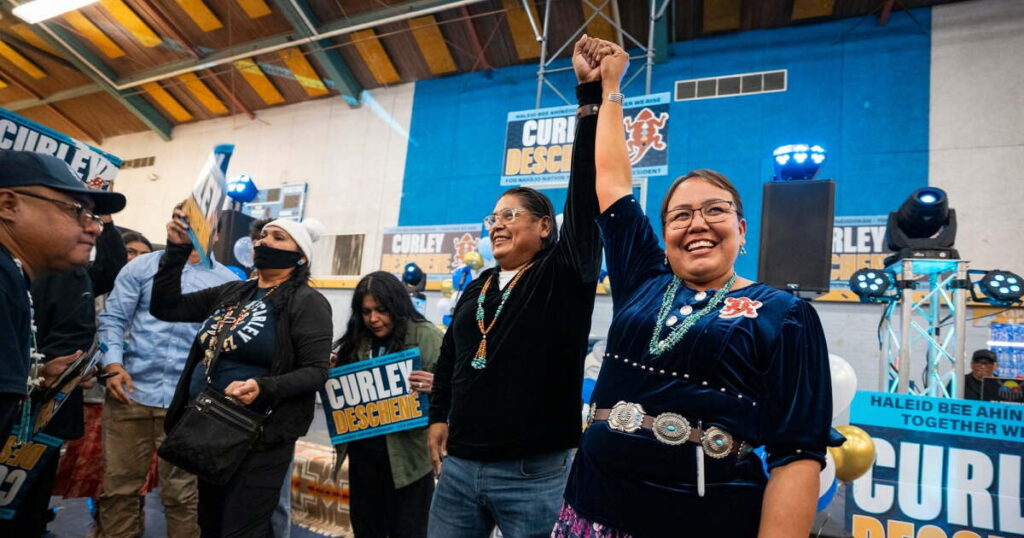
A trip to the Navajo Nation Council in third grade planted the seeds of political ambition for Crystalyne Curley. Witnessing a passionate exchange between lawmakers, she envisioned a future in politics. Fast forward to today, and Curley has not only realized that dream but also achieved a historic milestone: becoming the first woman president of the Navajo Nation.
The recent elections have been a groundbreaking event, not only for the Navajo Nation but also across the United States. Historic wins were seen nationwide, including the election of the first Black female governor, the first openly gay man, and the first Muslim to the U.S. Senate. This election was particularly significant for Native American women, who historically have been underrepresented in political leadership roles.
Peggy Flanagan made history as the first Native American woman elected to the Senate, Deb Haaland as the first Native American woman to become a state governor, and Curley as the first woman leader of one of the largest tribes.
The Navajo Nation’s Historic Election
Lene Bitsui, a supporter of Curley, believed she was the right person to bring stability back to the tribal government after a period of turmoil. Initially doubtful about the Navajo people’s readiness for a female president, Bitsui was delighted to be proven wrong.
Traditionally, the Navajo government, established over a century ago, has been male-dominated. Despite having the largest land base among federally recognized tribes, spanning parts of Arizona, New Mexico, and Utah, and being second in population only to the Cherokee Nation, the leadership has never been female. This contrasts with the matrilineal structure of Diné society, where women’s leadership is culturally significant.
Curley’s victory over attorney Justin Jones was narrow, and she faced significant challenges, including sexist rhetoric during her campaign. She acknowledges the higher expectations placed on her as the first woman in this role, emphasizing the need to work harder in a male-dominated political sphere.
Curley and her running mate, Chris Deschene, plan to shift the Navajo Nation’s focus from coal development to a more prominent role in federal Indian policy discussions once they assume office in January.
In another historic win, the Seneca Nation of Indians elected Tina Abrams as its first female president.
Native American Women Gain Ground in U.S. Politics
At her victory party, Minnesota’s Democratic Senate candidate Peggy Flanagan, a member of the White Earth Nation, expressed gratitude to her community, emphasizing the critical role Native women played in her journey to the U.S. Senate.
Historically, only four Native Americans, all men, have served in the U.S. Senate. Flanagan’s victory signifies a shattering of barriers, as noted by Jordan James Harvill, a strategist with Advance Native Political Leadership.
Flanagan joins Oklahoma Republican Sen. Tom Cole in the Senate. The potential election of Mary Peltola, a Yup’ik woman, in Alaska could mark the first time three Native Americans serve in the Senate simultaneously.
In the House, Kansas Democrat Sharice Davids and Oklahoma Republican Josh Brecheen retained their seats. New representatives include New York Democrat Claire Valdez and Michigan Democrat Sean McCann, both being the first Native Americans elected from their states.
Deb Haaland’s Historic Win in New Mexico
Deb Haaland, known for her trailblazing political career, has achieved another first as the first Native American woman governor of a U.S. state. Haaland, a Laguna Pueblo citizen, has deep roots in New Mexico, tracing back 800 years.
With a focus on making life more affordable and improving education, Haaland aims to deliver on her campaign promises. Her ascent to the governorship is a testament to the support she’s received from Native voters and fellow Native women in politics.
Haaland reflected on the significance of representation in politics: “It’s not just a slogan. It matters that people feel represented.”
___
This article is published through the Global Indigenous Reporting Network at The Associated Press.
—
Read More Arizona News