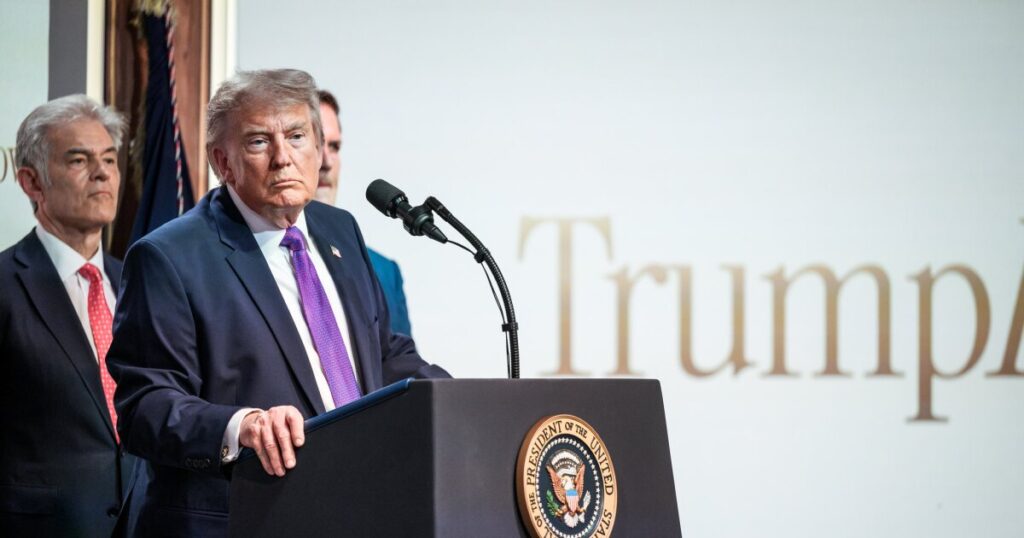
In a surprising turn of events, the Trump administration plans to abandon a $1.8 billion fund intended for individuals convicted during Biden-era prosecutions. However, Arizona Senator Mark Kelly and fellow Democrats are determined to advance legislation that prevents any president from potentially reversing this decision.
“We’re introducing this legislation to put a permanent stop to this and make sure no president, Republican or Democrat, can abuse the Department of Justice for these kind of corrupt deals in the future,” Kelly stated.
Amid backlash from Republican lawmakers regarding the “anti-weaponization fund,” Acting Attorney General Todd Blanche informed a House Appropriations hearing that the Department of Justice (DOJ) would abandon the proposal.
‘It’s a slap in the face’
Shortly after the DOJ’s announcement, former Capitol Police officer Harry Dunn and Metropolitan Police Department officer Daniel Hodges filed a federal lawsuit to block the fund. Dunn is currently running for a congressional seat in Maryland.
Concerns have been raised by law enforcement over the use of taxpayer money to compensate individuals convicted of assaulting police officers during the January 6 Capitol riot.
“It’s a slap in the face to the many officers that were injured that day,” said Patrick Burke, executive director of the nonprofit DC Police Foundation and a retired assistant chief at the Metropolitan Police Department.
Law enforcement representatives in Arizona also criticized the proposed payouts. Michael Hunt, president of Lodge 32 for the Arizona Fraternal Order of Police, questioned the justice of pardoning individuals who have committed crimes.
Timothy Cesolini, an advocate for law enforcement in Tucson, emphasized that a pardon does not equate to innocence. “If I was wrongfully accused of something and I had to spend time in prison, then that’s something totally different,” he shared. However, he believes that compensation for January 6 participants is unwarranted.
Burke highlighted the toll of the events on officers, mentioning the death of Officer Brian Sicknick and several subsequent suicides among officers. More than 140 officers were injured that day.
Burke expressed dismay over the vilification of police by the Trump administration, particularly when they were protecting federal lawmakers during the riot. “They went from, in some people’s eyes, heroes to zeroes,” he lamented, emphasizing the need to honor their sacrifices.
Concerns over fund
Last week, a federal judge halted the fund for two weeks, but Blanche assured lawmakers it would not be pursued further.
The fund was seen by both Democrats and Republicans as a political tool for Trump to reward allies, including those involved in the January 6 attack.
There was widespread concern regarding payouts to rioters and individuals like Proud Boys leader Enrique Tarrio, who were convicted for planning the attack.
On the first day of Trump’s second term, he pardoned nearly 1,600 individuals linked to January 6, including those who assaulted police.
Senate Majority Leader John Thune recently urged the White House to drop the fund, which had complicated Republican budget discussions.
Despite broad disapproval, Kelly and other Democratic lawmakers emphasized the need for legal safeguards. “I wouldn’t put it past the president to try to reinstate and try to get this thing through,” Kelly noted, acknowledging bipartisan opposition to the fund.
Kelly, alongside Senators Adam Schiff and Elissa Slotkin, introduced the Drain the Slush Fund Act just before Blanche announced the fund’s cancellation.
Schiff portrayed the legislation as a shield against future presidential slush funds, doubting the Trump administration’s commitment to the fund’s cessation.
The DOJ initially announced the fund on May 18 as part of a settlement between the IRS and Trump over leaked tax records, which resulted in the IRS dropping significant tax claims against Trump.
While the settlement itself remains intact, Blanche asserted that neither Trump nor his family would benefit from the fund.
Trump has consistently positioned himself and the January 6 participants as victims of judicial weaponization under the Biden administration.
By the time Trump returned to office and issued widespread pardons, federal prosecutors had secured convictions against over 1,100 individuals for their roles in the January 6 attack, including 17 from Arizona.
This article first appeared on Cronkite News and is republished here under a Creative Commons Attribution-NoDerivatives 4.0 International License.
—
Read More Arizona News
![Jody White’s Unconventional Michigan Supreme Court Candidacy Explored[embed]https://www.youtube.com/watch?v=8NfxFIPE4ac[/embed]](https://www.kitchentablenews.org/wp-content/uploads/2026/10/Jody-Whites-Unconventional-Michigan-Supreme-Court-Candidacy-Exploredembedhttpswwwyoutubecomwatchv8NfxFIPE4acembed.com2F842F0e2Fc7223daa43c9876b36a4e00773a42Fme-supc.png "Jody White’s Unconventional Michigan Supreme Court Candidacy Explored[embed]https://www.youtube.com/watch?v=8NfxFIPE4ac[/embed]")