Record Low Water Levels at Lake Powell Spark Concerns
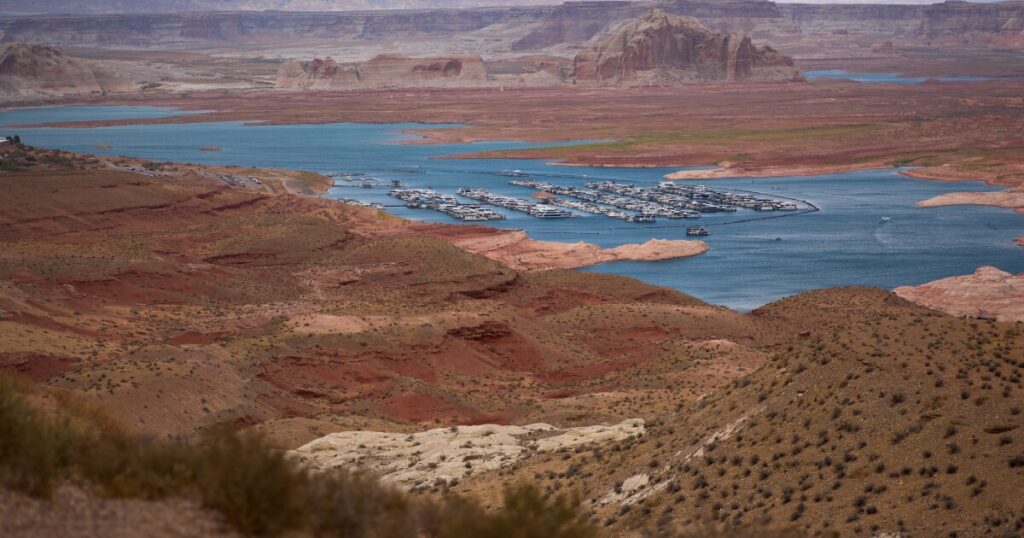
Lake Powell, the second-largest reservoir in the United States, has reached unprecedented low water levels, raising alarms about the ongoing challenges facing the Colorado River system. This significant development occurred on Saturday, shortly after Lake Mead, another crucial reservoir on the river, also hit a record low. These declining levels are a threat to the Colorado River Basin, which is vital for wildlife, hydropower, and over 40 million people across seven states.
As discussions continue among federal authorities and the states relying on the river, namely California, Arizona, Nevada, New Mexico, Utah, Wyoming, and Colorado, there’s an urgent need for a sustainable plan to manage this dwindling resource. The combination of persistent overuse, an exceptionally dry winter, and rising temperatures are major contributors to the depletion of both Lake Powell and Lake Mead.
According to the U.S. Bureau of Reclamation, Lake Powell’s elevation dropped to 3,519.91 feet (1072.9 meters) above sea level on Saturday, surpassing the previous low set in April 2023. This marks a decrease of over 20 feet (6.10 meters) since the start of the year. The reservoir is now perilously close—within 30 feet (9.1 meters)—to the critical threshold where turbines would cease generating hydroelectric power. In April, federal officials indicated that substantial measures would be needed to prevent reaching this point by year’s end.
A proposal put forth by the USBR in July suggests a 10-year strategy that includes significant water usage reductions for Arizona, California, and Nevada. This situation has been developing over several years, with both reservoirs at their lowest levels in nearly seven decades, and further declines are anticipated.
Historically, the combined storage of these reservoirs was last this low in May 1957 when construction of the Glen Canyon Dam, which created Lake Powell, was underway. Lake Powell began filling in 1963. The reduction in water levels has also affected the tourism industry surrounding Lake Powell, necessitating adaptations such as relocating marinas to deeper waters and adjusting boat ramps.
In response to the current situation, federal officials have decided against releasing cool water from Glen Canyon Dam. While this would have aided a threatened native fish downstream, it would have exacerbated the already strained hydropower production.
—
Read More Arizona News

![Botched Ad Mix-Up: Super PAC Error in Arizona Congressional Race[embed]https://www.youtube.com/watch?v=bEMgIlCkHz0[/embed]](https://www.kitchentablenews.org/wp-content/uploads/2026/10/Botched-Ad-Mix-Up-Super-PAC-Error-in-Arizona-Congressional-RaceembedhttpswwwyoutubecomwatchvbEMgIlCkHz0embed.com2F0e2F962Fe971102f49e7a4f2a64fd3cc60a22Fjonatha.png "Botched Ad Mix-Up: Super PAC Error in Arizona Congressional Race[embed]https://www.youtube.com/watch?v=bEMgIlCkHz0[/embed]")