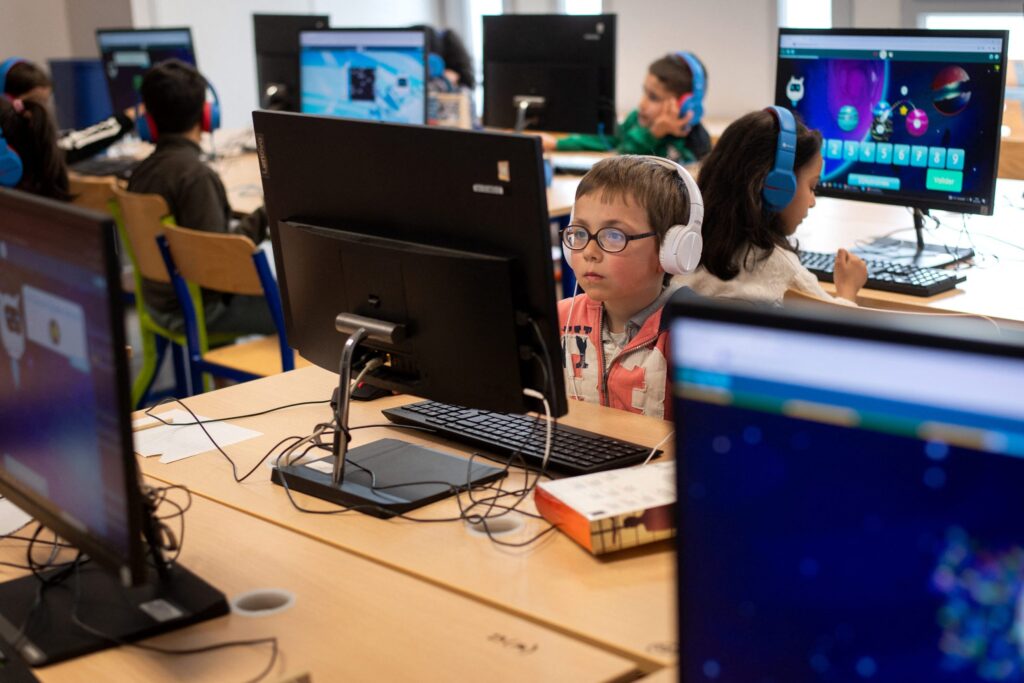
Artificial intelligence (AI) is revolutionizing task efficiency, yet new research indicates its potential in education by encouraging students to slow down. A recent study involving over 6,000 middle schoolers in Tennessee revealed that students retain more math knowledge when guided by an AI tutor that requires mastery of skills.
The experiment tested four methods for practicing fractions, assigning students to either standard computer-based lessons or similar software enhanced by an AI tutor. In each category, half the students had to correctly answer questions on the same skill three consecutive times if they made errors.
Utilizing specialized software akin to Khan Academy, students participated in a 50-minute session and later took a 15-minute test to evaluate retention. The most effective combination was AI tutoring with repetitive practice, leading to a small 3-percentage-point improvement over conventional methods.
Philip Oreopoulos, the study’s lead author and economist at the University of Toronto, remarked, “I don’t want to jump out and say we’ve demonstrated that AI is going to be the game changer that we hope it is.” This insight is crucial as AI’s impact on learning is often debated, with some suggesting it bypasses the learning process by providing direct answers.
The research, titled “Making AI Tutoring Productive: Evidence from a Mastery-Based Math Practice Experiment,” was conducted by experts from the University of Toronto and Wharton School, with a working paper soon to be released by the National Bureau of Economic Research.
Making students slow down
AI aids learning by guiding students through their errors, unlike traditional methods that only show solutions. Without AI, students risk skimming solutions without fully understanding their mistakes.
Numi, an AI tutor, guides students step by step
The AI tutor, Numi, interacts with students directly, helping them navigate errors. Students using AI with mastery learning invested more time per question and were more likely to answer subsequent questions correctly after an error.
While requiring students to answer three correct questions in succession is common, it doesn’t guarantee deep understanding. Students might guess correctly or learn through repetition without mastering the concept.
The study showed that AI-plus-mastery students excelled mainly in easier fractions, not extending benefits to complex problems. This 50-minute intervention did not yield a comprehensive understanding of fractions, raising questions about long-term effects.
Oreopoulos suggests further investigation into AI’s role in math education, emphasizing continuous testing to enhance learning methods. He notes that AI offers modest benefits, hinting at its potential to aid learning by promoting a slower, more thorough approach.
Kristin Fasiang is a graduate student in computer science and learning sciences at Northwestern University. Fasiang reported and wrote this story with The Hechinger Report’s Jill Barshay.
Contact staff writer Jill Barshay at 212-678-3595, jillbarshay.35 on Signal, or barshay@hechingerreport.org.
This story about AI and mastery learning was produced by The Hechinger Report, a nonprofit, independent news organization that covers education. Sign up for Proof Points and other Hechinger newsletters.
—
Read More Kitchen Table News
![Botched Ad Mix-Up: Super PAC Error in Arizona Congressional Race[embed]https://www.youtube.com/watch?v=bEMgIlCkHz0[/embed]](https://www.kitchentablenews.org/wp-content/uploads/2026/10/Botched-Ad-Mix-Up-Super-PAC-Error-in-Arizona-Congressional-RaceembedhttpswwwyoutubecomwatchvbEMgIlCkHz0embed.com2F0e2F962Fe971102f49e7a4f2a64fd3cc60a22Fjonatha.png "Botched Ad Mix-Up: Super PAC Error in Arizona Congressional Race[embed]https://www.youtube.com/watch?v=bEMgIlCkHz0[/embed]")