Pinal County Deliberates Approval of First Large-Scale Data Center
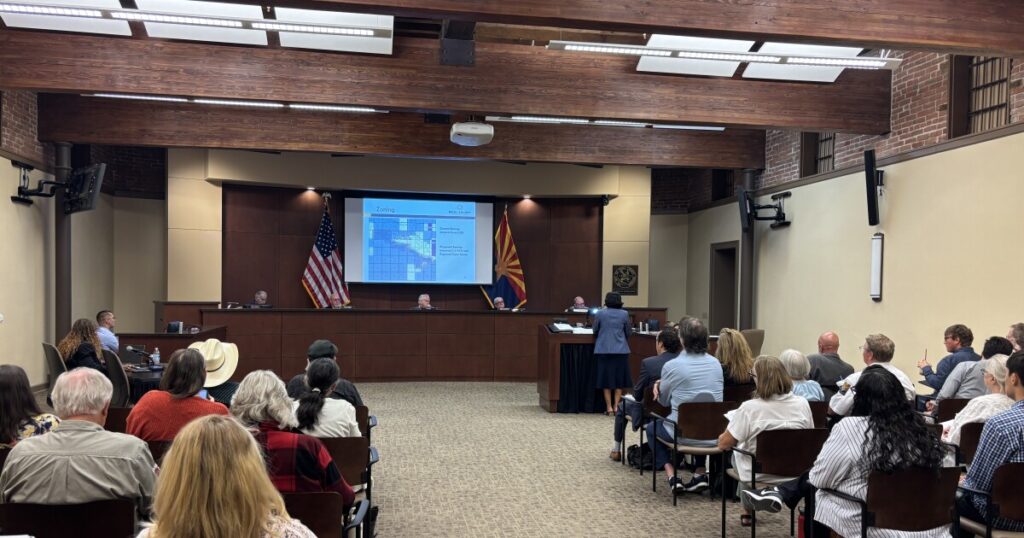
In a move that could significantly alter the energy landscape of Pinal County, officials are on the brink of deciding whether to greenlight the county’s maiden large-scale data center, identified as La Osa. Ahead of this pivotal decision, the Board of Supervisors convened a special session Wednesday to seek further expert insights.
David Ebert, the University of Arizona’s chief AI and data science officer, was a key speaker at the session. He highlighted the evolution of data centers, tracing back to the inception of computer technology, with Google pioneering its first hyperscale data center in the early 2000s. Ebert pointed out that efficiency advancements had previously kept energy consumption stable despite increasing internet usage. However, the surge of artificial intelligence in basic online functions is changing this dynamic.
“There’s a big difference with the use of computers for AI, in that the systems that are being deployed have very dense circuits, require a lot of computation, and that generates a lot of heat and a lot of electrical use,” Ebert noted.
Further complicating matters is the difficulty in assessing which data centers maintain sustainable operations. Ebert explained that discussions often isolate metrics such as water or energy use without addressing their interconnections or variability based on the center’s activities.
“We need to get away from just thinking of consumption, to, ‘what are they doing?’” said Ebert, illustrating that data centers might consume equal energy irrespective of ongoing computational tasks. He cited the University of Arizona’s practice of powering down cloud servers during student absences as a cost and energy-saving measure.
Supervisors Rich Vitiello and Jeff Serdy raised questions regarding the geographical siting of data centers. Vitiello highlighted Arizona’s susceptibility to droughts, while Serdy questioned the necessity of local data centers given their capability to disseminate information globally.
Ebert responded that many centers strive for water neutrality, balancing consumption with initiatives like recycling or watershed restoration. He also mentioned emerging evidence that cooling requirements might be less stringent than traditionally believed, with dry cooling potentially viable in Arizona’s arid environment. “If you’re running a data center at 95 degrees for a large portion of the year in Arizona, given how dry it is, you can actually use air being blown from outside to pull the heat away from the computer systems,” Ebert stated.
The decision concerning location hinges on the data center’s intended tasks. Ebert explained, “If you Google something, you don’t need a data center next door to answer that and get the answer 10 times as fast.” However, for functions like weather forecasting or emergency response, proximity could be critical.
The Energy Conundrum
During the meeting, county supervisors and Planning and Zoning Commission members expressed concerns about energy sustainability. Commission members Robert Klob and Gary Pranzo acknowledged their limited understanding of the energy implications of large-scale data centers.
Pranzo highlighted potential power supply challenges, mentioning that the county might need to boost its energy capacity by one-third to accommodate data centers alongside potential hydroelectric power losses. “A couple months back, we had a visit with APS, and during that presentation, we learned that the county needed to grow in power by 13%,” Pranzo explained. “Last month we had a visit with (Electrical District) 3, and we learned that when our hydroelectric power fails, we’re going to lose about 20 percent.”
The dynamic interplay of multiple utilities in Pinal County further complicates energy planning. Questions arose about prioritizing power distribution in emergencies, with concerns about residential versus data center needs.
Scott Scharli, overseeing strategic energy management, noted that data centers, despite their growing demand, currently account for a modest 7% of SRP’s peak energy usage. However, he acknowledged the rising interest in data center development within Arizona due to the state’s negligible natural disaster risks, proximity to major chip manufacturers, and dependable power supply.
To address the influx of data center projects, SRP devised a cluster application system, allowing for comprehensive impact studies. The first study in April 2025 considered 24 prospective centers with a combined energy demand of 7.2 gigawatts, surpassing SRP’s current capacity of 9 gigawatts, and estimated the transmission upgrade costs at $12.8 billion.
Applicants were required to commit to a 30% deposit on these costs, though only three proceeded, reducing the projected load growth to under one gigawatt and transmission costs to $1.8 billion. Scharli emphasized the necessity of a 15-year cost-sharing agreement for energy generation, given the extensive timelines for infrastructure development.
Scharli concluded that while some data centers propose temporary power solutions, integration into the grid remains essential for reliability and redundancy. “Because connection to the grid equals reliability and redundancy,” he affirmed.
—
Read More Arizona News