Legal Battle Intensifies as Tohono O’odham Nation Challenges Border Wall Expansion
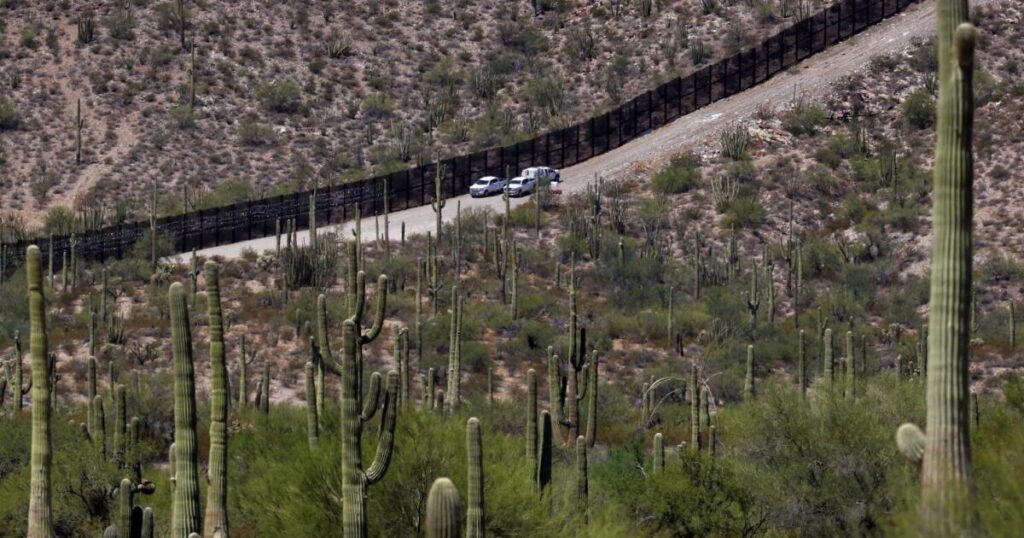
The Tohono O’odham Nation is making a strong legal push to stop the Department of Homeland Security (DHS) from constructing 62 miles of border wall across its reservation. The tribe’s attorney, Riyaz Kanji, has filed papers urging a federal judge to intervene immediately. While Congress has authorized DHS to bypass laws for border security projects, the tribe argues its congressional-established boundaries should take precedence.
The legal filing highlights a 1927 law stipulating that any changes to reservation boundaries require congressional action. Kanji maintains that DHS’s plans to erect barriers within proximity of the international border violate this law, as they alter the reservation’s boundaries without congressional approval. He is requesting an expedited hearing from U.S. District Court Judge Richard Leon, emphasizing that DHS is already proceeding with contract specifications and aims to finalize a contract soon.
In response, DHS, represented by Secretary Markwayne Mullin, a Cherokee Nation citizen, underscored its commitment to tribal sovereignty. However, the agency did not commit to halting construction. “DHS is committed to ongoing coordination with stakeholders, including tribal nations, throughout planning and construction activities,” a spokesperson stated. “DHS values its relationship with the Tohono O’odham Nation and remains focused on open communication and minimizing impacts.”
Chairman Vernon Jose of the Tohono O’odham Nation expressed a desire to redirect resources toward community welfare, suggesting modern border technologies as alternatives to a physical wall. “We are hopeful that DHS will reconsider moving forward with a border wall and instead implement modern border protection measures,” he said.
The tribe’s legal strategy is not solely based on boundary protection. Kanji emphasizes the tribe’s historical presence on both sides of the current international border, established long before the Gadsden Purchase of 1854. Thousands of tribe members remain in Mexico, and cross-border movement is essential for religious, familial, and practical reasons.
Despite long-standing cooperation with Homeland Security, including allowing Customs and Border Protection to establish bases and lease sites for surveillance towers, the tribe is concerned about the prospective 30-foot barrier’s impact. Kanji warns that construction could damage sacred sites and tribal lands, citing a recent incident where a 1,000-year-old geoglyph was inadvertently destroyed during border barrier construction in the Cabeza Prieta National Wildlife Refuge.
Rep. Adelita Grijalva criticized the incident, stating, “Bulldozing a 1,000-year-old sacred site is not an accident.” Kanji argues that such incidents exemplify the potential harm of the border wall on cultural and historical sites. “It will destroy sacred peaks upon which the O’odham have prayed for generations,” he told the court, also highlighting the obstruction of tribal ceremonies that require border crossing.
Ultimately, Kanji contends that DHS’s actions constitute illegal trespassing on the tribe’s federally recognized land. He seeks an immediate court injunction to prevent any further planning or contract execution related to the wall’s construction. As of now, no hearing date has been set.
—
Read More Arizona News


![Jody White’s Unconventional Michigan Supreme Court Candidacy Explored[embed]https://www.youtube.com/watch?v=8NfxFIPE4ac[/embed]](https://www.kitchentablenews.org/wp-content/uploads/2026/10/Jody-Whites-Unconventional-Michigan-Supreme-Court-Candidacy-Exploredembedhttpswwwyoutubecomwatchv8NfxFIPE4acembed.com2F842F0e2Fc7223daa43c9876b36a4e00773a42Fme-supc.png "Jody White’s Unconventional Michigan Supreme Court Candidacy Explored[embed]https://www.youtube.com/watch?v=8NfxFIPE4ac[/embed]")