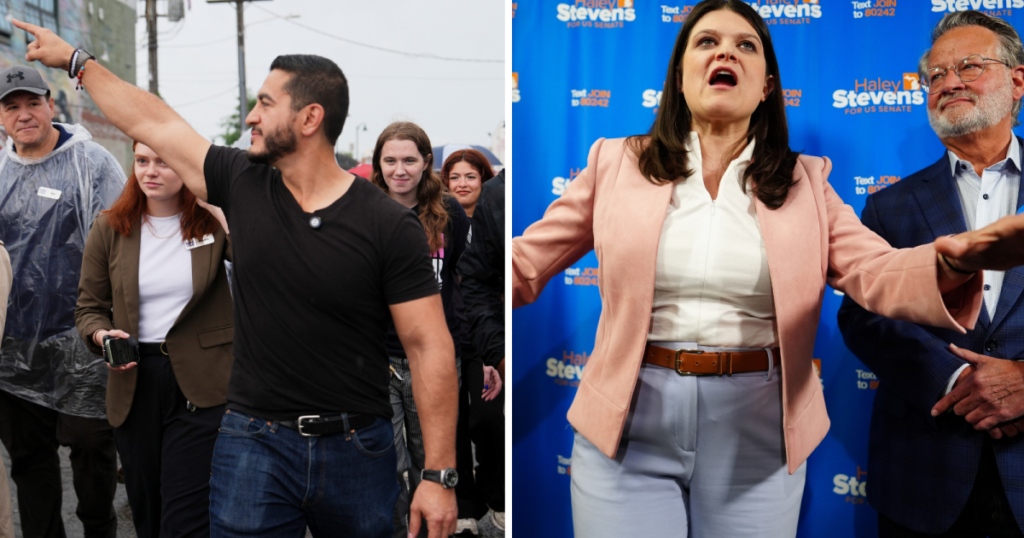
In the bustling heart of Detroit, two Democratic Senate hopefuls are running a race that could reshape Michigan’s political landscape. With the primary just around the corner, Abdul El-Sayed and U.S. Rep. Haley Stevens have been making their final pitches to voters, each offering a distinct vision for their party’s future.
Abdul El-Sayed spent a Sunday morning in a Detroit church alongside Black political leaders, seeking support from a community that holds significant sway in Michigan’s Democratic primaries. Haley Stevens, meanwhile, was at a nearby church, with prominent local pastors advocating on her behalf.
The two candidates have been vying for over a year, drawing nationwide attention and tens of millions of dollars in campaign funds. Their final appeals bring them to similar venues: Black churches, union halls, and rallies filled with dedicated supporters.
The Final Push
Stevens, a seasoned competitor in Democratic primaries, describes these final days as “the last word phenomenon,” where candidates scramble to make their final impressions. The core question remains: who can best unite Michigan’s Democratic voters come Tuesday?
For El-Sayed, endorsed by figures like Sen. Bernie Sanders, the campaign has been about challenging the traditional Democratic establishment. In contrast, Stevens, who boasts support from Senate Democratic leader Chuck Schumer, emphasizes her experience and electability.
The stakes of this primary extend beyond party lines. The winner must rally the Democratic base to fend off Republican Mike Rogers in the November election, crucial for the Democrats’ Senate ambitions.
Detroit’s Pivotal Role
The road to victory in Michigan often runs through Detroit, where the support of Black voters can be decisive. El-Sayed’s campaign centered on themes of economic justice and equal treatment, echoing his vision for the country.
“I believe in the kind of America where no matter where you grow up, the color of your skin, how you pray, you deserve equal rights in this country,” El-Sayed asserted at the Kingdom Covenant Church.
Meanwhile, Stevens engaged with congregants as familiar faces, underscoring her continued engagement with local communities. Her campaign also highlighted her ties to former President Barack Obama, leveraging her involvement in his administration’s auto industry rescue.
The Closing Strategies
As the campaign enters its final day, El-Sayed and Stevens will split their focus geographically. El-Sayed plans to capitalize on grassroots enthusiasm in Detroit, while Stevens heads west to bolster support in Democratic hubs like Grand Rapids and Kalamazoo.
Their strategies reflect a recognition that persuading new voters is less crucial than ensuring existing supporters cast their ballots. El-Sayed leans on a robust volunteer network, whereas Stevens relies on endorsements from prominent Michigan Democrats.
As the day of reckoning approaches, the candidates will have nothing left but to watch the votes roll in. “The votes will be counted,” Stevens remarked, capturing the anticipation of the outcome. “The election will be had.”
—
Read More Michigan News
![Jody White’s Unconventional Michigan Supreme Court Candidacy Explored[embed]https://www.youtube.com/watch?v=8NfxFIPE4ac[/embed]](https://www.kitchentablenews.org/wp-content/uploads/2026/10/Jody-Whites-Unconventional-Michigan-Supreme-Court-Candidacy-Exploredembedhttpswwwyoutubecomwatchv8NfxFIPE4acembed.com2F842F0e2Fc7223daa43c9876b36a4e00773a42Fme-supc.png "Jody White’s Unconventional Michigan Supreme Court Candidacy Explored[embed]https://www.youtube.com/watch?v=8NfxFIPE4ac[/embed]")