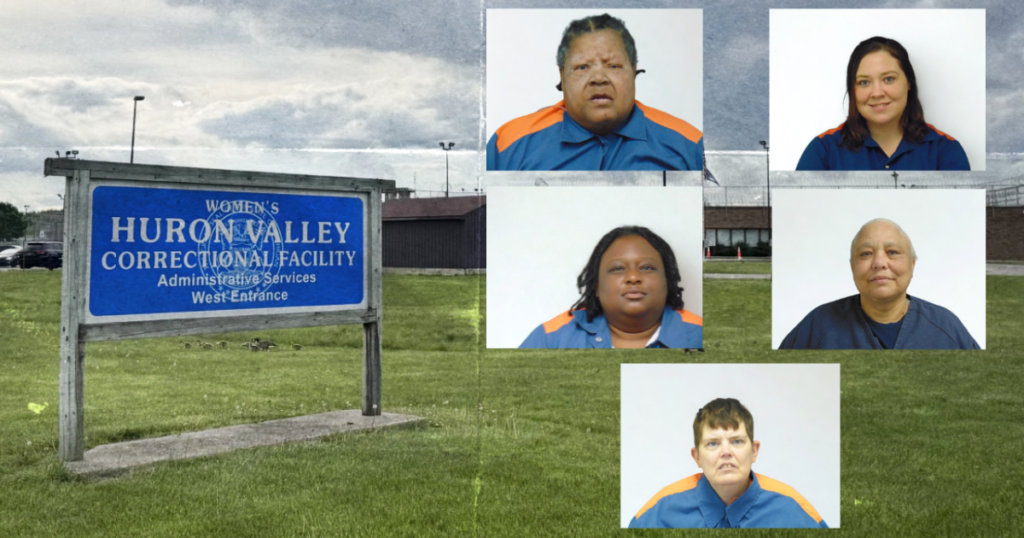
Ensuring proper healthcare services in prisons is a critical concern, particularly within Michigan’s Women’s Huron Valley Correctional Facility. Despite regulations mandating adequate medical care, inmates often face skepticism and delays, as highlighted by several recent deaths, including that of Khaira Howard.
Khaira Howard, a 28-year-old inmate at Women’s Huron Valley, died just days before her anticipated release. Before her death, Howard was confined to a wheelchair and spent her final days in the prison infirmary.

Prisoner Observation Aide Tina Stoll, who monitored Howard, reported that Howard was accused of feigning her symptoms. “She said that she had no feeling in her legs. They kept calling her a liar,” Stoll stated. “This girl couldn’t get out of her wheelchair. She slept in her wheelchair. She stayed in her wheelchair. They just kept telling her she was faking.” Stoll also noted Howard’s hallucination-like behavior shortly before her death.
An autopsy later confirmed that Howard’s symptoms were genuine. A blood clot in her leg had traveled to her lungs, resulting in her death. The report attributed her death to “natural” causes, although inmates suggest negligence played a role.
The Michigan Department of Corrections is currently investigating the circumstances leading to Howard’s death. The department emphasizes its commitment to transparency, promising to release findings publicly once the investigation concludes.
Several other women have also died at the facility, with autopsies pending in most cases. One of these was an elderly woman whose death was anticipated.
Institutional Skepticism
Inmates at Women’s Huron Valley frequently encounter skepticism regarding their medical concerns. In October 2023, after undergoing kidney surgery, Stoll herself was dismissed as “drug-seeking” despite expressing severe pain. “It doesn’t help that they believe everybody in here is drug seeking. Everybody,” Stoll said.
Stoll’s post-surgery pain was later attributed to a severe infection from a urine bubble under her kidney, diagnosed only after being rushed to the hospital.
Renyatta Hamilton, another inmate, reported menstrual issues as far back as 2014. Despite years of consultations and treatments, only recently did external doctors identify a uterine tissue growth that may be causing her symptoms.

Jamie Hein, a University of Michigan Ph.D. candidate and former inmate, notes that this distrustful attitude among medical staff is ingrained. “Medical staff inside is kind of trained to assume that prisoners are lying and trying to… seek drugs,” Hein explained. “If I didn’t have my family to advocate for me on the outside, I don’t know if I would have made it.”
Privatization
Hein attributes the healthcare crisis in Michigan’s prisons to privatization. Over the past 30 years, the state has transitioned from public to private healthcare providers, prioritizing cost over quality.
The shift has led to hiring less expensive Licensed Practical Nurses (LPNs) and Resident Care Aides, often inmates themselves, to replace higher-paid Registered Nurses (RNs). This change aims to reduce operational costs but raises concerns about the quality of care.
VitalCore Health Strategies, the current private contractor, has a history of legal issues related to medical neglect. Despite this, the Michigan Department of Corrections insists that it maintains stringent oversight and that the Chief Medical Officer has ultimate clinical decision-making authority.
VitalCore’s contract is up for renewal in September, leaving inmates uncertain about future improvements in their healthcare services.
—
Read More Michigan News



![Jody White’s Unconventional Michigan Supreme Court Candidacy Explored[embed]https://www.youtube.com/watch?v=8NfxFIPE4ac[/embed]](https://www.kitchentablenews.org/wp-content/uploads/2026/10/Jody-Whites-Unconventional-Michigan-Supreme-Court-Candidacy-Exploredembedhttpswwwyoutubecomwatchv8NfxFIPE4acembed.com2F842F0e2Fc7223daa43c9876b36a4e00773a42Fme-supc.png "Jody White’s Unconventional Michigan Supreme Court Candidacy Explored[embed]https://www.youtube.com/watch?v=8NfxFIPE4ac[/embed]")