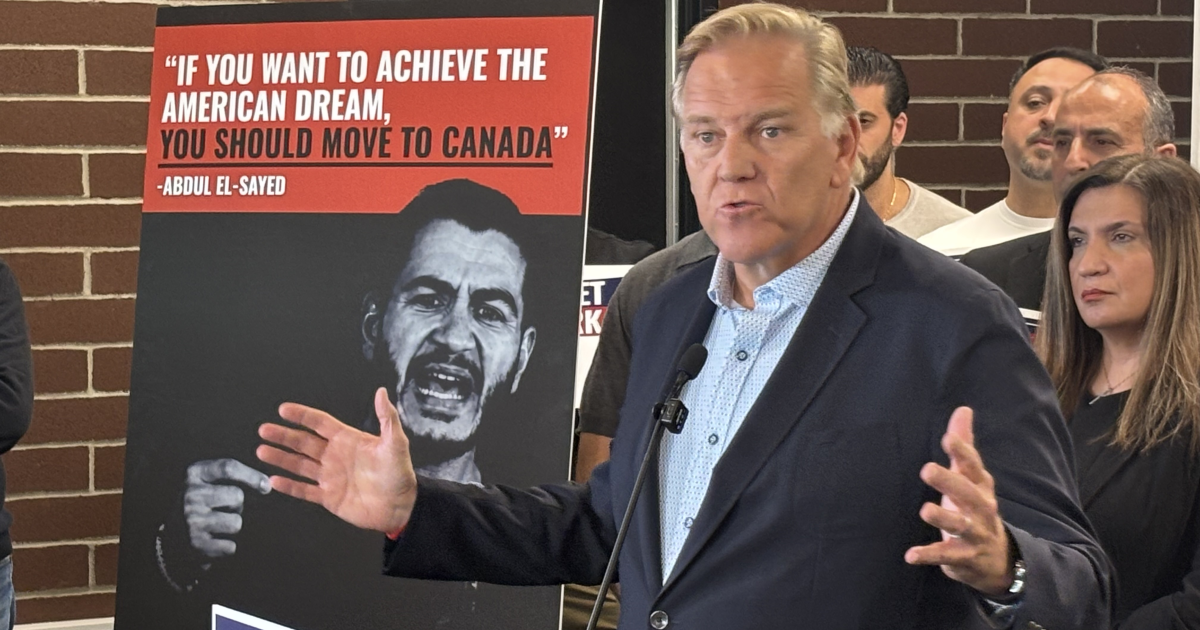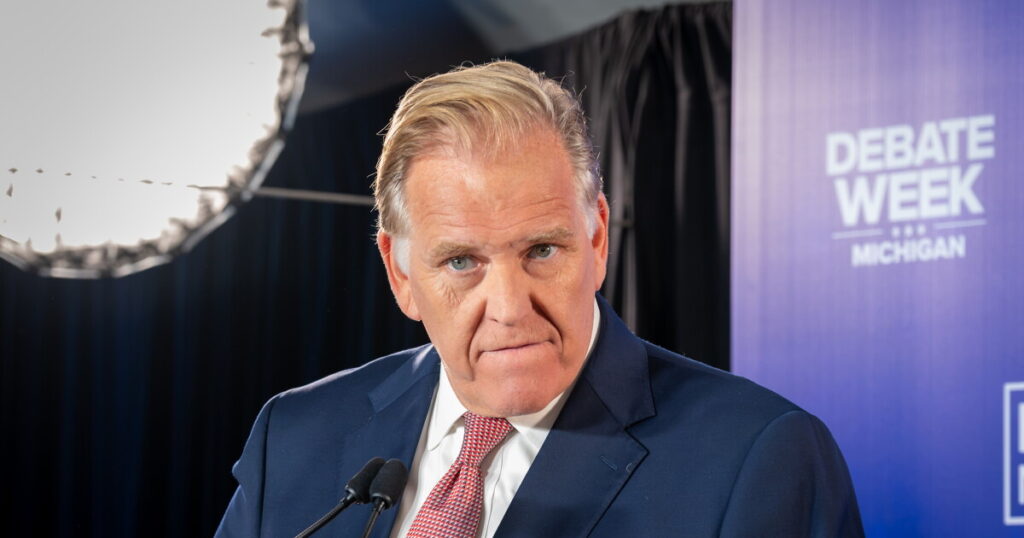
In a contentious debate in Grand Rapids, Michigan, the spotlight was on Mike Rogers and Abdul El-Sayed, representing the Republican and Democratic parties, respectively, for the U.S. Senate race. The event was marked by heated exchanges, with Rogers frequently steering the conversation away from the core issues.
Moderator Rick Albin of WOOD-TV had to intervene as the debate veered off course. “I’d like to be a part of the debate, too,” Albin remarked, highlighting the chaotic nature of the exchanges.
Rogers made repeated references to controversial groups such as the Muslim Brotherhood, Hezbollah, and Hamas, though he provided no evidence to connect El-Sayed, a Muslim, to these organizations.
Focus on Energy Costs
The debate touched on the issue of rising energy costs. Rogers, initially supportive of U.S.-Israel military actions against Iran, has shifted his stance due to soaring fuel prices. He now advocates for ending the conflict, supporting a temporary federal gas tax relief. “I’ve been pretty aggressive about saying we need a pause, both on the state level and the federal level,” Rogers stated.
El-Sayed, who has opposed the war from the start, emphasized its impact on the economy. “We’re going to continue to watch as the Iranian regime chokeholds the Strait of Hormuz, making our energy prices higher,” he said. “You’re going to pay for it, both at the gas tank and at the grocery store, and so we’ve got to end that war above and beyond pausing the gas tax.”
Debate Over Surveillance
Flock’s automated license plate cameras were another debate topic, with privacy concerns leading many municipalities to end contracts with the company. El-Sayed expressed his opposition, stating, “I think the idea of being surveilled wherever you are without your consent is a very dangerous thing.”
Rogers, who has a background in U.S. surveillance policy from his time on the House Intelligence Committee, shared his reservations about the cameras. “I think the states can do it. If they’re just using it for citizens who have committed no crimes, I would not be for that at all,” he said.
Image Credit: Russ McNamara / Michigan Public Radio Network
The debate took a personal turn when Rogers accused El-Sayed’s mother of being linked to a group with connections to al-Qaida. El-Sayed responded, “Go ahead and say it. You’ve been tiptoeing around it the whole time. You’re gonna go after my mom?” During the 2000s, El-Sayed’s mother, Fatten Elkomy, worked for the Islamic American Relief Agency, which faced legal issues, though she was never charged or implicated.
Israel and Defense Policy
The debate coincided with the anniversary of a Hamas attack in Israel. El-Sayed chose not to make a public statement, explaining, “I learned that when people are grieving, don’t step on their grief.” He also voiced opposition to U.S. funding for foreign military efforts, stating, “I don’t want our tax dollars buying weapons for other countries.”
Rogers, however, supported arming Israel and used this as a platform for further attacks on El-Sayed, accusing him of receiving financial backing from groups supporting Hamas and other extremist organizations. El-Sayed dismissed these claims, pointing out the economic struggles faced by everyday citizens.
Concerns Over National Debt
The candidates also discussed the national debt, now exceeding $40 trillion. Rogers highlighted his bipartisan efforts to reduce spending, noting, “I worked in a bipartisan way with my ranking Democrat. We sat down over the course of the summer and we cut out $11 billion of a $78 billion budget.”
El-Sayed criticized the Republican approach, arguing that their policies contribute to deficits and neglect public needs. “Every time his party’s in power, we do two things: we cut taxes for the richest people, or and we go to war,” he said. “So, what do you think you’re going to get with him? More deficit, more debt, only to tell us we can’t have health care.”
With significant funding from outside Michigan and high-profile endorsements, including visits from Donald Trump and Barack Obama, this election could shift the balance in the U.S. Senate. Michigan has not elected a Republican senator since 1994.
—
Read More Michigan News