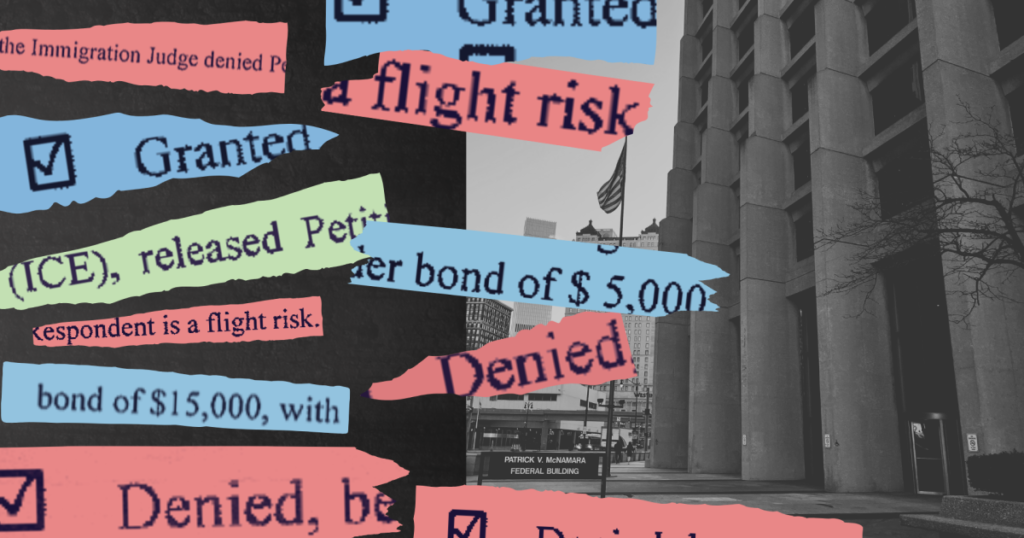
Despite efforts to secure release from detention, many immigrants in Michigan face an uphill battle in obtaining bond hearings. As federal judges continue to grant habeas corpus petitions, a notable increase in bond denials has been observed, raising concerns among legal advocates.
Legal Pathways and Increasing Challenges
During the Trump administration’s immigration enforcement, numerous detained individuals found a route to potential freedom through federal court petitions. Michigan judges have frequently granted these petitions, often instructing the government to conduct bond hearings or release detainees. However, a spike in bond denials has emerged since mid-January, as analyzed by Michigan Public, leading to skepticism about the pressures on immigration judges.
While the Department of Justice, which governs immigration courts, has not provided comments, some speculate that judicial decisions are being influenced to deny bond to those granted habeas corpus. Luis Fernandez-Escalante, a Venezuelan asylum seeker, shared his experience of witnessing multiple bond denials in a single day at the North Lake Processing Center.
Concerns from the Legal Community
Attorneys and former judges express apprehension about the fairness of bond hearings. Ruby Robinson, a senior attorney with the Michigan Immigrant Rights Center, noted a shift in bond hearing outcomes, where approvals are now seen as rare and significant events. Lawrence Burman, a retired immigration judge, highlighted the unusual nature of the current administration’s approach, suggesting it aims to encourage self-deportation.
Federal judges have recognized the constitutional violations in many detention cases, with Michigan Public tracking over 800 habeas petitions. However, winning a petition does not ensure release, as the government often opts for bond hearings instead. The status reports from these cases have given insight into the situation but also revealed the challenges many face in securing bond, with only some managing to afford the set amounts.
Judicial Decisions and Their Implications
Amidst growing concerns, some federal judges have questioned the validity of bond denials. Judge Douglas Harpool from Missouri overturned a high bond, criticizing the immigration court’s decision as disconnected from the facts. Similar sentiments were echoed by other judges who noted systematic denial of bonds.
In Michigan, legal practitioners have pursued additional federal petitions to contest bond decisions. Judge Jane M. Beckering has been pivotal in these cases, advocating that the government should prove flight risk rather than placing the burden on detainees. Her rulings have sometimes led to successful bond grants, though the DOJ continues to appeal these decisions.
The Broader Context
There is speculation that Detroit immigration courts are under pressure to deny or set high bonds, deviating from historical norms. Former judge Daniel Caudillo suggested that the administration’s portrayal of judges as “deportation judges” reflects an agenda that might influence court outcomes. Despite these concerns, Caudillo maintains confidence in the judiciary’s commitment to the law.
Retired judge Lawrence Burman noted subtle pressures faced by judges, such as dismissals for non-compliance with administrative expectations. NPR reported nearly 100 immigration judge dismissals in the past year, underscoring the potential influence of administrative policies on judicial processes.
—
Read More Michigan News