Emerging markets, comprising 86% of the global population, contribute 60% to the world’s domestic product yet account for only 10-12% of global market capitalization, as noted by Morgan Stanley International. Addressing this disparity, the International Investment Fund (IIF) is in its sixth year, aiming to bridge the investment gap in these regions. Established with backing from the William Davidson Institute, the fund serves as an academic course at the University of Michigan’s Ross School of Business, allowing graduate students to engage in real-world financing for small and medium enterprises (SMEs) in emerging markets.
IIF’s unique model involves students from various University of Michigan schools, like the Ford School of Public Policy and the Rackham Graduate School of Engineering, in executing due diligence and investment strategies. Professor Gautam Kaul, teaching the course at Michigan Ross, emphasizes its multidisciplinary approach, stating, “The International Investment Fund (IIF) exemplifies a new model of education at a top research university—it is multidisciplinary, research- and action-based, in a global context.” Students focus on investing in sectors such as agriculture, climate action, and educational technologies, while considering cultural contexts.
Available to masters and PhD students, IIF allows them to assume management roles in their second year. In the 2024–25 academic year, 40 students participated, gaining experience in evaluating enterprises and executing capacity-building projects. A partnership with Kenya’s Baobab Network has enhanced IIF’s efforts, sourcing startups for investment in healthcare and climate action across African markets.
Second-year MBA student Takudzwa Muravu, IIF’s Managing Director for 2025–26, highlights the synergy with Baobab: “Baobab has the boots on the ground, first-hand experience, and deep knowledge of the venture capital ecosystem across Africa.” Muravu, from Zimbabwe, appreciates how IIF has expanded his investor mindset, beneficial for evaluating startups like Kawu in Uganda, DohYangu in Kenya, and Swyft in Cameroon.
IIF collaborates with the University of Michigan Law School’s International Transactions Clinic for legal due diligence. Entrepreneurs like Swyft’s CEO, Franck Batchadji, value IIF’s commitment, stating, “We’re solving real problems in first-to-last-mile delivery, and it’s incredibly validating to have a partner like IIF who not only believes in our mission but is committed to helping us scale.”
WDI President Wendy Taylor praises IIF’s impact, aligning with WDI’s enterprise accelerator strategy. The Frontier Finance Lab, an extension of IIF, is being piloted to provide hands-on impact finance experience to U-M MBA and law students, connecting them with blended finance vehicles and donor-backed funds.
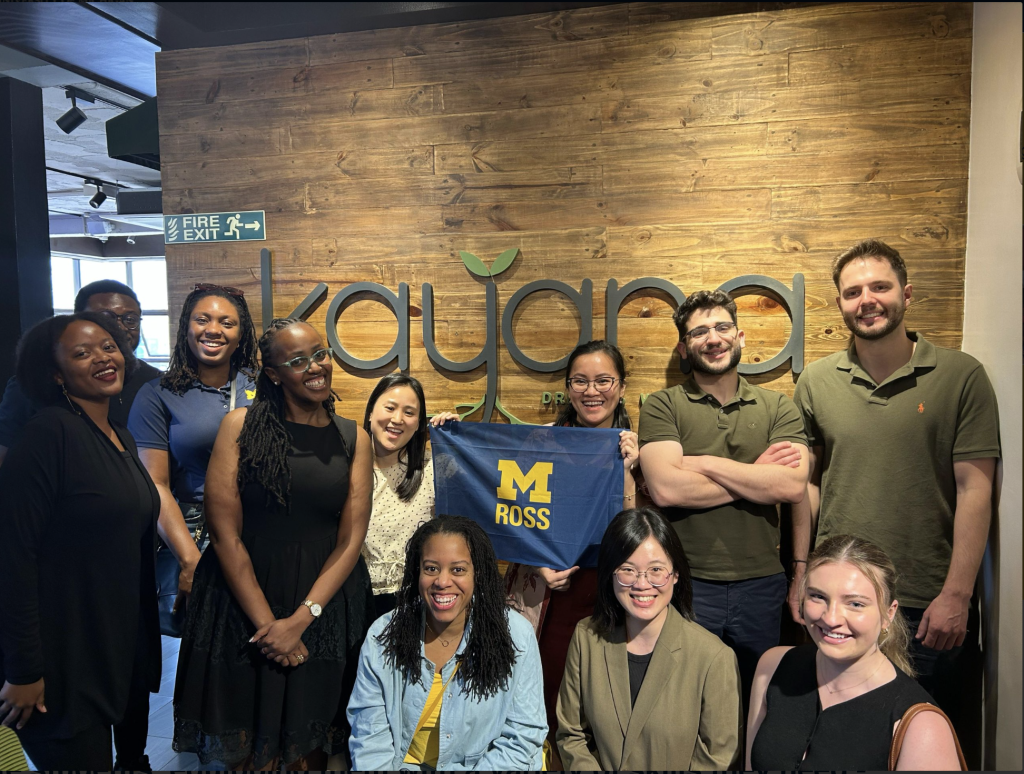
All images courtesy of the IIF team from their 2025 trip to Kenya.
—
Read More Michigan News