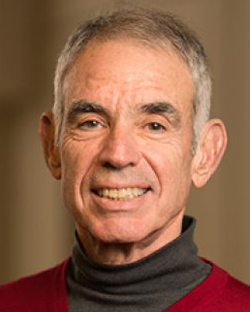
John Jonides, a pioneering architect in modern cognitive neuroscience, has been named as the University of Michigan’s 2027 Henry Russel Lecturer, an honor announced during the June 25 Board of Regents meeting. Jonides, a renowned expert in human brain imaging and cognitive processes, will present his lecture in winter 2027. The Henry Russel Lectureship represents the university’s highest recognition for senior faculty, awarded for exceptional research, scholarship, and service contributions to U-M and the broader community.
Additionally, four faculty members received the Henry Russel Awards, recognizing early to mid-career faculty for excellence. The awardees include:
- Mania Aghaei Meibodi, assistant professor of architecture at the A. Alfred Taubman College of Architecture and Urban Planning.
- Camille Avestruz, assistant professor of physics, LSA.
- Fangfei Miao, assistant professor of music, School of Music, Theatre & Dance.
- Cyrus Omar, assistant professor of electrical engineering and computer science, College of Engineering.

Jonides, the Edward E. Smith Distinguished University Professor of psychology and neuroscience, has made significant contributions to understanding cognitive control and working memory. His work has led to creating mechanistic models explaining how cognitive processes operate within neural systems. This research has influenced both foundational science and practical applications in education and mental health.
Jonides’ research established the differential roles of frontal cortex regions in working memory tasks, forming a widely cited taxonomy of executive functions. His work has advanced understanding of cognitive challenges in conditions like major depressive disorder and ADHD. Jonides’ extensive scholarship is published in top scientific journals such as Science and Nature.
His accolades at U-M include the Distinguished Faculty Achievement Award and the Excellence in Research Award. Jonides’ academic journey began with a B.A. from Johns Hopkins University, followed by graduate studies at the University of Pennsylvania, culminating in a Ph.D. in psychology. He joined U-M as an assistant professor in 1975, achieving the rank of Edward E. Smith Distinguished University Professor by 2025.

Aghaei Meibodi integrates robotics and computational design to enhance 3D printing’s efficiency in construction, earning an NSF CAREER Award in 2025. Her innovative methods are published in journals like Automation in Construction.
Aghaei Meibodi’s academic path includes a B.A.Sc. from Curtin University, an M.Arch. from KTH Royal Institute of Technology, and a Ph.D. in architectural design and technology from KTH. She joined U-M in 2019 after roles at ETH Zürich.

Avestruz employs AI in galaxy cluster science, addressing cosmological questions like dark energy. Her interdisciplinary work improves galaxy catalog reliability and impacts cosmological research.
Avestruz’s education includes a B.A. from Barnard College and a Ph.D. in physics from Yale. She held fellowships at the University of Chicago before joining U-M in 2019.

Miao redefines Chinese dance studies from a transnational perspective. Her research challenges Western academic traditions and examines U.S.-China relations through dance.
Miao’s academic credentials include a B.A. from Beijing Dance Academy, an M.F.A., and a Ph.D. from UCLA. She joined U-M in 2020, focusing on Chinese dance studies.

Omar aims to revolutionize programming experiences, focusing on intuitive and accessible environments. His work on the “structure editing problem” seeks to simplify code manipulation.
Omar’s background includes dual B.S. degrees from the University of Illinois and a Ph.D. from Carnegie Mellon University. He joined U-M in 2019, leading the Future of Programming Lab.
—
Read More Michigan News





![Botched Ad Mix-Up: Super PAC Error in Arizona Congressional Race[embed]https://www.youtube.com/watch?v=bEMgIlCkHz0[/embed]](https://www.kitchentablenews.org/wp-content/uploads/2026/10/Botched-Ad-Mix-Up-Super-PAC-Error-in-Arizona-Congressional-RaceembedhttpswwwyoutubecomwatchvbEMgIlCkHz0embed.com2F0e2F962Fe971102f49e7a4f2a64fd3cc60a22Fjonatha.png "Botched Ad Mix-Up: Super PAC Error in Arizona Congressional Race[embed]https://www.youtube.com/watch?v=bEMgIlCkHz0[/embed]")