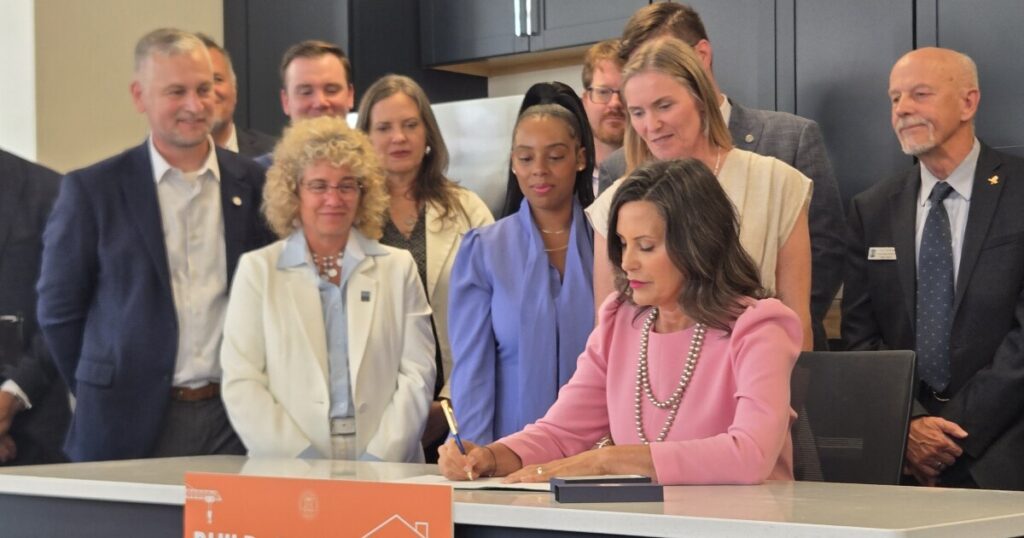
In a significant move to address the affordable housing crunch in Michigan, several new legislative measures were enacted into law on Tuesday. These policies aim to incentivize the development and refurbishment of affordable housing units, while also placing restrictions on large corporations acquiring single-family homes.
One key element of the new legislation is a policy designed to stimulate the construction of low-income housing by providing a state-level match to the federal Low Income Housing Tax Credit. This initiative, co-sponsored by State Representative Kristian Grant (D-Grand Rapids), also seeks to revitalize existing affordable housing units. As Grant remarked, older buildings often have issues like “dark hallways” and “old smell,” deterring potential residents. The new policy aims to make these spaces appealing once again.
The state currently faces a shortfall of approximately 97,000 affordable housing units, according to Amy Hovey, Director of the Michigan State Housing Development Authority. Hovey believes that these credits will build on the state’s progress toward meeting its housing goals. However, the non-partisan House Fiscal Agency estimates that the initiative could cost Michigan up to $252 million over the first six years.
Despite the cost, Hovey is optimistic about the potential benefits. “If we get housing developed that meets the needs of employers and families, that will drive up families’ incomes and will allow for more funding to be generated for the state budget,” she said to reporters.
Another significant component of the new laws is a ban on large companies buying single-family homes, with certain exceptions. This state measure follows a similar federal restriction signed by President Donald Trump, which targets companies owning more than 350 single-family homes. Michigan’s version applies to entities owning at least 100 homes in the state and valued at $375 million or more.
Hovey supports the policy, even though, as she noted, “We don’t have a lot of large institutional owners of housing” in Michigan. She believes the state and federal measures will prevent potential long-term issues.
The legislation has received bipartisan support, although some research questions the effectiveness of restricting institutional investors in making housing more affordable.
The newly signed bills also focus on reducing regulatory barriers by easing safety requirements for certain multi-family buildings. However, several other housing initiatives, including a bipartisan package aimed at establishing statewide zoning standards, have yet to be passed. These proposed measures would make it easier to build various types of smaller housing units.
Representative Grant, who is leading efforts on the zoning reform package, emphasized its importance, stating, “It is what makes sense and when you look at the data, when you look at the proof all around the country about what is really going to move the needle for affordable housing, and affordable home ownership, it is zoning reform.”
The zoning bills have encountered resistance from local governments concerned about state interference with local policies.
Governor Gretchen Whitmer expressed her willingness to continue working on housing policies, noting that legislative sessions might be limited in the months leading up to the election. “At the end of the day, it’s always going to be about what’s possible, what can get done. We’ve got less than six months left in the year, I know the Legislature’s probably not going to be around a whole lot. But I remain eager to do more to help people get into affordable housing,” Whitmer stated.
Whitmer described the newly signed bills as “a big step forward” in the ongoing effort to address the state’s housing challenges.
—
Read More Michigan News