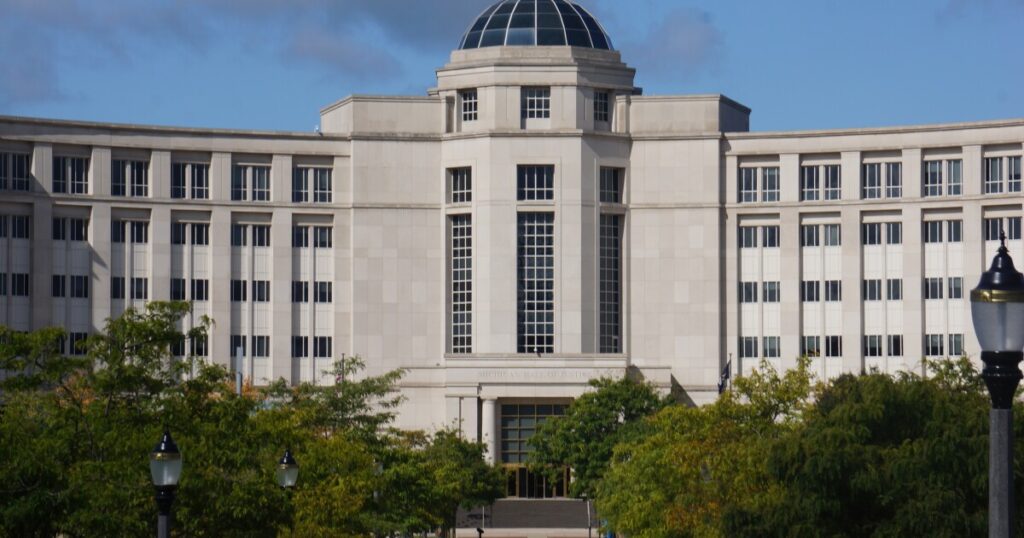
Michigan Supreme Court Urged to Invalidate Campaign Donation Ban Initiative
A legal challenge is underway in Michigan as a business-supported group seeks to prevent a petition initiative from reaching voters. The initiative aims to prohibit campaign donations from political committees tied to regulated monopoly utilities and major government contractors. For more details on the petition drive, click here.
The Protect MI Free Speech committee has filed a lawsuit, contending that the state’s election board did not adhere to its own protocols when certifying that the campaign succeeded in collecting the requisite signatures from registered voters. The lawsuit document is available here.
According to the challenge, the Michigan Bureau of Elections, alongside the bipartisan Board of State Canvassers, relied on an estimate rather than meeting the strict legal threshold. The election board validated the signatures using a random sampling method, concluding that the campaign had narrowly met the requirement of 356,958 signatures.
John Sellek, representing Protect MI Free Speech, criticized this approach, stating, “The idea of direct democracy for Michigan citizens has to follow the rules, and these people did not follow the rules.” He added, “The board of canvassers shrugged their shoulders and said we don’t really care, it’s close enough, and that’s wrong. So, we’re asking the Supreme Court to force the board of canvassers to follow the rules.”
On the other side, Christy McGillivray from Michiganders for Money Out of Politics views the lawsuit as a strategy to bypass putting the issue to a vote. “The easiest and cheapest way for our opposition to stop our initiative to get money out of politics before facing Michigan voters at the ballot is by defeating us in court,” she remarked. McGillivray expressed confidence in their eventual success, noting, “We are confident we are going to prevail and this is expected.”
The Supreme Court has been requested to make a decision by August 20. This timeline would allow the Legislature to address the issue during the 40-day window mandated by the Michigan Constitution, or alternatively, let it be included in the November ballot if the court challenge is unsuccessful.
—
Read More Michigan News