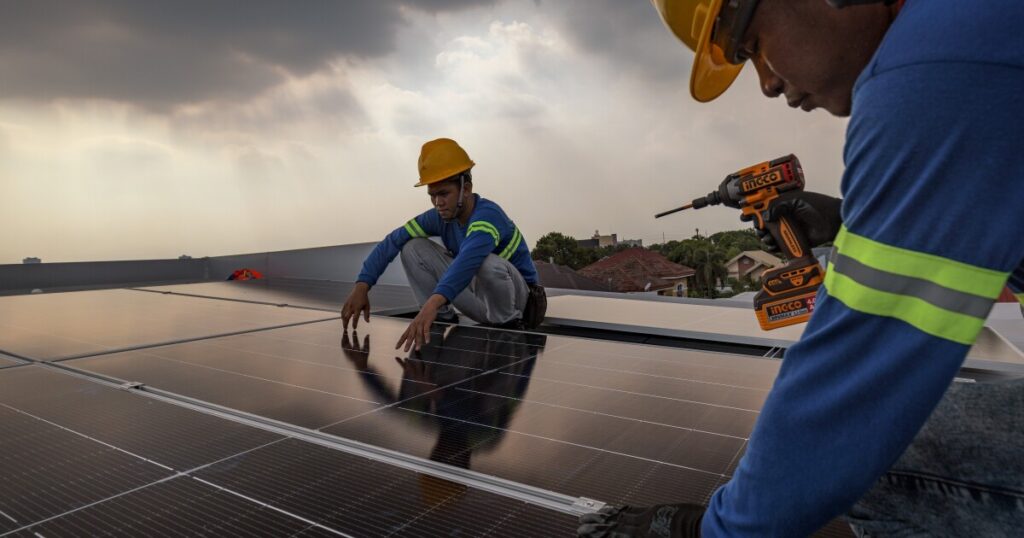
The Middle East is once again at the center of global tensions as a new wave of bombings underscores the vulnerability of traditional energy sources. Over four months into the U.S.-Israeli conflict with Iran, the impact on global energy strategies is undeniable: nations are accelerating their shift away from fossil fuels.
Countries across Asia and Africa are actively turning towards solar power, battery technology, and electric vehicles (EVs) to minimize their reliance on imported natural gas and oil. This shift is a direct response to the unpredictability of fossil fuel prices and supply, highlighted by the effective shutdown of the Strait of Hormuz, which has disrupted over 20% of liquified natural gas (LNG) supplies. Both European and Asian natural gas prices have surged by more than 50% since the onset of the conflict.
China is at the forefront of this energy revolution, with its exports of solar panels rising by over 80% compared to last year, according to Ember, an energy think tank. Additionally, more than 2 million electric passenger vehicles were shipped between January and May, with a significant portion occurring in the latter months, as noted by SIA Energy, an oil and gas consultancy. The consultancy’s analysis humorously suggests, “If China’s car industry were handing out a salesman of the year award for 2026, President Trump would be a leading contender.”
The International Energy Agency (IEA) reports that in the previous year, electric vehicles helped avoid the consumption of about 1.7 million barrels of oil per day, a figure exceeding Nigeria’s daily crude oil production. As fossil fuels remain a primary cause of global warming, the transition to renewable energy and electric vehicles is increasingly seen as an essential solution to climate challenges.
“The ongoing conflict in the Middle East has been ‘an accelerator for the transition,'” says Jan Rosenow, a climate and energy professor at Oxford University. In a world of uncertainties, Rosenow highlights that many countries consider investing in renewables and EVs as both a means of achieving energy security and an economically sensible move. “And that’s not gonna go away,” he adds.
Ezra Acayan / Getty Images
/
Getty Images
Speeding Up the Transition
The fossil fuel sector has long touted natural gas as a “transition fuel” away from coal and oil. However, the conflict with Iran has highlighted the inherent risks associated with natural gas. “The Gulf seemed like a safe space [for sourcing natural gas], and then this happened,” comments Fareed Mohamedi, managing director at SIA Energy.
Asian natural gas prices skyrocketed by over 100% from their pre-war levels at their peak in March. Nations like the Philippines and Tuvalu have experienced energy crises triggered by the war, leading to school and office closures and rationing of fossil fuel supplies.
However, the increased importation of solar technology, batteries, and EVs has provided some relief. Pakistan’s investments in solar and batteries have reduced its reliance on oil and natural gas imports, saving the nation billions, according to the nonprofit Centre for Energy and Clean Air.
Following Pakistan’s lead, the Philippines imported over $400 million in solar panels from February to May, marking a 139% increase from the previous year, based on Chinese export data cited by Ember.
Chinese solar and battery imports have significantly influenced the financial dynamics of global renewable projects, notes Dele Kuti, global head of energy and infrastructure for Standard Bank, Africa’s largest bank. In 2025, Standard Bank’s renewable energy financing exceeded nonrenewable power projects by an 8 to 1 ratio.
“The Chinese crashed the market!” Kuti exclaims. “We started looking at, when it comes to solar projects, it’s actually not bad from a cost perspective.”
The Iran conflict, occurring just four years after the energy crisis from Russia’s invasion of Ukraine, has exposed the dangers of dependence on imported fossil fuels, according to Kaushik Deb of the University of Chicago’s Energy Policy Institute. “This crisis is driving the need for this energy transition to happen much faster,” Deb asserts.
“This is where the transformation to electric on the transportation side,” he continues, “or increasing the share of renewables in the electricity grid is so, so, so central.”

Ritesh Shukla / Getty Images
/
Getty Images
More EVs Equal Less Oil Demand Long Term
Driven by Chinese exports, global electric vehicle sales have surged, reducing the need for gasoline and thereby affecting global oil demand. Kingsmill Bond, analyst at Ember, points out that 45% of global oil is consumed by road transportation, such as cars, motorcycles, and trucks, according to the International Energy Agency (IEA).
Prior to the Iran conflict, the IEA anticipated a rise in global oil demand this year. However, disruptions resulting from the Strait of Hormuz closure have led them to revise expectations to a decline in oil demand for this year.
Despite the global EV sales increase, the U.S. has seen a decline, largely due to the Trump administration’s removal of federal tax credits for EV buyers, a significant policy change. According to Cox Automotive, U.S. EV sales have slumped compared to last year.
Mohamedi highlights that while oil and natural gas will still be needed for products like fertilizers, plastics, and jet fuel, the demand for oil and diesel is rapidly declining. “Because of renewables and EVs,” Mohamedi states, “countries can say, ‘I don’t need this insecurity.'”
Copyright 2026 NPR
—
Read More Michigan News

![Botched Ad Mix-Up: Super PAC Error in Arizona Congressional Race[embed]https://www.youtube.com/watch?v=bEMgIlCkHz0[/embed]](https://www.kitchentablenews.org/wp-content/uploads/2026/10/Botched-Ad-Mix-Up-Super-PAC-Error-in-Arizona-Congressional-RaceembedhttpswwwyoutubecomwatchvbEMgIlCkHz0embed.com2F0e2F962Fe971102f49e7a4f2a64fd3cc60a22Fjonatha.png "Botched Ad Mix-Up: Super PAC Error in Arizona Congressional Race[embed]https://www.youtube.com/watch?v=bEMgIlCkHz0[/embed]")