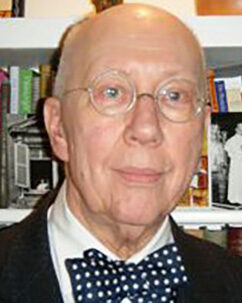
Charles Witke, esteemed professor emeritus of Greek and Latin in LSA, passed away on March 21, 2026. Born Edward Charles Witke on September 22, 1931, in Los Angeles, he was the son of Emil Ernst and Ethel Ann Witke. He earned his B.A. from the University of California at Los Angeles in 1953, followed by his A.M. and Ph.D. from Harvard University in 1957 and 1962, respectively.

Witke’s academic journey included teaching at the University of Chicago before moving to the University of California at Berkeley. There, he became an associate professor and chaired the Committee on Mediaeval Studies from 1964 to 1970. After a short period at the State University of New York at Binghamton, he joined the University of Michigan in 1971 as a professor of classical studies and directed the Program in Comparative Literature.
During his tenure at U-M, he served as associate dean of LSA from 1971-74 and was on the executive committee from 1975-78. Ordained as a deacon in 1988 and a priest in 1989 in the Episcopal Church, he retired in 2001. He is survived by his wife, Aileen Gatten.
Witke was renowned for his extensive work on Latin literature, including notable monographs on Roman satirists Lucilius, Horace, and Juvenal. His research later focused on Middle Ages and Renaissance texts, covering Latin paleography, Erasmus, theology, and liturgy. His later contributions included translating Erasmus’ “Hyperapistes.”
Italy played a significant role in Witke’s life; he was a Fulbright Fellow there and received the Rome Prize from the American Academy in Rome (1960-62). He frequently returned to the Academy and held a Resident position in 1997. He received grants from various universities and the National Endowment for the Humanities.
Charles Witke’s legacy includes his academic mastery, dry wit, and signature bow tie. A memorable story involves his graceful handling of a minor accident involving his car, demonstrating his unmaterialistic nature. When informed by a student of the mishap, his concern was for the dogs and garden, famously stating, “Well, then nothing important was damaged.”
— Submitted by Basil Dufallo, professor of classical studies, LSA
—
Read More Michigan News