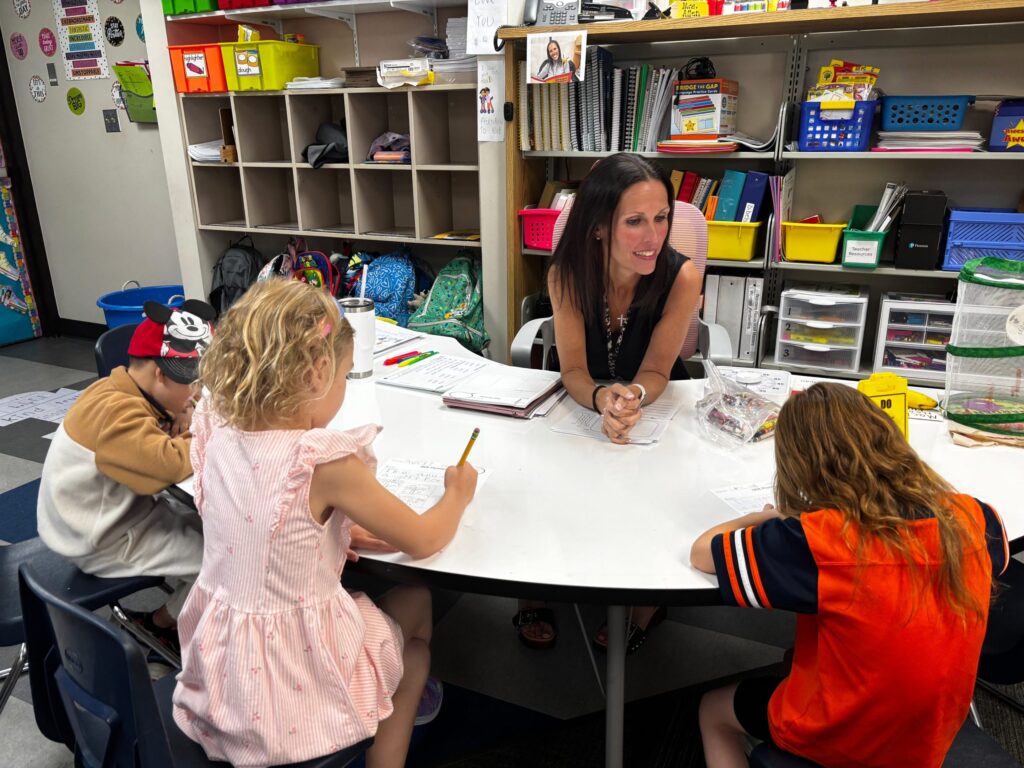
HIGHLANDS RANCH, Colo. — In Gabrielle Grace’s first-grade class at Sand Creek Elementary near Denver, students were busy writing about their summer plans. Among them was 6-year-old Dean, who finished his work early.
“This stuff was just too easy for me,” Dean said, pointing to his worksheet filled with a topic sentence and list of activities. “I wrote this, like, before the bell rang,” he added.
At the start of the year, most of Grace’s students struggled to write sentences, but now they compose organized, complete sentences independently. Dean’s progress is a goal for many elementary educators who face challenges with student writing skills.
Amid concerns over low writing scores, some districts, like the Douglas County district with 61,000 students, are reevaluating writing instruction. They’ve increased teacher development in evidence-based writing methods and emphasize explicit writing instruction. Efforts echo in Tennessee, Pennsylvania, California, and Rhode Island.
Writing remains a neglected educational area, according to Randy Barth, CEO of SRSD Online. Despite a focus on math and reading, writing proficiency data for elementary students is limited, with no nationwide scores released since 2002.
Recent state test results highlight this issue. In 2025, over half of Texas’ third graders received no credit for an essay prompt, while California saw only 17 percent meet writing standards. Florida students scored an average of 6 out of 12 points on their writing test.
Elementary educators face many challenges in teaching writing, a complex task requiring knowledge, motor skills, and vocabulary. Chrissy Everett, a Douglas County fourth-grade teacher, finds writing instruction demanding due to its reliance on executive function skills.
Douglas County leaders noticed writing scores lagged behind reading scores in 2023. They discovered teachers lacked training and used varied methods. The district has since adopted the Self-Regulated Strategy Development (SRSD) approach, focusing on structured writing with evidence-based responses.
This approach, supported by Releasing Writers, involves reading and analyzing writing examples, following a routine to respond to prompts, and using strategies and acronyms like “TIDE” (topic, important details, ending) to guide students.
Teachers initially hesitated about the new method, fearing students might not enjoy writing. However, the positive impact on students’ skills convinced them otherwise, as students now have the tools to write effectively.
Federal research supports the SRSD method, showing improvements in writing quality across genres and grades. Despite its evidence-based nature, widespread adoption remains limited due to awareness gaps and competing educational priorities.
Douglas County officials believe that focusing on writing enhances reading skills. After implementing SRSD, the district reported a 3-point increase in state writing scores and improvements in math scores, attributed to better question analysis skills.
Students noticed the change, with fourth-grader Connor Miles recalling feeling “completely lost” without guidance in the past. Now, students like Arya Melancon appreciate the structured approach, enabling them to tackle writing prompts with confidence.
—
Read More Kitchen Table News