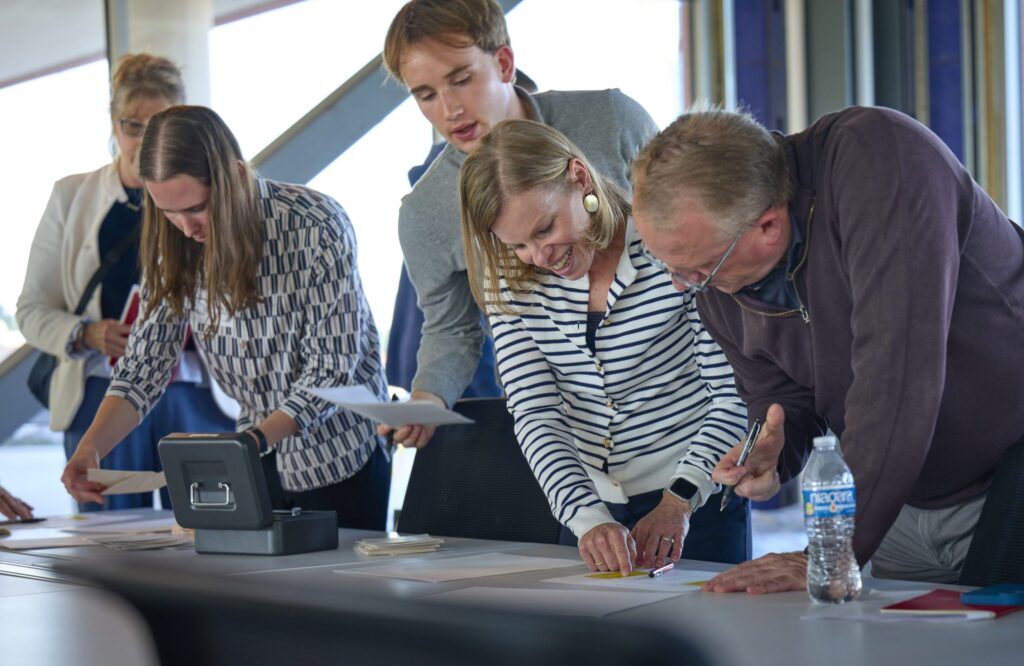
KENOSHA, Wis. — Andrew Staff was aware of the data. As a sophomore at the University of Wisconsin-Madison, he helped prepare an information packet for 26 Kenosha County residents, each randomly chosen and paid $100 to engage in a community assembly addressing the local housing crisis. The pressing issue: Could factory-built homes offer a solution?
By the end of the six-hour session, which saw residents debating various concerns, Staff was overwhelmed. Affordability was only one aspect; he listed others like proximity to parks, transportation, and the fact not everyone desires homeownership.
Days later, Staff changed his major from political science to public policy, newly introduced at the University of Wisconsin-Madison’s La Follette School of Public Affairs, which organized the Kenosha event to provide students with practical experience.
“I don’t just want to think about political theory,” said Staff. “I want to get out there and do things.”
Gen Z is notably dissatisfied with national politics, distrusts government, and worries about political division. Yet, they are eager to act: 79% of those polled in April 2026 believe in participating in democracy, with 38% considering state or local office roles, up from 34% in 2025. Youth voter turnout in the November midterms was the second-highest in decades, as estimated.
Universities are responding with public policy courses, emphasizing practical skills over theoretical political science. In July, Columbia University introduced a major in global affairs and public policy. The University of Pittsburgh, Kentucky State, University of Texas at Austin, Georgetown, and University of Virginia have followed suit.
Students explore mundane topics like town budgets and current municipal issues like data centers and affordable housing. The experiential learning approach attracts students anxious about job prospects, said Peter Levine from Tufts University’s CIRCLE. “Public policy seems pretty concrete, like you could work in state government.”
Young people are disillusioned with national politics, noted Levine. This may wisely direct them towards state and local politics, which they might have overlooked.
New public policy majors are rapidly expanding. Jodi Sandfort, dean of the Evans School of Public Policy & Governance at the University of Washington, noted their public service major started last year with eight graduates, but 118 applied this fall. She credits the surge to a decline in K-12 education on complex government issues, prompting students to make sense of current events.
At Wisconsin-Madison, Susan Webb Yackee said the public policy certificate program’s enrollment rose from 53 to 649 in six years. Students are seeking more applied learning experiences. The new major has 42 enrollees, expected to grow to 417 in five years.
The major includes a course, Advancing Public Policy in a Divided America, teaching productive disagreement. Professor Amber Wichowsky challenges students with questions like “What makes a political view ‘reasonable’ or ‘unreasonable’?”
The La Follette Main Street Agenda project, part of the Kenosha event, started in 2022 as town halls to address voter concerns. Plans include working with Leadership Wisconsin and local officials to lead community assemblies.
The aim is for community members to deliberate and find collective solutions. The Kenosha assembly generated recommendations for the County Housing Task Force on design, transportation, zoning, and energy efficiency.
New courses like Local Democracy at Olin College of Engineering are emerging. Professor Erhardt Graeff urges students to engage in local governance. Last spring, students attended a town meeting debating a road narrowing plan, sparking strong public interest.
Such courses encourage students to navigate real-world governance challenges. As Jada Quijano from New York City noted, class discussions are “very productive conversations.” Maya Dreymann from Florida emphasized the need for these tough conversations as they prepare to influence government.
—
Read More Kitchen Table News