Michigan Secretary of State Introduces New Election Oversight Policy Amid Gubernatorial Run
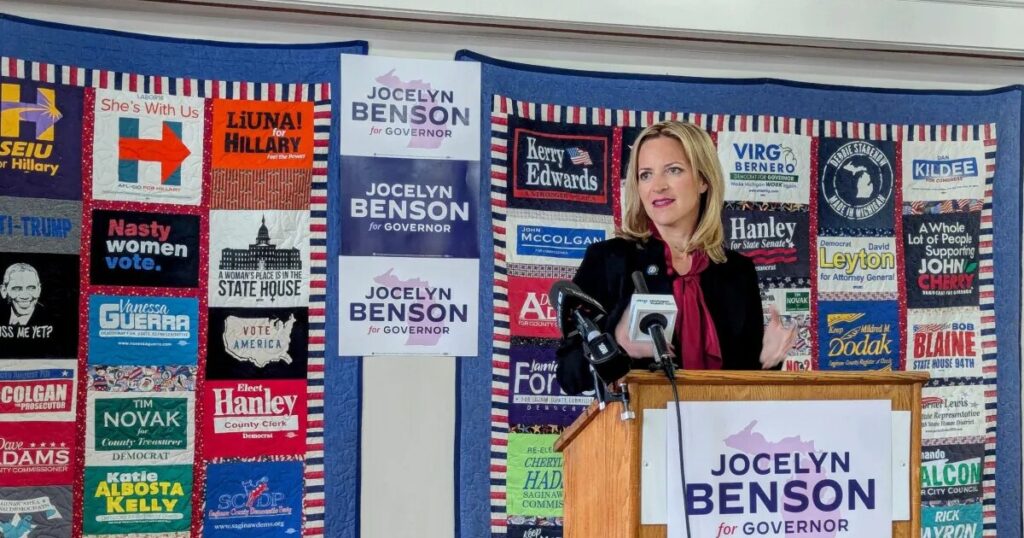
In the midst of her campaign for governor, Michigan Secretary of State Jocelyn Benson has unveiled a new policy aimed at eliminating potential conflicts of interest in the upcoming elections. This policy, which has been under development since 2025, shifts the responsibility for most election functions to the state Bureau of Elections, thereby removing Benson’s direct involvement.
Announced on Wednesday, the “firewall” policy seeks to address concerns raised by some Republican candidates about Benson’s ability to impartially oversee an election in which she is a participant. While these candidates have recently called for her recusal, Benson’s office maintains that the policy has been in the pipeline since last year.
In a communication to the Board of State Canvassers, Benson emphasized the policy’s role in fostering transparency and setting a precedent for future secretaries of state. She noted, “These processes largely reflect how the Bureau of Elections and I handled potential conflicts of interest during my reelection campaign in 2022.”
The Bureau of Elections, comprised of nonpartisan civil servants, will manage state-level election functions. Benson’s policy ensures that the bureau operates independently, keeping its work confidential from her until decisions are finalized.
Policy Details
The newly established policy, which was crafted with the assistance of the Election Reformers Network, outlines six key areas where Benson will avoid conflicts:
- Ballot Access: Benson will not receive reports on candidate petition signatures until they are publicly available online.
- Affidavits of Identity: She will remain uninformed of candidate disqualifications due to affidavit errors until the review process is complete.
- Recount Petitions: Benson will not be notified of recount petitions until they are received by the Board of State Canvassers.
- Post-Election Audits: Audit results will be withheld from Benson until finalized.
- Campaign Finance: Benson is delegating her authority on campaign finance issues to Director of Elections Jonathan Brater until the election is certified.
- Local Elections Supervision: Decisions regarding local election officials will be made by Brater without Benson’s involvement.
The policy also clarifies that no additional steps are required for issuing “certificates of election” after results are certified, stating, “There is no mechanism or standing for the secretary or department staff in their professional capacities to challenge the certified results.”
Republican Concerns
Despite the policy, some GOP candidates remain skeptical about Benson’s role as both a candidate and election overseer. Perry Johnson, a Republican gubernatorial candidate, has suggested federal oversight of signature validation, stating, “I just think that because we end up having the secretary of state in charge of her own election, that she ought to recuse herself.”
Simon Schuster
/
Bridge Michigan
Johnson, who was barred from the 2022 ballot due to invalid signatures, further insisted on social media that Benson “must recuse herself from overseeing this election” entirely. Another candidate, Aric Nesbitt, has called for federal oversight of Michigan’s elections, citing a lack of trust in Benson’s management.
However, officials from both parties have dismissed these claims as misrepresentations of the electoral process. The Election Reformers Network suggests that such accusations are often politically motivated. The bipartisan Board of State Canvassers, tasked with finalizing candidate lists and certifying results, has also dismissed concerns about Benson’s influence on signature verification.
Board Chair Richard Houskamp, a Republican, stated, “I don’t think it’s a legitimate concern. Secretary Benson’s nowhere near those signatures.” Echoing this sentiment, Democratic Vice Chair Mary Ellen Gurewitz remarked, “That’s just bullshit, and they know it… The secretary of state is not involved (in signature verification). Never has been.”
Historically, secretaries of state have managed elections while running for office, as seen with Benson’s predecessor, Ruth Johnson, who successfully ran for state Senate while in office. Chris Thomas, a former director of elections for Michigan, noted that challenging the integrity of the process is a common political tactic.
—
Read More Michigan News