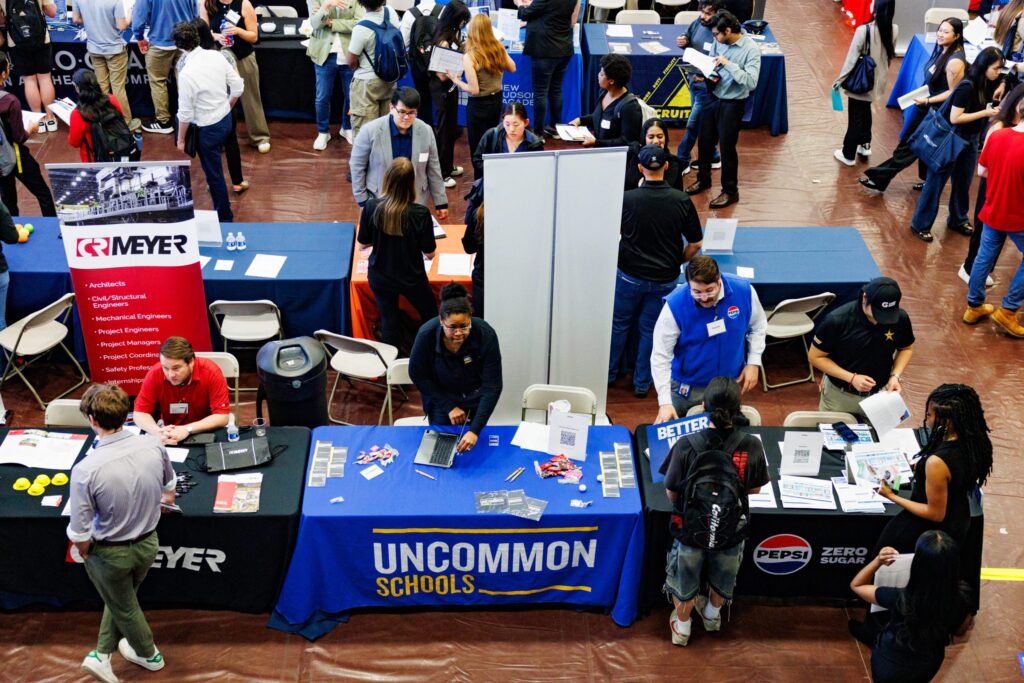
PHILADELPHIA — The bustling college gym hosts numerous employers, but for Jimmy Myers, a freshman at Drexel University, the focus is solely on the Southeastern Pennsylvania Transportation Authority.
Myers, identifying as a “train nerd,” is keenly interested in the railway’s trolley modernization project and eager to discuss it with a SEPTA recruiter.
However, the recruiter is delayed, leaving Myers waiting in the noisy gym. Eventually, he seeks solace at a table set up by Drexel’s Center for Autism and Neurodiversity, designed as a refuge from sensory overload.
The job market is challenging for today’s college graduates, with companies reducing entry-level hiring due to economic uncertainty and artificial intelligence advancements. Less than half of 2024 graduates have secured jobs related to their education, as highlighted in one report.
The situation is even tougher for autistic individuals, who historically face high unemployment rates. Prior to the hiring decline, over 30% of autistic graduates were unemployed, with many employed in office support roles, as noted in a study.
Autistic students often struggle with traditional hiring practices, including interviews that favor neurotypical candidates. Universities are addressing this by offering career-readiness classes and one-on-one coaching, and some are collaborating with employers to create more inclusive hiring practices.
A few major corporations are partnering with colleges to recruit neurodivergent students for internships and jobs. The College Autism Network’s executive director, Lee Burdette Williams, highlights the influence of parental and policy pressures on these developments.
Despite these efforts, only about 150 colleges in the U.S. offer autism support programs, and just a subset focuses on job preparation. Many autistic students remain undisclosed, complicating estimates of their college enrollment numbers. The best estimates suggest between 135,400 and 286,254 students are autistic, according to research by Bradley E. Cox.
Most autistic college students possess average or above-average IQs, and many face social challenges such as heightened sensory systems, anxiety, and executive functioning difficulties. These traits can make college life more demanding but also highlight their resilience and unique skills.
“I can generate connections that others might not see and come up with cool and interesting ways to solve a task,” said Eli Werbach, a fifth-year engineering technology major at Drexel who is autistic.
Tyler Murphy, a sophomore at Drexel studying animation and visual effects, says he views his autism as his superpower.
“If I find something I like, I’m able to hyperfocus and learn every bit of knowledge about it and apply it to the tasks,” Murphy said.
Recognizing these strengths, companies like SAP and Microsoft have developed neurodiverse hiring programs. These initiatives have proven beneficial, with EY reporting nearly $1 billion in business value generated by neurodiverse employees in 2023.
However, interview processes often continue to exclude capable autistic candidates. Zoe Gross, director of advocacy for the Autistic Self Advocacy Network, notes that interviewers unintentionally favor candidates exhibiting neurotypical social behaviors.
AI-enabled tools can further disadvantage autistic individuals, evaluating them on factors like eye contact and vocal cadence, as explained by Amy Edwards, director of Drexel’s Center for Autism and Neurodiversity.
Colleges like Drexel and Rowan University are preparing autistic students through practice interviews and coaching sessions. Rowan’s Autism PATH program has improved employment outcomes for graduates, with a 66% job placement rate.
Drexel’s co-op placement rate is in the mid-90s for students in the autism support program, according to Peg Monaghan. Rather than encouraging students to mask their traits, universities emphasize authenticity in interviews.
At the career fair, the recruiter finally arrived. Myers rushed over to greet her and helped her spread a navy blue tablecloth across her station, complimenting the SEPTA button she was wearing (“the best transit logo”) and the train sticker on her laptop. He then proceeded to pepper her with questions about Philadelphia’s trolley modernization project.
“You are ahead of the game!” the recruiter exclaimed, seemingly impressed by his knowledge of the project. When Myers asked a question she couldn’t answer, she offered to get him a meeting with the chief of planning, “so you can ask your question directly.”
When the conversation was over, Myers returned to the Center for Autism and Neurodiversity’s table and said the exchange gave him hope.
“If I can demonstrate my expertise like I just did, I think I can get a co-op,” he said.
—
Read More Kitchen Table News