TACOMA, Wash. — Noah Herd developed a passion for computers from a young age.
He learned to repair his family’s desktop and eventually created a video game after mastering a programming language.
The lure of six-figure salaries offered by tech companies during the pandemic steered him toward a coding career.
“It’s cool to build things with software,” said Herd, a 30-year-old senior at the University of Washington Tacoma majoring in computer science. “It requires more creativity than you think.”
However, as graduation nears, he observes massive layoffs in the tech industry, including 30,000 jobs cut at Oracle and 8,000 at Meta, with Microsoft announcing employee buyouts.
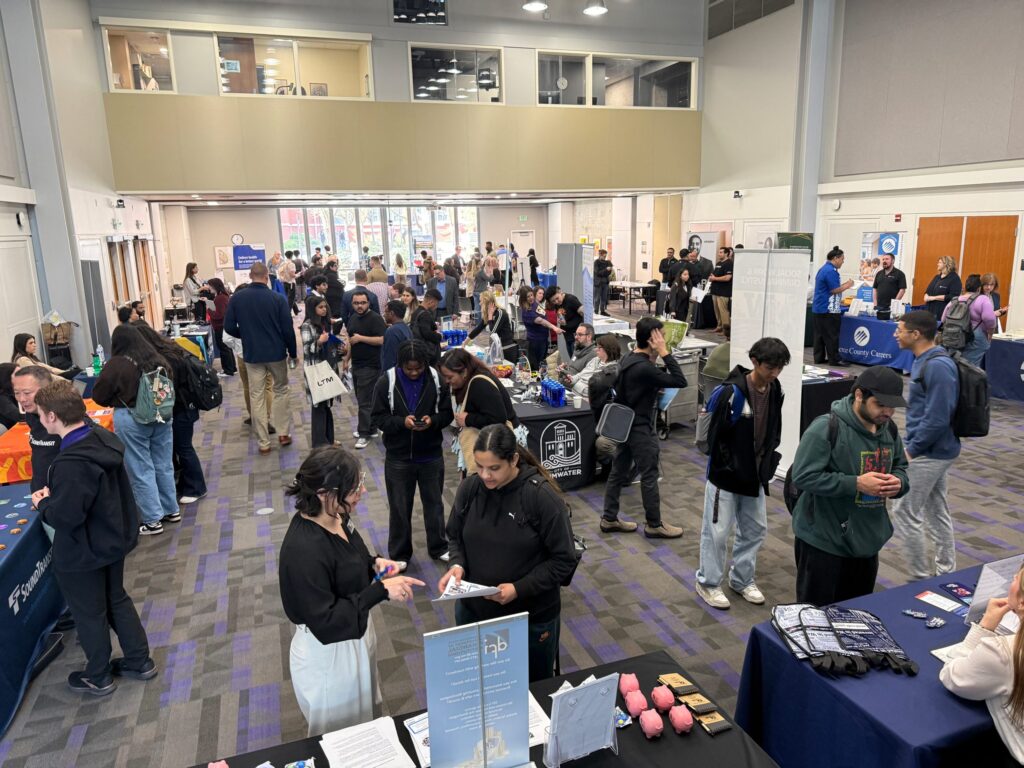
“It’s not looking good,” Herd said after a career fair at UW Tacoma, despite tech recruiters attracting long lines. “I want to be a software engineer, and I’m still pushing for that. The reality is I have to pay rent.”
Software development ranks high among jobs AI might replace, alongside customer service, graphic design, and data entry. Entry-level workers and Generation Z, especially those in repetitive roles, could be most affected.
Last fall, recent graduates faced the highest unemployment rate in five years. Data shows a decline in employment for 22- to 25-year-olds in AI-exposed jobs. Handshake noted a 2% drop in full-time job postings compared to last year, 12% below pre-pandemic levels.
Yet, students like Herd hesitate to fully blame AI for bleak job prospects. Many are prepared for a “low hire, low fire” economy, competing with laid-off workers. Labor experts assert AI hasn’t yet significantly impacted entry-level or white-collar work.
Colleges are adapting by integrating AI into career services, urging students to leverage technology for a competitive edge. Networking and soft skills like communication and critical thinking are emphasized as irreplaceable by AI.
“Technical skills may come and go, change and evolve. We’re not teaching the same things in agriculture that we did 25 years ago,” said John Woods, provost and chief academic officer at the University of Phoenix. “But we are still teaching judgment, critical thinking, teamwork.”
Concerns arise that AI may reinforce inequities, favoring well-connected individuals for top jobs.
“The effects of AI on labor markets are obviously evolving as we speak,” said Steven Durlauf, a University of Chicago economist who studies human capital and wealth inequality. Young workers “lack clarity about the world they’re entering, and when you don’t know all the probabilities, people tend to assume the worst.”
Durlauf and other experts highlight challenges in distinguishing AI’s impact amid recent economic disruptions: the pandemic-induced tech hiring spree, subsequent reversals, federal workforce cuts, and inflationary pressures.
At the UW Tacoma fair, Herd and peers lined up to meet Anshul Bhandari from Infoblox, a cloud computing firm hiring for various positions. Infoblox uses AI for initial interviews and programming yet still requires human oversight.
“I see AI as an enabler, not job killer,” he said. “A third of our code is written by AI, but we still need humans. We still need human oversight — at least for the foreseeable future.”
Opinions on job prospects vary among students. Laura Cortez, a mechanical engineering junior, applied to over 200 jobs with few responses, attributing hiring challenges to economic conditions and job scarcity.
Cortez perceived minimal threat from AI in her field, suspecting its primary use is in resume filtering. Some students exploit AI systems by embedding hidden keywords in resumes.
Ibadat Sandhu, aspiring to work in cybersecurity, noted rising experience requirements for entry-level roles. “Even with internships, they’re getting more specific with what they want from students,” said Sandhu.
Monika Rani, pursuing a master’s in accounting at UW Tacoma, hopes to secure finance work before AI dominates. “I think my job is secure,” she said. “We still need humans to double check and oversee AI. It’s useful now, but still contains errors. It’s not 100 percent.”
Despite mixed messages, hiring for graduates is expected to rise, especially in information, engineering, trade, and construction sectors, according to the National Association of Colleges and Employers (NACE) survey. Manufacturing and utilities may see declines.
Most employers don’t yet require AI skills on resumes, but 35% of entry-level jobs demand some proficiency. Nearly 60% of employers assign AI tasks to interns, and a shift toward skills-based hiring is underway.
Gatta said it’s important for college graduates — most of whom have never heard of skills-based hiring — to translate skills they learned with faculty on research or in student clubs onto a resume.
“Employers don’t want them to list ‘critical thinking’ or ‘teamwork.’ They want candidates to explain what that means and provide examples when that was really important and useful,” Gatta said. “That’s helpful for students in all majors, even in computer science.”
Jonathan Wright, director of career services at the College of Southern Nevada, advises students to embrace additional training and AI tools to enhance resumes. “Employers still need the humans to manage all these AI tools,” he said. “The human element is still there. Stop running from the technology. Embrace it, and add it to your tool belt.”
Amanda Figueroa at UW Tacoma noted AI could exacerbate existing inequalities, as certain groups like Black women face challenges securing internships and entry-level positions.
The weekend before finals in early June, Herd said he had mixed feelings as commencement approached, proud to earn his degree but scared about the future.
He’s set himself a deadline of six months to find a job in computer science. If that doesn’t happen, he said he will consider joining the military.
“I really don’t want to do that,” he said, “but I need to be able to feed myself.”
—
Read More Kitchen Table News