Unveiling the Hidden History of Black Lumberjacks in Northern Arizona
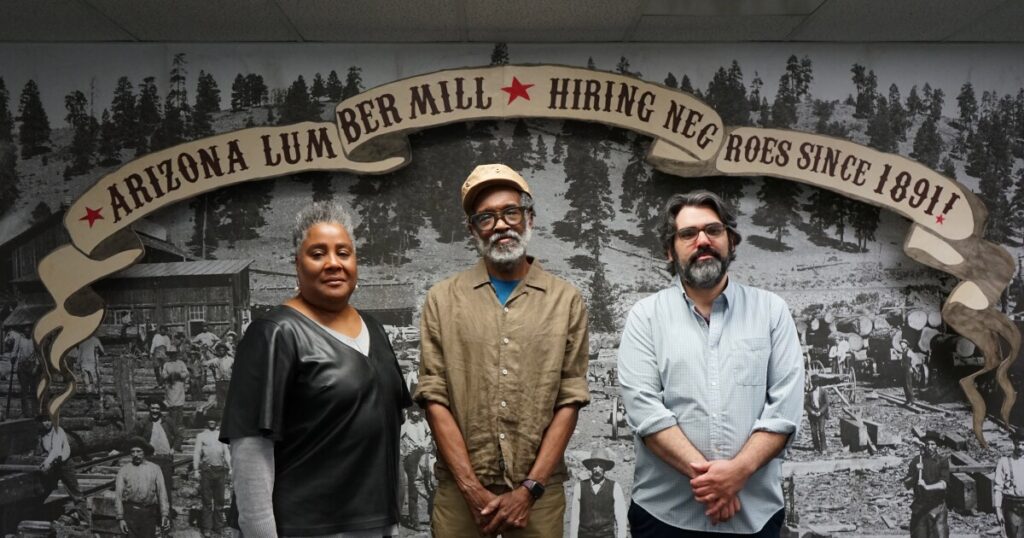
A black-and-white photograph spans an entire wall at Northern Arizona University’s Riles Building, depicting the solemn faces of men from a bygone era. This image is part of an exhibit by Chip Thomas, better known as Jetsonorama, revealing the overlooked stories of African American workers in Arizona’s lumber industry.
Thomas points out a significant detail in the photo: “The Arizona Lumber Mill, hiring Negroes since 1891.” This statement highlights the early employment of African Americans in Flagstaff’s lumber mill, located at the base of today’s Observatory Mesa, which was notably integrated for its time.
Contrastingly, just 30 miles away in Williams, the Saginaw and Manistee Mill and Box Company had a policy against hiring African Americans. Thomas’s exhibition seeks to shed light on such disparities and bring the narrative of Black lumberjacks to the forefront in a place symbolized by Louie the Lumberjack.
The exhibit explores the migration of skilled African American lumbermen from the South to Arizona, driven by the depletion of Southern forests and the oppressive Jim Crow laws. “It’s comparable to the Great Migration northward in a lot of ways,” Thomas explains, noting the workers’ expertise and the segregation they faced in social settings despite working together.
This project is a collaborative effort between Thomas and students from NAU’s Department of Comparative Cultural Studies. Teaching professor Russell Pryba describes the exhibition as taking Thomas’s renowned street art style indoors and creating an immersive environment around it.

Bernadine Lewis, program director for NAU’s Center of Inclusive Excellence and Access, shares a personal narrative from her Geechee Gullah heritage, reflecting on the mystical songs and tools of the lumbermen. She contrasts this with the mainstream image of the lumberjack, urging a broader recognition of African American contributions to American history.
The Black Lumberjacks exhibit is a dynamic portrayal of history, inviting viewers to engage with the legacy of these skilled workers through an artistic lens. It runs until Juneteenth, June 19, at the NAU campus, with plans for a more extensive exhibition at Flagstaff’s Coconino Center for the Arts next year.
The exhibition’s continuation at the Coconino Center for the Arts promises a deeper exploration of this rich yet often overlooked chapter of American history.
—
Read More Arizona News


![Jody White’s Unconventional Michigan Supreme Court Candidacy Explored[embed]https://www.youtube.com/watch?v=8NfxFIPE4ac[/embed]](https://www.kitchentablenews.org/wp-content/uploads/2026/10/Jody-Whites-Unconventional-Michigan-Supreme-Court-Candidacy-Exploredembedhttpswwwyoutubecomwatchv8NfxFIPE4acembed.com2F842F0e2Fc7223daa43c9876b36a4e00773a42Fme-supc.png "Jody White’s Unconventional Michigan Supreme Court Candidacy Explored[embed]https://www.youtube.com/watch?v=8NfxFIPE4ac[/embed]")