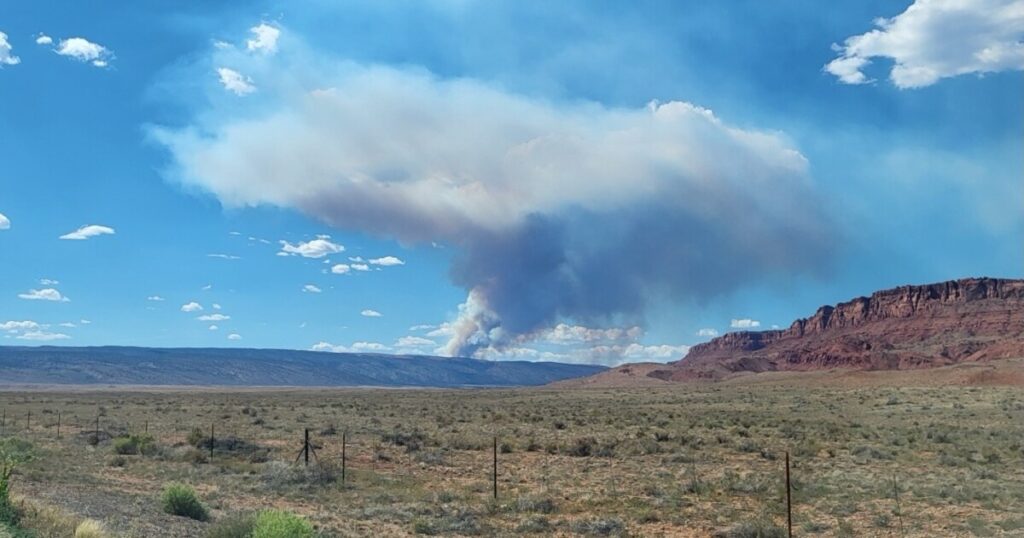
Fire Rages Across Utah-Arizona Border, Threatening Local Wildlife and Communities
Amidst the rugged landscapes of the Utah-Arizona border, a wildfire has expanded dramatically, consuming over 2,200 acres with only a small fraction contained. The blaze, known as the Rock Canyon Fire, was sparked by a lightning strike and is being propelled eastward by fierce winds across the Kaibab Plateau.
As the fire makes its way towards House Rock Valley, Bureau of Land Management (BLM) spokesperson Dolores Garcia highlights the challenges faced by firefighting teams. “The conditions are dry enough, and the lighter fuels like your grasses, your shrubs, have grown back to the point that the fire is moving through there pretty quickly,” Garcia explains. “It’s not providing the pause or relief that we would usually see in some burn scars.”
The fire’s path is being fueled by last year’s White Sage Fire burn scar, as well as highly flammable cheat grass that has proliferated since the previous summer. This invasive species, combined with low humidity during the night and challenging terrain, has complicated containment efforts.
In response to the escalating threat, BLM officials have taken precautionary measures by evacuating campers and visitors from the area, and implementing closures to ensure public safety.
In another part of the region, the Dellenbaugh Fire continues to burn northeast of Kingman within the Grand Canyon–Parashant National Monument, covering an area of 766 acres. While there is no official containment yet, authorities are optimistic about achieving some level of control soon.
Compounding the environmental challenges, scientists from the U.S. Geological Survey have identified traces of human contamination and so-called “forever chemicals” in Monument Springs and other isolated springs within Grand Canyon National Park. These findings raise concerns about long-term impacts on water quality and ecosystem health.
—
Read More Arizona News


![Jody White’s Unconventional Michigan Supreme Court Candidacy Explored[embed]https://www.youtube.com/watch?v=8NfxFIPE4ac[/embed]](https://www.kitchentablenews.org/wp-content/uploads/2026/10/Jody-Whites-Unconventional-Michigan-Supreme-Court-Candidacy-Exploredembedhttpswwwyoutubecomwatchv8NfxFIPE4acembed.com2F842F0e2Fc7223daa43c9876b36a4e00773a42Fme-supc.png "Jody White’s Unconventional Michigan Supreme Court Candidacy Explored[embed]https://www.youtube.com/watch?v=8NfxFIPE4ac[/embed]")