Ann Arbor Mayoral Debate: Housing, Energy, and Political Influence in Focus
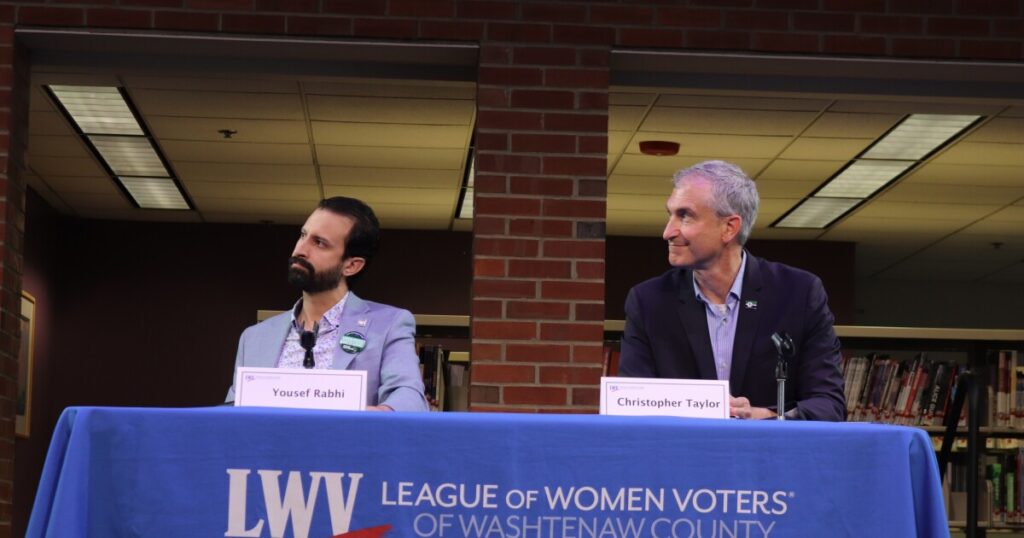
The Ann Arbor District Library became a bustling hub of political discourse as over 150 community members gathered to witness mayoral candidates Christopher Taylor and Yousef Rabhi engage in a spirited debate. Organized by the League of Women Voters of Washtenaw County, the forum presented a platform for the candidates to outline their visions for the city’s future.
Christopher Taylor, who has held the mayoral office since 2014, emphasized his administration’s efforts to mitigate Ann Arbor’s housing crisis. He pointed to the Comprehensive Land Use Plan as a pivotal initiative aimed at increasing city density through zoning changes. “I am always here for housing,” Taylor asserted. “We need that in our community. We need the affordability that more housing will bring. This is our existential problem. It’s a distraction to talk about anything else.”
In contrast, Yousef Rabhi, a Democratic Socialist and Washtenaw County Commissioner, expressed skepticism towards what he termed “trickle-down housing.” He advocated for the construction of more low-income public housing and opposed selling public land to private developers for luxury projects. “Instead of selling our land off to private developers to build for-profit luxury condos, let’s use that land to actually build housing for working and middle class people in this community,” Rabhi stated.
Housing was not the only topic of contention; the candidates also discussed the city’s carbon neutrality objectives. Rabhi criticized DTE, calling it an impediment to renewable energy efforts and proposed municipalizing Ann Arbor’s power grid. “DTE spends a lot, and by a lot, I mean hundreds of millions of your ratepayer money to influence our legislators and to buy lawmakers,” Rabhi argued. “I came to the conclusion that there’s only one way to achieve 100% renewable energy, to achieve reliable energy, to achieve cheaper energy, and that way is municipalizing our power grid here in the city of Ann Arbor.”
Taylor, however, suggested that public ownership of the power grid is financially and legally challenging in the short term. He highlighted the achievements of the current Sustainable Energy Utility, which aids residents in accessing renewable energy while staying connected to DTE’s grid.
Accusations flew as both candidates accused each other of benefiting from corporate and dark-money backing while professing reformist ideals in politics. Taylor condemned corporate influence, alleging Rabhi accepted corporate PAC money. Conversely, Rabhi denied these claims and accused Taylor of being behind attack mailers funded by Michigan Deserves Better. “The fact that that dark money mailer ran it in your mailboxes at pretty much the same time that his mailer did should tell you something,” Rabhi commented.
Taylor rebutted the accusations, urging voters to trust his track record. “Basic services are fundamental to everything we do: clean water, fire, and firefighters that show up on time; parks; free and fair elections,” he mentioned. “Each and every day, we do the boring work, and we keep it boring.”
The debate, moderated by Catherine Murau, President of the League of Women Voters of Washtenaw County, underscored the importance of direct civic engagement. Murau noted, “There’s nothing like that in-person experience, and also being given the chance to ask your own questions and to just kind of feel — not just see a recording — but feel the atmosphere and be surrounded by people who care.”
As the Democratic primary on August 4 approaches, voters will choose between Taylor and Rabhi, with no Republican candidates in the race.
Editor’s note: DTE is among Michigan Public’s corporate sponsors.
—
Read More Michigan News