John Muir’s unexpected journey to the Petrified Forest in eastern Arizona unveils a lesser-known chapter in the naturalist’s life, as recounted by author Scott Thybony in this month’s Canyon Commentary.
High above the colorful badlands of Petrified Forest National Park, a forgotten tea tin lid stirs memories of the renowned naturalist John Muir. The inscription reads, “Lipton’s Tea,” a reminder of Muir’s Scottish heritage and his love for tea, which he famously carried along with “only a tin cup, a handful of tea, a loaf of bread, and a copy of Emerson” during his Yosemite adventures.
In 1905, amidst personal tragedy, Muir ventured into the desert to find solace and help his ailing daughter. Following the death of his wife Louie to lung cancer, Muir, then 67, was desperate to heal his youngest daughter, Helen, who was suffering from pneumonia. With medical advice suggesting the dry Arizona air could aid recovery, Muir, along with Helen and his oldest daughter Wanda, set out for the Painted Desert.
Upon arrival at Adamana, the entrance to the Petrified Forest, the family settled into the Forest Hotel’s two-room adobe house. Over time, the desert’s climate worked its magic, and Helen regained her health, later living a full life.
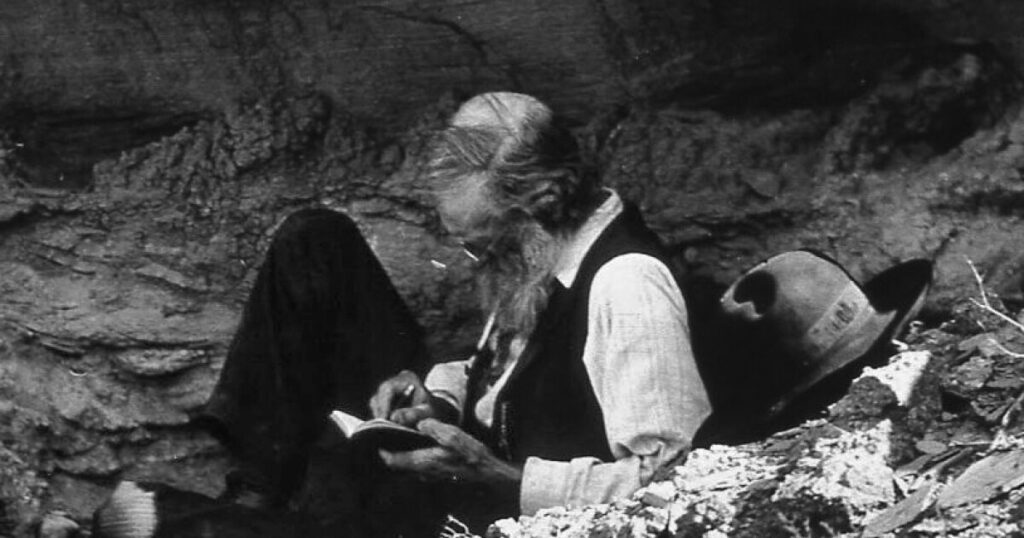
While the grief-stricken Muir struggled to write, he immersed himself in the exploration of the stone trees, which he deduced had been transported by ancient floodwaters before petrifying. Although he never published his findings, Muir described these as “the first great forests of the world.”
Helen Muir/Arizona Memory Project/State of Arizona Research Library
Muir’s desert journey was unexpected yet enlightening. While he was familiar with the Sierra Nevada, the Petrified Forest’s fossilized trees and ancient human artifacts captivated him. He uncovered fossil bones of phytosaurs, crocodile-like reptiles, and took an interest in the area’s prehistoric rock art, though interpreting them proved challenging.
His archaeological pursuits included excavating a kiva at Puerco Pueblo, where he developed a chronology of the region’s pottery. This endeavor coincided with his advocacy for the Antiquities Act of 1906, aimed at protecting such historical sites.
Muir’s collected artifacts were donated to the University of California, Berkeley, where he dedicated time to study them, despite the toll on his “old paleontological body.” His solitude in this work was profound, as expressed in a letter: “I sit silent and alone … in the deeper silence of the enchanted old forests …”
The time spent in Arizona revitalized Muir’s love for nature, enabling him to move past his sorrow and return to California with renewed vigor. By August 1906, he resumed writing, continuing his legacy of conservation.
Scott Thybony is a Flagstaff-based writer. His Canyon Commentaries are produced by KNAU Arizona Public Radio and air on the last Friday of each month.
Brought to you by Sedona Red Rock Tours, offering guided tours to Sedona, the South Rim, Antelope Canyon.
Commentator Scott Thybony headed into the Painted Desert to find the route taken by an eccentric anthropologist in 1881. He discovered a wind-carved world and learned from a friend a more civilized way of traveling in the backcountry.
—
Read More Arizona News