Interested in more updates on rural life? Subscribe to the Harvest newsletter for the latest news and exclusive insights.
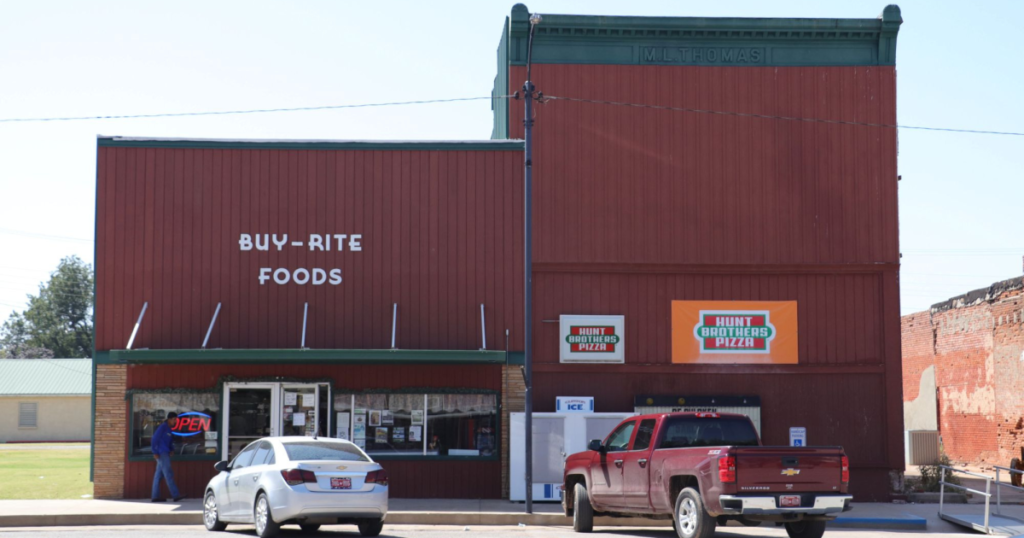
In the heart of Pond Creek, Oklahoma, Buy-Rite Foods serves as a crucial lifeline, offering essentials from groceries to personal care items. For many locals, this store is not just convenient but a necessity, particularly as it’s the only place in town where Supplemental Nutrition Assistance Program (SNAP) benefits can be utilized.
“There’s a lot of regulars that we know exactly what they want when they walk in the door,” says Chrystal Hamblin, a familiar face at the store’s register. “And I think this store depends on things like that, and so does this town.”
Anna Pope
/
Harvest Public Media
The acceptance of SNAP at Buy-Rite Foods ensures locals aren’t compelled to travel long distances for their grocery needs, a factor crucial to the store’s financial health. However, the store has noticed a significant decline in SNAP transactions, plummeting by about 90%. This downturn follows Oklahoma’s implementation of stricter regulations on SNAP purchases.
“I don’t see near as many. I mean, it used to be after school, parents would just send their SNAP card with their kid, ‘Hey, go get your snacks or whatever you need after school,’” Hamblin noted. “And a lot of that can’t be used on SNAP now and so we don’t see that.”
Since President Donald Trump assumed office again, his administration, alongside Congress, has introduced substantial reforms to the SNAP program, affecting every facet of it. Federal authorities argue these measures aim to reduce waste and fraud or to promote healthier choices. However, experts on food and hunger warn these changes might limit people’s ability to afford food.
This concern is particularly pronounced in rural regions, where SNAP participation exceeds urban areas, as noted by the Food Research and Action Center. Gina Plata-Nino, SNAP Director for the advocacy group, highlighted that these areas often grapple with higher poverty rates, fewer employment opportunities, and limited transportation.
“We’re highly concerned,” Plata-Nino remarked.

Anna Pope
/
Harvest Public Media
SNAP Policy Overhaul
The landscape of SNAP has undergone major transformations since the passage of the Trump administration’s One Big Beautiful Bill Act, or H.R. 1, in July of last year.
This legislation introduced expanded work requirements, eliminated the SNAP Education program, ended eligibility for certain legal immigrants such as sex-trafficking survivors and refugees, and transferred hundreds of millions of dollars in administrative costs to states.
Additionally, states like Oklahoma, Kansas, Texas, Missouri, and North Dakota received waivers to exclude certain junk foods from SNAP purchases. While the restrictions aim to foster healthier eating habits, experts argue there is limited evidence of their effectiveness and they may complicate the program.
A federal judge has blocked similar restrictions in states like Nebraska and Iowa, citing the USDA’s failure to comply with the required process for implementing these changes, as noted in a lawsuit.
New regulations that require stores to stock more fresh foods to continue accepting SNAP benefits are also set to take effect this month. Experts say these changes could limit options for SNAP recipients, particularly in rural areas.
Since July 2025, approximately 5.4 million individuals have exited the program.

Anna Pope
/
Harvest Public Media
According to the Center on Budget and Policy Priorities, it’s improbable that the reduced need is the cause of declining enrollment. Plata-Nino explained that the ongoing policy changes, executive orders, and alterations to the program rules have contributed to fewer participants.
“H.R. 1 was just the thing that like — it’s the main piece of the pie, but all of these other things are also impacting them. So it’s not just one thing, it’s everything,” Plata-Nino said. “But H.R. 1 is the biggest driver.”
Rural Food Insecurity Exceeds National Levels
In 2024, nearly 16% of rural households experienced food insecurity, surpassing the national average by 2 percentage points, according to the U.S. Department of Agriculture’s Household Food Security Report. The Trump administration canceled this report last year.
James Ziliak, director of the University of Kentucky’s Center for Poverty Research, noted that falling SNAP enrollments are likely to have a substantial impact in rural communities, where incomes are often lower. “Many of those folks are going to be affected by these changes in the program,” Ziliak said. “And they already face a number of significant challenges to making ends meet.”

Anna Pope
/
Harvest Public Media
SNAP is the largest food assistance program in the nation, and Ziliak asserts it’s among the most effective elements in the social safety net. Evidence suggests that SNAP reduces food insecurity, helps lift people out of poverty, and positively impacts health outcomes.
Despite its successes, Ziliak mentions that congressional discourse often highlights the challenges faced by such programs, leading to the vilification of participants rather than addressing systemic issues. “I think we should be proud of how effective the program’s been, but also vigilant and always trying to improve,” Ziliak commented. “And it’s just not so clear that the goal of the Congress with H.R. 1 was to improve the program, so much as it is to punish those who are on the program.”
Ziliak further notes that cuts to SNAP could particularly impact small grocery stores with thin profit margins. For every dollar spent through SNAP, it’s estimated that over $1.50 is generated in economic activity.
“If you cut both enrollment in the program, as well as the benefits, then that’s going to be less money spent in the local community, which could have a spillover effect on the local grocery sector,” he said.
‘As long as I have SNAP, I have food.’
In the small town of Cache, Oklahoma, with a population of about 3,000, only a few convenience stores accept SNAP. Savannah Huling, one of the local residents, relies on these benefits to feed herself and her 7-year-old son, supplementing with visits to the local food bank due to persistently high food prices.
Huling acknowledges that not everyone in her community understands the realities of food insecurity. “There’s really not as big of an awareness as you’d want because it’s like the battle of the stereotypes,” she says. “Some people are thinking, ‘Oh, if you just get up and get a job…’ but then you got the people who actually know.”

Anna Pope
/
Harvest Public Media
There is apprehension that food insecurity could worsen due to impending changes to SNAP. Starting as early as 2027, states may face significant financial responsibilities in covering SNAP program costs.
The financial obligation of states will be tied to their SNAP error rate, which includes both overpayments and underpayments to recipients. As of fiscal year 2025, 37 states will owe something.
Brian Colby, vice president of the Missouri Budget Project, indicated that Missouri currently pays at least $50 million in administrative costs. If the error rate remains above 8% this fiscal year, expenses could escalate to $150 million.
“If you add a further responsibility to the state for the SNAP program it’s going to be exceedingly painful to deal with,” Colby said. “because Missouri just doesn’t have $150 million sitting around unappropriated or unspent.”
Colby expressed concern that a tight state budget would complicate SNAP administration and participation, leading some individuals to opt-out or lose benefits due to paperwork, errors, or programming issues. “That is really exacerbated by having to react so quickly to the changes at the federal level, much quicker than had been in the past,” he added.
Fears exist that some states might consider eliminating SNAP altogether due to increased costs, potentially leaving millions without access to affordable groceries.
Despite these challenges, Savannah Huling remains hopeful. She is about to begin a new job and is optimistic about qualifying for SNAP. Huling understands that her wages alone may not suffice to cover all expenses.
“I’m going to get this job, work my hours, hopefully get SNAP and have groceries and keep going,” she said. “As long as I pay my bills, I have a house. As long as I have SNAP, I have food.”
This story was produced in partnership with Harvest Public Media, a collaboration of public media newsrooms in the Midwest and Great Plains. It reports on food systems, agriculture, and rural issues.
—
Read More Michigan News