In Saline Township, a contentious debate over the establishment of a vast data center project has taken center stage. At the heart of this debate is Michigan gubernatorial candidate John James, who recently visited the area to express his stance.
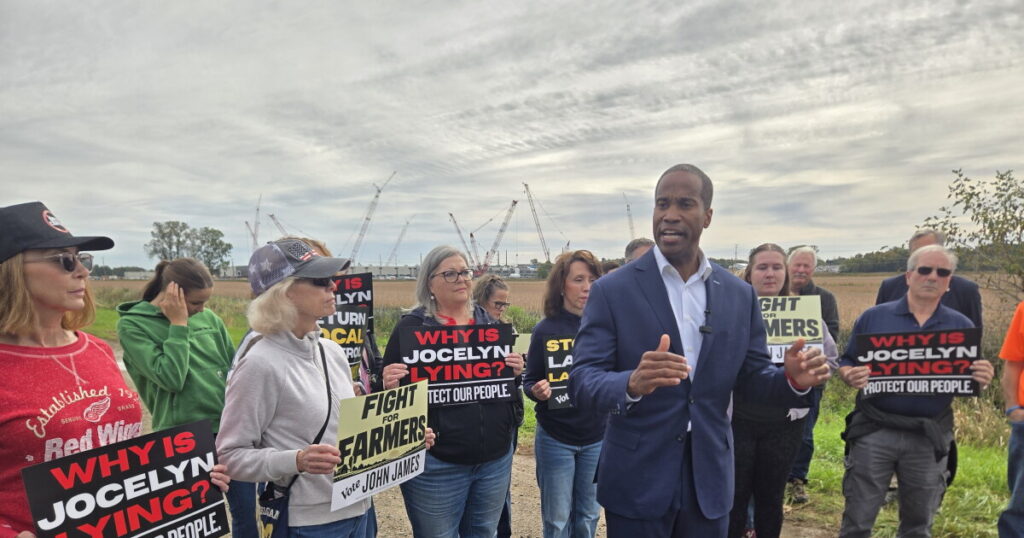
James addressed a crowd near farmland adjacent to the data center initiative linked to OpenAI and Oracle. Initially, local authorities attempted to halt the project but eventually conceded following legal challenges. Several officials participated in a ceremonial groundbreaking last summer.
Advocating for “local control,” James criticized the state’s role in attracting data center projects with fiscal incentives. “I believe very strongly that Michigan is open for business. But we are not for sale. And, ultimately if you want a data center, fine, we’ll help. If you don’t want a data center, fine, we’ll help. But, ultimately, the control should be by the locals, not dictated by Lansing and lawyers and lobbyists,” he stated at the press conference.
James differentiates himself from former President Donald Trump, whose administration has been a proponent of AI development, often clashing with local opposition. The One Big Beautiful Bill Act initially included measures to limit local governance over AI-related projects.
Meanwhile, Michigan Secretary of State Jocelyn Benson accused James of opposing local governance by supporting the OBBBA in Congress. “He has voted four times to block local control. Four times to block communities from having a voice in data centers,” Benson remarked during a campaign visit to Flint.
Benson’s connections to the Saline Township project have also faced scrutiny. Her husband is employed by Related Companies, a partner in the project. Benson asserts that her husband has withdrawn from Michigan ventures. James, however, accused her of profiting from the data center industry.
Despite their disputes, both candidates share some common ground on the issue, such as supporting a temporary halt on new data center projects until further regulations are established. They also emphasize environmental protections and ensuring residents aren’t financially burdened by the centers’ energy demands.
State regulators note that certain protections are already embedded in utility contracts approved by the state’s Public Service Commission. Legislative efforts to enshrine these utility requirements into law have yet to succeed this term.
James diverges from Benson in his preference for data center locations, advocating for their placement on existing industrial sites instead of agricultural land, a stance supported by local resident Ron Zimmerman. “Why does it need to be taking farmland and food capacity away from, not only Michigan, but the rest of the world. People want to talk about food insecurity. Why are we taking the supply out?” Zimmerman expressed.
Zimmerman clarified that his concerns were about the community impact of data centers, rather than opposing their existence altogether.
—
Read More Michigan News