Chino Valley Residents Turn to Water Hauling Amid Growing Water Crisis
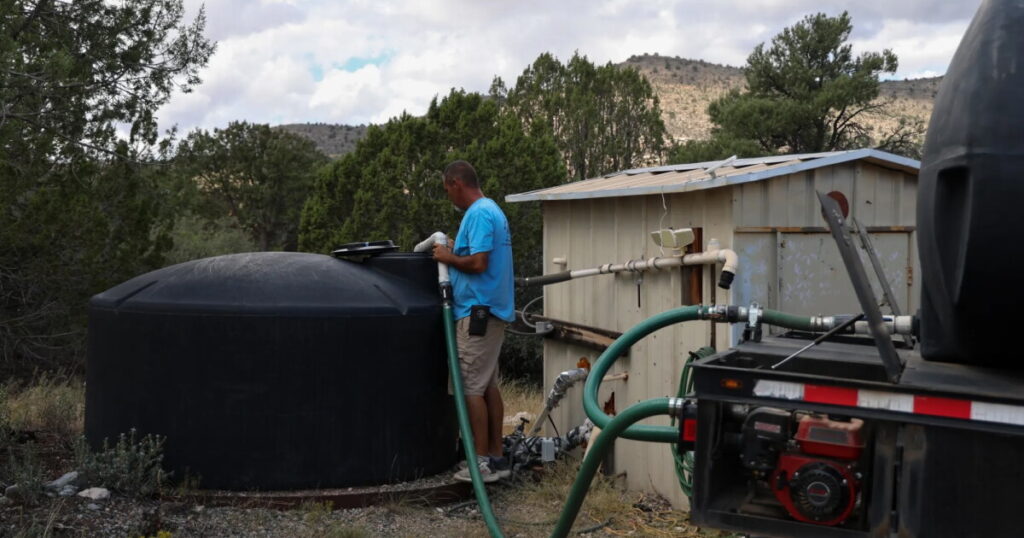
As water becomes increasingly scarce in Chino Valley, the sound of a gas-powered motor signals a vital service for the community: water hauling. Adam Brice, a local water hauler, is on a mission to provide this essential resource to residents facing drying wells.
Chino Valley, located 16 miles north of Prescott, is witnessing the impact of regional growth on its water supply. The Prescott metro area, which includes Prescott Valley, Chino Valley, and Dewey-Humboldt, has struggled with water shortages due to extensive groundwater pumping and inadequate recharge. The area has been outside of safe yield for 27 years, according to the Arizona Department of Water Resources.
The depletion of water resources has significantly affected rural homeowners, prompting them to seek alternative solutions. “The wells that you’re seeing right now that are drying up – that’s the canary in the coal mine,” said Mark Holmes, water advisor for Chino Valley. “The bird has died.”
Efforts to address the overdraft through regional cooperation and stormwater retention are underway, but many residents have resorted to hiring water haulers like Brice. He operates Brice Water Delivery LLC, providing water to about 90 to 100 regular customers. His routine involves filling a 2,035-gallon tank at the local water station and making multiple trips daily to meet demand.
“With everything that’s been going on for 15 to 20 years, you could have great water, and then two weeks from now you might not,” Brice remarked, reflecting on the area’s unpredictability. His own family’s well dried up in the early ’90s, leading him to start hauling water for his parents and eventually expanding his services.
Brice’s pricing varies between $85 to $90 per 1,000 gallons and $110 to $125 per 2,000 gallons delivered. His clientele includes a diverse range of individuals, from working-class residents to those with physical or financial challenges. “Some of them just can’t do it physically, and we try to take care of a lot of those people price-wise,” he explained.
Understanding the Water Shortage
The drying wells in Chino Valley are attributed to several factors. Mark Holmes points to reduced incidental recharge due to drought and climate change, alongside increased groundwater pumping. Sarah Porter of Arizona State University notes that while drying wells don’t always signify a depleted basin, certain areas have become “permanently” dry, such as West Chino Valley and near Coyote Springs.
The Prescott Active Management Area (AMA), unlike its Phoenix counterpart, lacks a backup water supply from the Colorado River. This reliance on regional water sources exacerbates the situation. Tracy Lund of Prescott Valley suggests that the area’s current challenges could foreshadow future issues for other regions.
Efforts to Mitigate the Crisis
Gary Beverly of the Citizens Water Advocacy Group points out the impact of Prescott’s wells on neighboring water sources. In 2024, these wells accounted for 80% of Prescott’s groundwater supply. The competition between private and municipal wells adds to the strain, with exempt wells posing additional risks.
Given the limited agricultural water usage in Prescott AMA, municipal demand has overtaken agricultural needs, leaving fewer options for conservation. An ADWR report from 2022 indicated that achieving safe yield in the area is unlikely.
Community and Regional Solutions
Residents like Jerry Carter, who relies on Brice for water, have considered solutions like rainwater harvesting but face challenges in implementation. Holmes and Beverly advocate for stormwater retention as a viable option, given the lack of external water sources.
Holmes proposes establishing a regional water authority to address these issues collaboratively. Discussions are ongoing among local governments to explore regional efforts and conservation strategies. “This new regional authority needs to be created,” Holmes emphasized, highlighting the necessity of unified action.
For Brice, water hauling has become a way to serve his community, fostering cooperation among local haulers. His involvement in community events, such as the Chino Valley Territorial Days parade, reflects the strong community ties that water hauling has helped nurture.
—
Read More Arizona News