The Arizona-Mexico border sees fewer migrant crossings, yet the perilous Sonoran Desert continues to claim many lives. Despite a significant drop in migrant encounters, the number of migrant deaths remains troublingly high.
According to the Pima County Office of the Medical Examiner and Humane Borders, July 2026 recorded 19 migrant deaths, marking the highest monthly death toll for July in the past two years. By 2026, the remains of 89 migrants had been discovered, approaching the 102 total found in 2025. However, these figures may not represent the actual year of death, as bodies are often found long after passing.
In contrast, U.S. Customs and Border Protection data highlights a 61% decrease in attempted migrant crossings or “encounters” in the Tucson and Yuma border sectors from fiscal years 2025 to 2026. The previous year saw an 88% drop from 2024 to 2025.
The data from the U.S. Customs and Border Protection and Humane Borders do not coincide in timeframes or exact locations. Nonetheless, the disparity between the decline in crossings and the persistent death toll underscores the dangers migrants face in the desert.
Joel Smith, operations manager for Humane Borders, observed, “The amount of people crossing has significantly decreased,” noting that the situation is calmer compared to previous years.
The Harder Path
Humane Borders, in collaboration with the Pima County Office of the Medical Examiner, uses an interactive map to track where migrant remains are found.
Miranda Haley from Humane Borders urges closer inspection of the map. “The desert is vast,” she explains, emphasizing that the map only shows where bodies are found, not where migrants actually perish. The desert’s vastness and inaccessibility mean many deaths remain unrecorded.
Courtesy
/
Humane Borders
As enforcement increased near ports in 2025, migrants sought alternative, riskier paths. Smith noted, “In 2006, it was easy. They just walked through the Altar Valley.” Now, migrants traverse the more treacherous Baboquivari Mountains to avoid surveillance, a path less favored by border patrol agents.
Mónica Ruiz House from No More Deaths cited University of Texas at El Paso and University of Arizona’s Binational Border Institute research about this shift. High surveillance and border militarization make crossings deadlier, forcing migrants into challenging terrains.
Both the Border Patrol and humanitarian groups recognize the dangers migrants face. While Humane Borders attributes the fatalities to increased surveillance, U.S. Customs and Border Protection points to smuggling organizations.
Border Patrol stresses that smugglers prioritize profit over safety, often misleading migrants and leaving them stranded. To mitigate risks, agents trained in emergency medical care and rescue operations are deployed in the desert.
The Unknown Numbers
Since 1981, 4,517 migrant remains have been discovered in Arizona’s borderlands, with 1,639 unidentified. Both Border Patrol and humanitarian groups agree these numbers likely understate the true death toll.
Haley mentions, “Our death numbers seem to reflect probably about half to maybe a third of what is actually out there.” Smith concurs, noting that desert scavengers quickly scatter remains, making discoveries rare during searches.

Courtesy
/
Humane Borders
Smith adds that Border Patrol counts only remains found by their agents, potentially excluding those discovered by others, a contradiction noted in a 2024 U.S. Government Accountability Office report.
The Pima County Medical Examiner Annual Report for 2025 documented 106 migrant remains, whereas the Border Patrol Tucson sector reported only 70 deaths, highlighting discrepancies in data collection.
Where the Water Can’t Reach
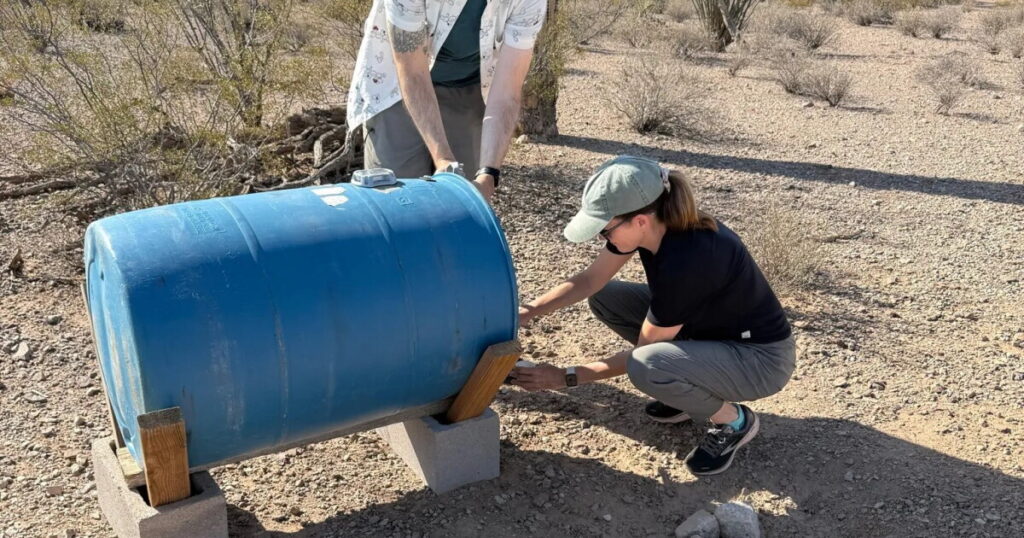
Humane Borders supports migrant safety by maintaining water stations marked by flags and blue barrels, though these are sometimes vandalized, incurring repair costs. Smith notes that vandalism is seasonal, increasing in cooler months when “vigilantes and alt-right provocateurs” are more active.
Water station placement is limited by road access, with some areas of Cabeza Prieta National Wildlife Refuge and Organ Pipe Cactus National Monument inaccessible due to wilderness protection laws.

Courtesy
/
Humane Borders
Recently, two federal agencies declined permit renewals for 12 water stations in southern Arizona, citing concerns that they encourage migrants to venture into dangerous terrains.
Raquel Montez of Organ Pipe Cactus National Monument explained in a letter that while water stations aim to save lives, they might inadvertently lead migrants into perilous areas.
Haley counters that water stations are placed in response to death data, insisting that migrants don’t cross for “warm, slightly chlorinated tasting water.” She argues that the red dots on the map, representing deaths, appear before the blue barrel stations are set up.
Weather Patterns and Night Crossings
Extreme heat is a leading cause of migrant deaths, but monsoon season also poses risks. Floods can scatter or obliterate remains, complicating recovery efforts.
Night crossings add danger as migrants often flee in panic when encountering agents. In the dark, the desert’s steep canyons can lead to fatal falls or drownings. However, Ruiz House cautions that recovery data doesn’t always align with actual death dates.
From 2020 to 2023, the Pima County Office of the Medical Examiner found that 27% of remains had been in the desert for six to eight months or more.

Courtesy
/
Humane Borders
Prevention through Deterrence
Haley notes that conservative border residents and Republican ranchers also call for improved immigration policy over deterrence strategies, which they say increase desert deaths.
She highlights that Operation Gatekeeper and Operation Hold the Line in the 1990s, aimed at preventing illegal crossings, led to more deaths. These policies, she argues, turn the desert into a lethal barrier.
The Border Patrol acknowledges the harsh desert conditions and criminal exploitation but did not comment on deterrence policies. Haley maintains that illegal entry is a misdemeanor, not warranting a death sentence, and that her work doesn’t encourage illegal crossings.
She shares that migrants consistently express, “I would not be here if I had any other option. But I would rather die in this desert trying than watch my family starve in front of me.”
—
Read More Arizona News