 This story was originally published by Barn Raiser and is reprinted with permission.
In May, students and staff at the University of Wisconsin—Platteville Baraboo Sauk County were shocked to learn their campus was closing just weeks before the semester’s end. The closure prompted frantic efforts for students to transfer and staff to secure new positions in the UW system.
The Baraboo campus closure is part of a trend where the University of Wisconsin has closed eight of its 13 branch campuses over three years. These two-year colleges offered affordable higher education options, especially for rural and first-generation college students.
A memorial event was held by faculty and students to commemorate Boo U’s legacy, attended by members of its inaugural graduating class who received their degrees in the 1970s.
“It was really a memorial,” says Karen DeSanto, a Wisconsin legislator from Baraboo. “The students talked about how this place shaped and changed lives in this community. We don’t have that any more.”
College closures are happening at an alarming rate, nearly one every three weeks, according to The Hechinger Report. Unlike most closures affecting private institutions, Wisconsin’s two-year public colleges are an exception.
University officials blame the closures on declining enrollment, with the UW system experiencing over a 10% drop since 2010. Boo U’s enrollment fell from over 500 a decade ago to just 100 students in its last year, making it financially unsustainable.
Budget cuts, beginning in 2015 under former Gov. Scott Walker, combined with tuition freezes, have left the UW system among the nation’s worst funded. A 2017 merger made two-year colleges branches of four-year institutions, creating competition that further strained resources.
Dan Kallgren, a history professor from UW-Marinette, said, “At that point the writing was really on the wall.” Marinette ended in-person classes in 2024 but offered remote classes for another year. “I was the last faculty member on campus,” recalls Kallgren, who taught a Western Civilization course via video link.
Despite rural campus closures, UW officials contend Wisconsin students have options with 13 four-year and 16 technical colleges statewide. However, Kallgren argues that liberal arts colleges like Marinette uniquely supported rural students exploring higher education.
“Think about the rural kid screwing up his courage and coming here, then getting turned on to engineering or history,” says Kallgren. “That avenue is now closed.”
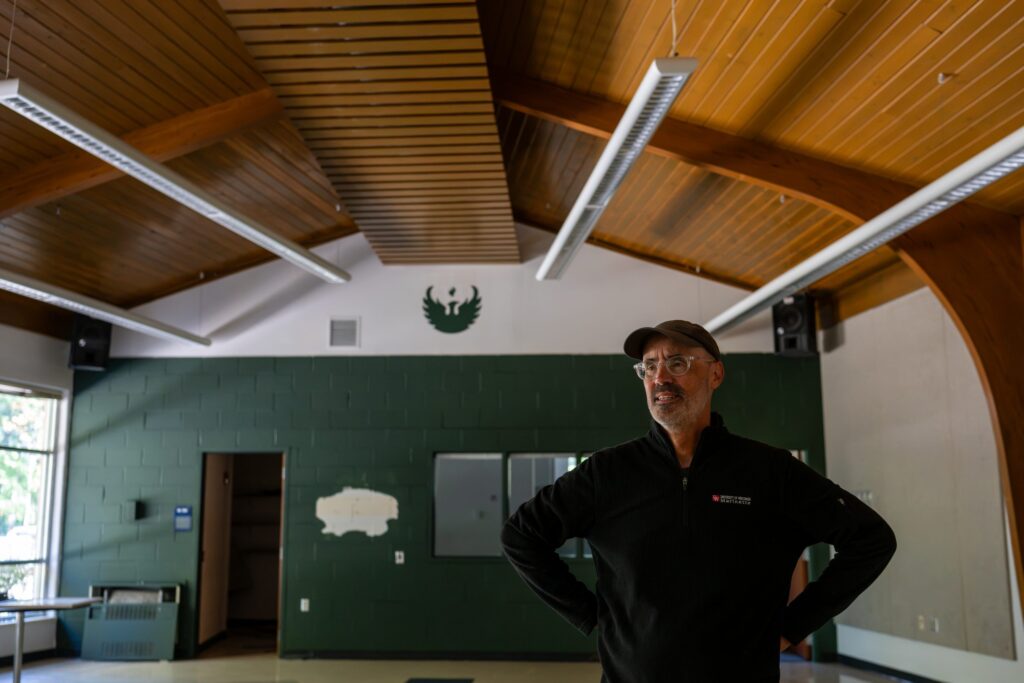
 Dan Kallgren taught the final course at University of Wisconsin-Marinette before the school ended in-person instruction in 2024. He says that shuttering the two-year branch campuses will close opportunities for rural students and fails to acknowledge the role such liberal arts schools play in providing a supportive and affordable environment for education.
Credit: Kara Counard
Education Deserts
Research led by Nicholas Hillman, a former UW-Madison scholar, suggests that most students choose colleges within 20 miles of home. As proximity decreases, the likelihood of attending college drops, leading to “education deserts” in under-served regions, a growing concern in Wisconsin.
“They’ve hollowed out the two-year schools and the liberal arts transfer mission and now they’re sealing the coffin,” says Hillman. “The question is, if you shut one door, have you opened another?”
Data suggests rural student enrollment in the UW system is declining at a greater rate than statewide averages. The closures of branch campuses contribute to this trend, compounding the challenges of college access in rural Wisconsin.
Douglas Haynes from UW-Oshkosh highlights the disparity between well-funded campuses and those facing program cuts. “There are going to be increasing numbers of (rural) students who just don’t go to college any more,” he says.
A study identifies Wisconsin as having the second-highest “brain drain” rate in the U.S., with educated youth leaving the state post-graduation. Diminishing college access could create another form of brain drain, limiting rural students’ opportunities from the start.
 History teacher Alex Stevens in his classroom at St. Thomas Aquinas Academy, in Marinette, Wisconsin, reflects on his time as a student at UW-Marinette. Credit: Kara Counard
The Wisconsin Idea
Alex Stevens, from tiny Stevenson, Michigan, chose UW-Marinette due to its proximity and affordability. This local option allowed him to pursue higher education without incurring debt, later transferring to UW-Green Bay for a history degree. Stevens now teaches history in Marinette.
Stevens’ experience is less likely now, not only because the campus closed but also due to Wisconsin’s shift from liberal arts to career-focused programs. In 2023, former UW President Jay Rothman recommended moving away from liberal arts to career-specific programs, especially for low-income students.
An investigation revealed that most of the 82 cut academic programs within the UW system were in humanities or social sciences.
Alyssa Ratledge from MDRC notes, “It’s all about getting a job with a positive ROI (return-on-investment),” but warns that this narrow focus on vocational training limits students’ opportunities for personal growth and exploration.
As branch campuses close, the Wisconsin Idea — a vision of education enriching lives beyond academia — is fading. In Baraboo, the community debates future uses for vacant buildings, while in Marinette, only the theater arts program survives, sustained by partnerships, donations, and ticket sales.
Lauryn Albaugh, who leads the theater program, hopes to inspire local youth as she once was. “I really attribute my love for the arts to this theater program,” she says. However, Albaugh is one of only two remaining employees at UW-Marinette, with facilities inspected weekly by a maintenance worker.
Jennifer C. Berkshire is the host of the education podcast “Have You Heard” and the co-author (with Jack Schneider) of The Education Wars: A Citizen’s Guide and Defense Manual. She teaches in the Boston College Prison Education Program and the Education Studies program at Yale.
This story was originally published by Barn Raiser.
This reporting is part of a collaboration with the Institute for Nonprofit News‘ Rural News Network. Five nonprofit newsrooms were involved: Barn Raiser, Carolina Public Press, Mountain State Spotlight, Oklahoma Watch and Shasta Scout. The series was edited by veteran investigative editor Dee J. Hall, co-founder and former managing editor of Wisconsin Watch. Support from Ascendium Education Group made this project possible.
The post When community colleges close, rural students get shut out of the liberal arts appeared first on The Hechinger Report.
—
Read More Kitchen Table News