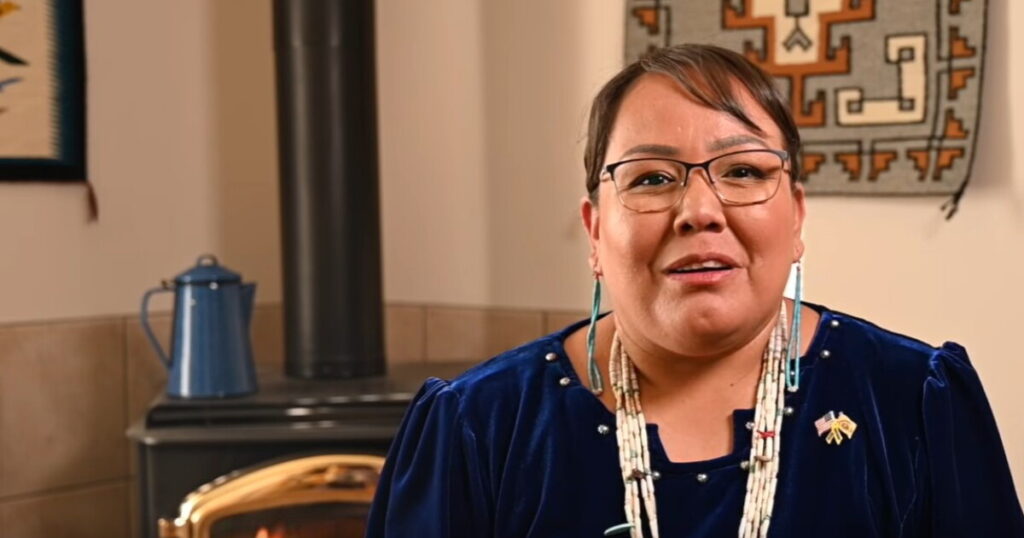
Navajo Nation Makes History with First Female President
The Navajo Nation witnessed a landmark event with the election of Crystalyne Curley as its first female president, a position she aspired to since childhood. Her victory is part of a broader wave of milestones achieved in the recent midterm elections, marking significant progress for Native American women in political leadership positions.
Curley’s political journey began with a third-grade field trip where she observed a spirited debate among tribal lawmakers. “I thought to myself at a very young age, that’s where I want to be,” Curley recalled.
Curley’s election comes amidst a series of historic firsts in the midterms, including the election of the first Black female governor and the first openly gay man and Muslim to the U.S. Senate. This election cycle has been particularly notable for Native American women, who have seldom held formal political power despite their significant roles in family and community leadership.
Other significant victories include Peggy Flanagan’s election to the Senate, Deb Haaland’s governorship win, and Curley’s leadership of one of the largest tribes in the nation. “This is a win for all Navajo women,” Curley told The Associated Press.
Advocacy groups like Advance Native Political Leadership have highlighted the progress made through decades of political organizing. Jordan James Harvill, a strategist with the group, described the developments as a “seismic shift that is happening in our communities.”
The Trailblazing Path of Crystalyne Curley
Curley, alongside her running mate Chris Deschene, secured their victory with a margin of 1,115 votes. However, their opponent, New Mexico attorney Justin Jones, has not conceded. Lene Bitsui, a supporter of Curley, expressed her initial doubts about the readiness for a female president but was pleased to be proven wrong.
The Navajo government, established over a century ago under federal pressure, has traditionally been male-led. The tribe’s extensive land base covers parts of Arizona, New Mexico, and Utah, making it the largest federally recognized tribe by land area.
While some hold that traditional teachings oppose women in top government roles, others argue that the matrilineal structure of Diné society supports female leadership. Curley faced sexist rhetoric during her campaign and anticipates higher scrutiny in her new role. “As women, we have to work twice or triple as hard, especially within Navajo politics,” she stated.
Curley and Deschene plan to shift the Navajo Nation away from coal development and strengthen its influence in national federal Indian policy discussions.
Native Women’s Expanding Political Influence
In addition to Curley’s victory, other Native women have achieved significant political milestones. Democrat Peggy Flanagan celebrated her Senate win, crediting the support of Native women. “I could not run for the U.S. Senate without Native women,” she acknowledged.
Flanagan’s win marks a broader trend, with Mary Peltola’s potential Senate seat win in Alaska possibly leading to the first instance of three Native people serving simultaneously in the U.S. Senate. In the House, Native American representatives Sharice Davids, Josh Brecheen, Claire Valdez, and Sean McCann secured their seats, enhancing Native representation.
Deb Haaland’s Historic Governorship
The midterms also saw Deb Haaland elected as the first female Native American governor in New Mexico, adding to her list of firsts, including her previous roles as a U.S. Congress member and the first Native American to lead a U.S. Cabinet agency.
Haaland, known as “Auntie Deb” in some areas, aims to fulfill campaign promises to improve affordability and education in New Mexico. Reflecting on her support from Native voters, she stated, “It’s not just a slogan. It matters that people feel represented.”
—
Read More Arizona News