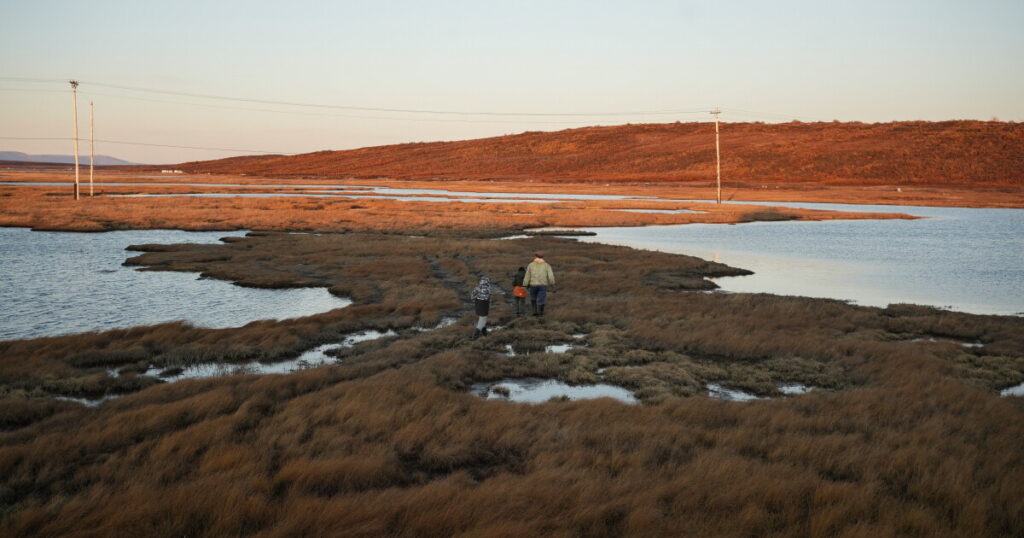
In the remote city of Kotzebue, Alaska, residents face the challenge of securing their annual diesel supply within a tight three-month window. Positioned north of the Arctic Circle, this community relies heavily on diesel for power, due to its difficult accessibility by air and sea. The icy conditions restrict barge access for most of the year, making timely fuel delivery crucial.
Currently, diesel accounts for 75% of Kotzebue’s energy consumption, with locals spending approximately 20% of their income on energy, a stark contrast to the national average for low-income households. Chad Nordlum, energy project manager for the Native Village of Kotzebue, highlights the community’s vulnerability to global market fluctuations, especially during geopolitical tensions like the Iran conflict. “Right now, with the Iran war going on, the diesel prices are very high and we’re locked in to much higher prices than we’ve had in the past. There’s really nothing the community can do about diesel prices, but what we can do is produce our own energy,” Nordlum told Grist.
A beacon of hope came in the form of a $20 million grant from the Environmental Protection Agency for a wind energy initiative, part of a broader $150 million investment in Alaskan tribal infrastructure. This project aimed to reduce diesel dependency to 40-50% and empower local energy decisions. However, the Trump administration halted the grant in 2025, leaving the project stalled.
This funding withdrawal was one of many affecting Indigenous communities across the U.S., as documented by the Brookings Institution. Their reports detail how the One Big Beautiful Bill Act and the Department of Government Efficiency (DOGE) cut significant funding, including $468 million from environmental and agricultural projects essential for climate resiliency and job creation.
Despite substantial post-pandemic investments in Indigenous areas under the Biden administration, Brookings emphasizes ongoing underinvestment, which contradicts federal treaty obligations and impedes environmental protection efforts. Rob Maxim of Brookings Metro, who is Mashpee Wampanoag, stresses the importance of climate funding for Indigenous communities, which frequently bear the brunt of climate change impacts.
“The actions that the Trump administration is taking are particularly significant, but it’s not totally out of trend with previous administrations,” Maxim noted, pointing out that underinvestment is a longstanding issue. The Biden-era funds included over $700 million for tribal climate and infrastructure projects, intended for initiatives like solar panel installations for the Hopi Tribe, which were also cut.
Maxim argues that such funding is a federal duty derived from treaties and should be protected from political shifts. “The funding that was flowing to Indian Country was not being done on the basis of race or DEI, and it was absolutely not illegal,” he said, underlining the focus on tribal sovereignty and welfare.
While the White House remained silent on the issue, the EPA defended its funding reviews, claiming over $351 million in Tribal grants since the Trump administration’s second term.
Brookings’ Glencora Haskins criticized the lack of understanding in the federal approach to tribal funding, noting the frequent targeting of programs with “tribal” identifiers. She advocates for legislative measures to secure funding continuity for Indigenous communities, aligning with trust and treaty obligations.
In Kotzebue, Chad Nordlum remains hopeful for the wind project’s revival amid political changes. Meanwhile, he pursues a smaller-scale solar initiative to address the community’s urgent energy needs. “Our main goals are energy security and economic development for the tribe, which is ultimately being able to invest in our own community, help make the lives of people here a little more sustainable,” Nordlum added, emphasizing the importance of energy affordability and availability for the community’s future.
This story is published through the Global Indigenous Reporting Network at The Associated Press.
—
Read More Arizona News