Michigan Supreme Court Reviews Legislative Authority in Bill Presentment Case
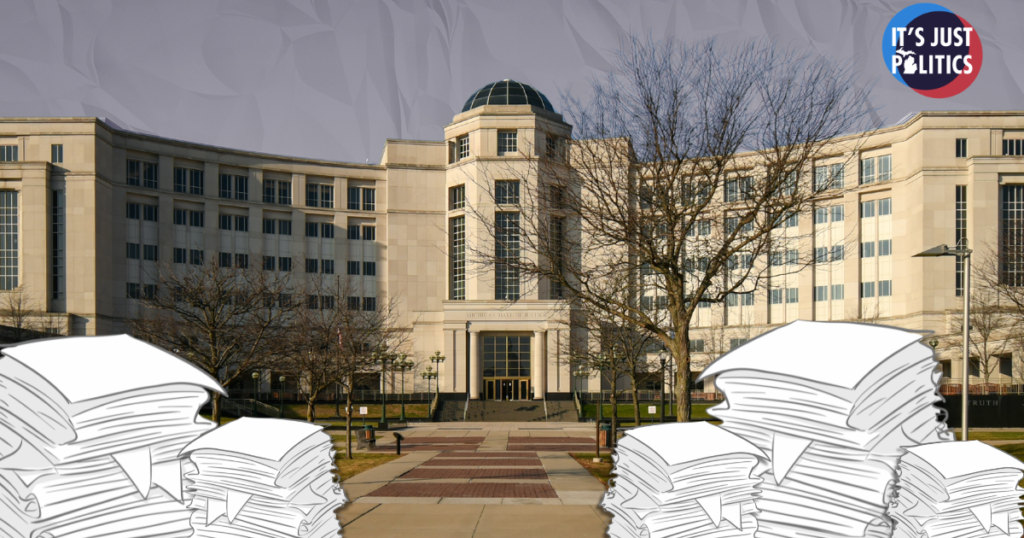
The Michigan Supreme Court is currently deliberating a pivotal constitutional issue that could reshape legislative processes in the state. At the heart of the debate is whether legislative leaders have the unilateral authority to decide which bills are forwarded to the governor after passing both legislative chambers.
This unprecedented case emerged from a situation where nine bills, approved by both the House and Senate, remain stalled in the House clerk’s office. The delay occurred when Republicans assumed control of the House in January 2025 and House Speaker Matt Hall (R-Richland Township) directed the bills to be held.
The stalled legislation includes measures that would alter public employer contributions to employee health insurance, protect public assistance payments from debt collection, integrate corrections officers into the Michigan State Police pension system, and permit Detroit historical museums to seek tax millage.
Senate Democrats are urging the Supreme Court to mandate that these bills be sent to Governor Gretchen Whitmer. The current arguments focus on whether the Supreme Court should hear the case, potentially leading to further deliberations, or allow the appeals court’s decision to remain.
Attorney Mark Brewer, representing Senate Democrats, argued, “If the House’s anti-majoritarian tactic is allowed to succeed, it will unilaterally and drastically change Michigan’s bicameral legislature, its separation of powers, our checks and balances, and the majoritarian principles which underlie everything we do in state and local government in this state.” He emphasized that no legislative leader should have the power to halt a bill post-approval by both chambers.
In contrast, House Republican attorney Kyle Asher contended that the Michigan Constitution grants legislative leaders the discretion to decide on bill presentation. “Nothing in the constitution says who must present the bills, nothing in the constitution says every bill must be presented, nothing in the constitution says when a bill must be presented,” Asher stated, explaining that this has always been a matter for the Legislature to decide.
Asher further clarified that the presentment clause in the Michigan Constitution is often misinterpreted. It simply stipulates that a bill must be presented to the governor before becoming law, not that every bill must be presented.
Lower courts have previously ruled that the House Republicans acted unconstitutionally by withholding the bills from Governor Whitmer. Senate Democrats are seeking a Supreme Court order to enforce this finding. Governor Whitmer has not yet commented on the matter.
The Supreme Court faces a complex situation, as it lacks direct enforcement power, which resides with the executive branch, and has no budgetary authority, which is controlled by the Legislature. The effectiveness of the Court’s rulings depends on the cooperation of the other branches and public trust in the judicial process.
The Court of Claims judge cautiously ruled that the bills should proceed to the governor without issuing an enforcement order. The Court of Appeals supported this decision and instructed an order to be issued. The Supreme Court’s next steps remain to be seen.
_______________________
Inquiries on Michigan Politics? If you have questions or feedback about our coverage, feel free to email us at politics@michiganpublic.org.
_______________________
Democrat Chedrick Greene has secured victory in the special election for Michigan’s 35th Senate district, maintaining the Democratic hold on the Senate.
_______________________
Key Political Discussions
Democrats Maintain Senate Control: Chedrick Greene’s victory in the Mid-Michigan special election ensures the Democrats retain their majority in the Michigan Senate. “The seat representing parts of Midland, Bay, and Saginaw counties has been vacant since January 2025, when former state senator Kristen McDonald Rivet took her seat in Congress. Democratic Governor Gretchen Whitmer’s long delay in scheduling a special election was decried by Republicans as politically motivated,” reports Michigan Public’s Steve Carmody. Greene secured a decisive lead over Republican Jason Tunney, a result seen as indicative of potential trends for upcoming mid-term elections.
Fay Beydoun Charged: The Michigan Attorney General has filed charges against Fay Beydoun, a businesswoman from metro-Detroit, for allegedly mismanaging state funds. Beydoun faces 16 charges linked to her handling of a $20 million state grant for a business accelerator, including larceny by conversion and conducting a criminal enterprise. The investigation is ongoing, with potential for additional charges, according to The Detroit News’ Beth LeBlanc and Craig Mauger.
Stabenow’s Endorsement: Former Michigan Senator Debbie Stabenow has endorsed U.S. Representative Haley Stevens in the Democratic primary for the state’s open U.S. Senate seat. Stabenow believes Stevens is the strongest candidate to face Republican Mike Rogers in the general election, as reported by Melissa Nann Burke of The Detroit News. Stevens is competing against state Sen. Mallory McMorrow and physician Abdul El-Sayed in a highly competitive primary.
_______________________
Yours in political nerdiness,
Rick Pluta & Zoe Clark
Co-hosts, It’s Just Politics
—
Read More Michigan News