The Rise of Anti-Muslim Sentiment Amid Historic Political Milestones
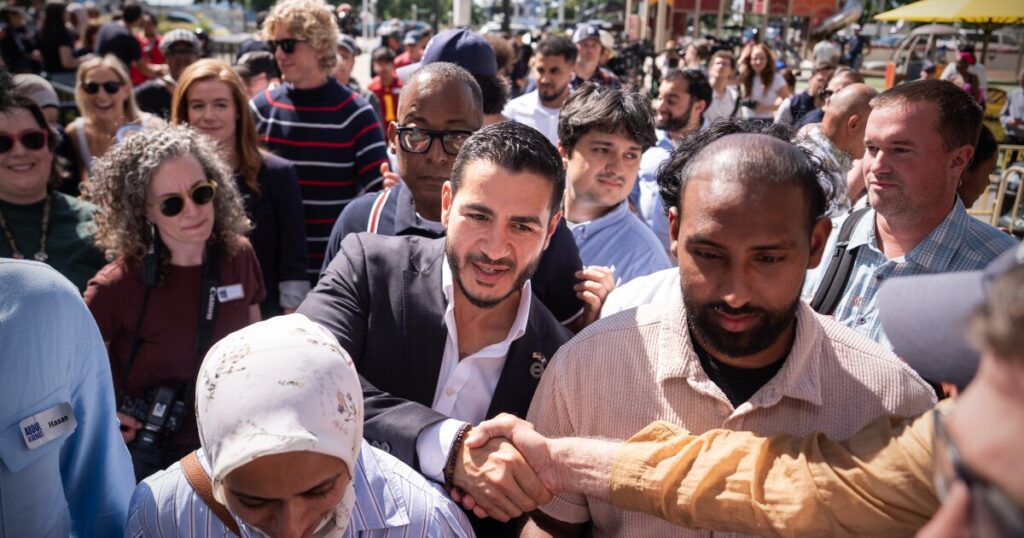
This month, Michigan witnessed a historic political milestone as Abdul El-Sayed became the first Muslim to receive a Democratic nomination for the U.S. Senate. However, this achievement is accompanied by a backdrop of growing anti-Muslim sentiment across the United States, highlighting the challenges faced by Muslim Americans.
Prominent Republicans, including former President Donald Trump, have responded to El-Sayed’s nomination by emphasizing his full name, Abdulrahman Mohamed El-Sayed, in an attempt to portray him as a threat to American society. U.S. Rep. Nancy Mace, R-S.C., took to X to claim, “Every single Muslim holding public office in America is a Trojan horse, and a threat to both national security and our republic.”
El-Sayed, addressing these criticisms, pointed out that such attacks reveal the frailty of those who make them. “We all pray for the same things. … We want what’s good for our kids and our families,” he shared with MS NOW after his primary victory. “They’re going to use Islamophobia, because their ideas are tired.”
Beyond the political sphere, anti-Muslim sentiments have intensified in various communities, particularly in response to proposals for new mosque constructions.
The Tensions in Texas
In McKinney, Texas, a suburb of Dallas-Fort Worth, the city council faced a heated debate on August 4 regarding the approval of the McKinney Islamic Association’s new mosque. Despite the fierce anti-Islam rhetoric, the council unanimously approved the proposal. Former Mayor George Fuller, advocating for fair treatment, was met with hostility and even physical aggression from some opponents. “I have never witnessed so much hate, anger and lack of humanity in our beautiful community gathered in one place as I did today at City Hall,” Fuller later commented on Facebook.
U.S. Rep. Keith Self, R-Texas, encouraged the council to deny the mosque proposal, warning of potential threats such as child marriage and honor killings.
North Carolina’s Controversy
In Mooresville, North Carolina, similar tensions arose during a public comment session about a mosque project that had already received approval. Residents expressed fears linking Islam to extremist violence abroad and depicted it as a political regime. Following the meeting, the town commissioners released a summary of the mosque project, emphasizing that it adhered to zoning laws applicable to all religious assemblies.
Legal Battles in Oklahoma
In Broken Arrow, Oklahoma, the rejection of a rezoning proposal for a new mosque resulted in a lawsuit against the city council, accusing it of succumbing to bigoted opposition. Meghan Murphy from CAIR’s Legal Defense Fund stated, “They did not want a mosque in their city. They did not want Muslims here,” highlighting the council’s alleged discriminatory actions.
Persistent Challenges and Political Rhetoric
The opposition to mosque constructions is not isolated, with similar campaigns occurring across the nation. In Murfreesboro, Tennessee, a prolonged legal battle over a mosque ended with its construction, despite facing significant hostility and threats.
Amidst these challenges, some Republican officials have introduced bills targeting sharia law and expressed concerns about Muslim communities in major cities, which CAIR and other groups argue are unfounded fears used for political gain. Republican governors in Texas and Florida have attempted to shut down CAIR, alleging terrorism ties, claims CAIR has strongly denied through legal action.
Edward Ahmed Mitchell, from CAIR, observes a rise in anti-Muslim rhetoric, especially during election years. “Every election year, we expect a rise in anti-Muslim hate,” Mitchell noted. “It’s been worse this year than it has been in years.”
—
Read More Michigan News