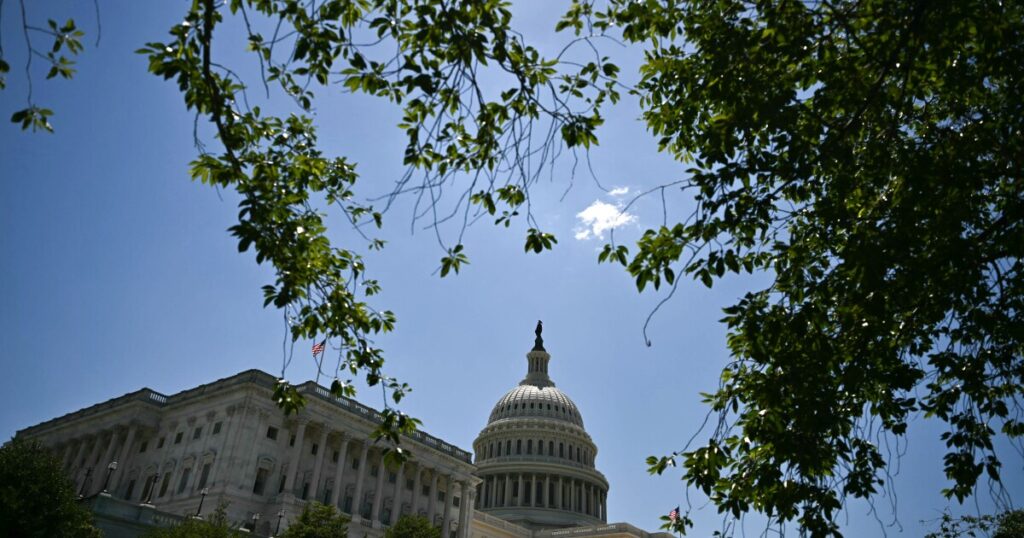
Senate Republicans Push $70 Billion Immigration Funding Package Amidst Internal Divisions
In a significant legislative move, Senate Republicans have approved approximately $70 billion for immigration enforcement agencies following an extensive 18-hour voting session. This funding, which was initially excluded from a prior agreement to reopen the Department of Homeland Security, is set to last throughout the remainder of President Trump’s presidency.
Notably, Senator Lisa Murkowski of Alaska stood alone among Republicans by opposing the measure. The funding proposal is now poised for a House of Representatives vote, potentially as soon as next week.
While the Senate’s approval marks a strategic triumph for Republicans who have been advocating for enhanced immigration enforcement, the prolonged voting process highlighted existing tensions within the party. Central to the debate is the Trump administration’s controversial $1.8 billion proposal intended to compensate individuals claiming political targeting by the government, including potential payouts to January 6 insurrectionists.
This contentious fund emerged from an out-of-court settlement linked to a $10 billion lawsuit filed by President Trump against his administration over a 2019 tax record leak. The initiative has faced widespread criticism from lawmakers across the political spectrum, including Republicans who were present during the Capitol insurrection in 2021.
“We have a lot of members who are concerned, obviously,” Senate Majority Leader John Thune, R-S.D., remarked last month regarding the fund.
Senator Bill Cassidy, R-La., expressed skepticism about the fund’s priorities, stating on X, “People are concerned about paying their mortgage or rent, affording groceries and paying for gas, not about putting together a $1.8 billion fund for the President and his allies to pay whomever they wish with no legal precedent or accountability.” Cassidy recently lost his reelection race to a Trump-endorsed challenger.
During a House testimony on Tuesday, acting Attorney General Todd Blanche attempted to address these concerns by announcing the administration’s decision to abandon the fund. However, uncertainty persists as President Trump expressed indecision on Wednesday, stating, “I’d have to ask the lawyers. I don’t know.”
Senate Minority Leader Chuck Schumer initiated efforts Thursday night to return the bill to the Senate Judiciary Committee to eliminate the fund, securing support from three Republicans facing re-election this November: Susan Collins of Maine, Dan Sullivan of Alaska, and Jon Husted of Ohio.
Republican senators proposed several amendments to limit or redirect the fund, including an initiative by Sen. Thom Tillis, R-N.C., to allocate funds toward fraud enforcement. Additionally, eight GOP senators backed an amendment to prevent disbursements to January 6 insurrectionists.
Repeated Legislative Delays
The debate over the fund is the latest hurdle in advancing the immigration enforcement package, which President Trump initially requested Congress to pass by June 1. Republicans resorted to a special procedure known as reconciliation to bypass the Senate’s usual 60-vote requirement for most legislation, enabling funding for Immigration and Customs Enforcement and Border Patrol without Democratic support.
Democrats have aimed to leverage their position to negotiate reforms to immigration enforcement, including face-covering restrictions and mandatory body cameras, following the fatal shooting of two American citizens in Minnesota by federal agents earlier this year. The resulting impasse led to a record-breaking 76-day shutdown of the Department of Homeland Security.
—
Read More Michigan News






![Jody White’s Unconventional Michigan Supreme Court Candidacy Explored[embed]https://www.youtube.com/watch?v=8NfxFIPE4ac[/embed]](https://www.kitchentablenews.org/wp-content/uploads/2026/10/Jody-Whites-Unconventional-Michigan-Supreme-Court-Candidacy-Exploredembedhttpswwwyoutubecomwatchv8NfxFIPE4acembed.com2F842F0e2Fc7223daa43c9876b36a4e00773a42Fme-supc.png "Jody White’s Unconventional Michigan Supreme Court Candidacy Explored[embed]https://www.youtube.com/watch?v=8NfxFIPE4ac[/embed]")