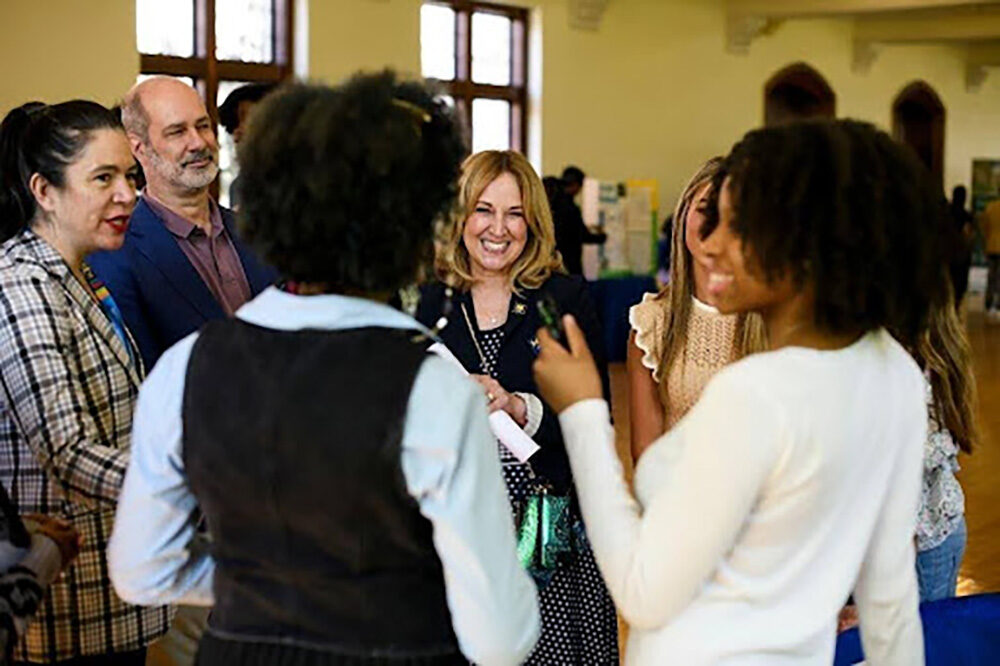
Education serves as the cornerstone for human advancement, pivotal to societal health and functionality. Innovations from AI development to effective communication all trace back to education. At the University of Michigan’s Marsal Family School of Education, groundbreaking research shapes the future of learning. Marsal’s mission is to enhance understanding of education, ensuring it remains empowering and meaningful for everyone.

Explore Marsal’s leadership in education research that enriches lives, communities, and society.
Look to the Marygrove Learning Community: Modeling what education can be
The Marygrove Learning Community exemplifies education as a catalyst for neighborhood revitalization. In 2018, a collaboration named the Detroit P-20 Partnership began, involving Marsal School, Detroit Public Schools, Starfish Family Services, Marygrove Conservancy, and The Kresge Foundation. This initiative aims to create a comprehensive prenatal-to-college education that prioritizes children, families, and educators.
On this innovative campus, Marsal Education co-designs project- and place-based learning opportunities to enhance student engagement and education justice. The nation’s first Teaching School offers a transformative three-year residency for early-career teachers, integrating Marsal faculty support and veteran mentorship.
Students and families benefit from integrated services addressing basic needs, promoting health, and supporting overall well-being. Marsal Education continuously studies campus efforts to develop a scalable model of collaborative, project- and place-based public education.

Look to Educators: Preparing teachers who transform
High-quality instruction is the most influential factor in student learning. Marsal is dedicated to producing the most informed, intentional educators, leading global efforts in educator preparation. This fall, Marsal will welcome first-year students into its educator programs, enhancing teacher training by five years through an innovative model.
Despite its world-class status, Marsal prioritizes affordability and accessibility, with many students achieving a “debt-free teaching degree” through scholarships and the Go Blue Guarantee.
Look to LEAPS: U-M undergraduates changing the world through education
LEAPS, or Learning, Equity, and Problem Solving for the Public Good, is a pioneering undergraduate program where students become “learning leaders.” They develop skills in collaboration, communication, and leadership, partnering with peers, communities, and organizations.
Through coursework and experiential learning, LEAPS students gain an understanding of social structures and policies, fostering strong problem-solving abilities. The program combines research university capabilities with community learning in Detroit, supporting students in their future careers.

Look to the Learning Sciences: Advancing capacity for human learning
The Eileen Lappin Weiser Center for the Learning Sciences propels human learning capabilities, fostering relationships that encourage understanding and thriving. Current projects include leveraging AI to enhance learning and exploring environmental justice through place-based and community-engaged research.
The center incubates innovative ideas, supporting community engagement and co-design of educational tools and practices.
Look to the Study of Higher Education: Scholarship that improves postsecondary opportunity
Marsal’s Center for the Study of Higher and Postsecondary Education leads in global educational improvement, focusing on access, equity, and policy. Dr. Jeremy Wright-Kim’s research on community colleges and Dr. Walter Ecton’s work on Career and Technical Education exemplify Marsal’s commitment to impactful, evidence-based research.
Look to Marsal: U-M’s education experts
Marsal’s initiatives, characterized by evidence-based research, community engagement, and educator empowerment, model transformative education. This approach enriches lives and enhances society, inviting collaboration from the university community.
—
Read More Michigan News