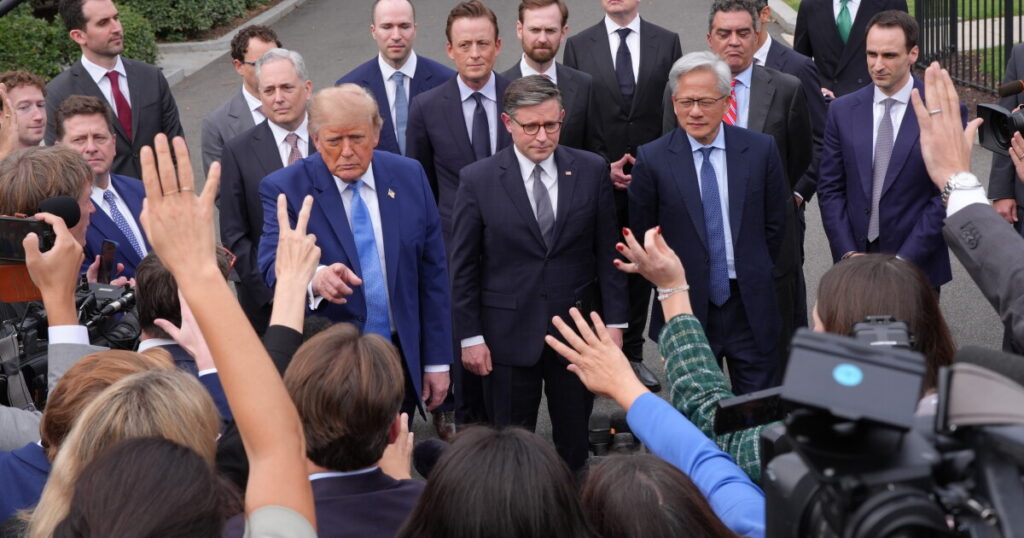
The White House became the epicenter of an AI dialogue as President Donald Trump, alongside key tech leaders, announced a voluntary agreement aimed at addressing public concerns over artificial intelligence. This move seeks to balance innovation with accountability through internal and external reviews.
During an unscheduled press briefing, Trump expressed confidence in the industry’s ability to regulate itself, stating, “I think I’m seeing tremendous self-policing. And they understand that they have to self-police.”
In collaboration with House Speaker Mike Johnson, Trump met with top executives from AI giants investing heavily in infrastructure across the nation, facing some bipartisan pushback. Signatories of the accord include Anthropic CEO Dario Amodei, Google CEO Sundar Pichai, Meta CEO Mark Zuckerberg, OpenAI President Greg Brockman, Nvidia CEO Jensen Huang, and Elon Musk, founder of xAI.
Posted on Trump’s Truth Social, the accord outlines four voluntary measures for AI companies, proposing the establishment of “robust internal controls” and an alignment with an “independent external auditor” to ensure these controls are effective. Additionally, each company’s board will form a committee to review audit reports. The accord suggests these steps might eventually become legislative measures.
AI Growth and Concerns
President Trump lauded the potential economic benefits of AI, mentioning the significant growth in investments and stock market gains. However, Dario Amodei highlighted the inherent risks of AI, emphasizing, “The technology has very real risks.”
The accord also proposes a committee of around ten members to oversee AI initiatives, with Trump expected to appoint a leader after industry consultations. While some measures are already in practice, experts like Shri Narayanan from the University of Southern California stress the importance of innovation in both AI capabilities and safety. Conversely, Robin Jia, also from USC, warned against excessive reliance on self-regulation, citing potential misalignments with public interest and increased risks as models improve.
AI’s Role in Government Services
Trump introduced an AI chatbot, America.gov, designed to assist the public with government services, during a daylong event celebrating AI’s transformative impact. Trump asserted the U.S. would not hinder AI’s development, stating, “I will never stifle the growth of a technology that will be bigger than the industrial revolution.”
The event included discussions on the chatbot’s future capabilities, such as enabling online passport applications, as highlighted by Secretary of State Marco Rubio.
Addressing Community Concerns on Data Centers
In response to local opposition to emerging data centers, Trump announced commitments from tech leaders to support local schools and reduce energy costs. He remarked, “You’re going to see, data centers are going to be very popular,” and suggested that unresolved opposition might drive these centers overseas.
Amidst these discussions, OpenAI’s Sam Altman emphasized the company’s focus on safety, noting a recent decision to delay a new model’s rollout due to safety concerns. Trump, framing the AI race as a contest with China, declared, “I didn’t want to do anything, because we’re leading. Why would I want to do anything?” This comment followed an agreement with China to establish a channel for AI-related communications.
—
Read More Michigan News