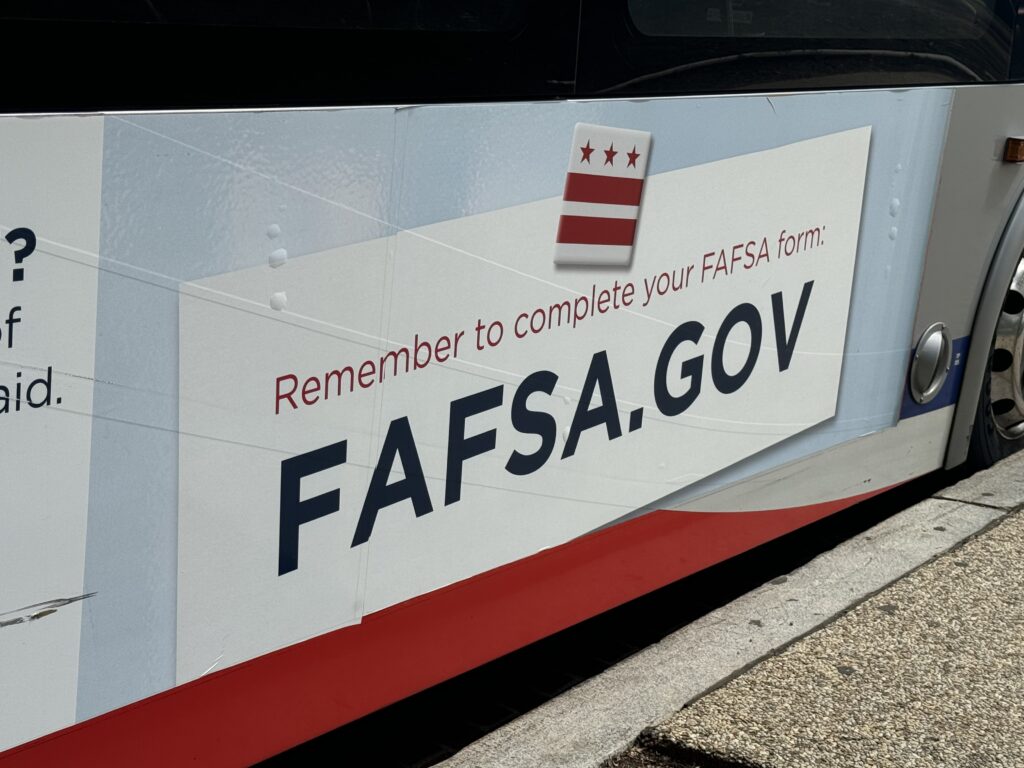

A sign reminding people to complete the Free Application for Federal Student Aid — better known as FAFSA — appears on a bus near Union Station in Washington, D.C. (Shauneen Miranda/States Newsroom)
WASHINGTON — The U.S. House passed a bill aimed at combating financial aid fraud on Wednesday. The legislation, which saw a 249-172 vote, mandates the Department of Education implement an identity fraud detection system for the Free Application for Federal Student Aid (FAFSA). Supported by nearly 40 Democrats, the bill targets fraudulent “ghost students” who misuse stolen identities for federal student aid, costing taxpayers millions.
This measure solidifies a fraud detection tool already in progress, aligning with a broader anti-fraud initiative across the federal government under President Donald Trump’s administration. Utah Republican Rep. Burgess Owens, the bill’s sponsor, emphasized its role in protecting taxpayer dollars and ensuring federal aid benefits actual students.
Education Secretary Linda McMahon praised the House’s decision, highlighting the step as crucial in eliminating fraud and abuse by enforcing screening for suspicious applications. She stated, “Since Day One, the Trump Administration has been committed to restoring existing fraud detection capabilities while building the most comprehensive fraud-detection system in the Department’s history.” A similar bipartisan initiative has been proposed in the Senate.
Fraud detection system
The bill requires the Education Secretary to evaluate each FAFSA submitted on or after Oct. 1 using the identity fraud detection system. If there’s suspicion of fraud, applicants and designated schools must undergo additional verification before receiving federal aid. The legislation mandates an annual audit of the system and a report to Congress on its efficacy. It also incorporates provisions from another bill by Pennsylvania GOP Rep. Glenn “GT” Thompson targeting student aid fraud.
‘Vague enforcement standards’
Rep. Bobby Scott, a leading member of the House Committee on Education and Workforce, opposed the bill, warning it could complicate access to student aid. While he acknowledged the importance of preventing aid fraud, he criticized the bill’s “vague enforcement standards” and punitive mandates. Scott suggested Congress should allow the existing fraud detection tool to operate and evaluate its results before codifying a new system.
—
Read More Montana News
![Jody White’s Unconventional Michigan Supreme Court Candidacy Explored[embed]https://www.youtube.com/watch?v=8NfxFIPE4ac[/embed]](https://www.kitchentablenews.org/wp-content/uploads/2026/10/Jody-Whites-Unconventional-Michigan-Supreme-Court-Candidacy-Exploredembedhttpswwwyoutubecomwatchv8NfxFIPE4acembed.com2F842F0e2Fc7223daa43c9876b36a4e00773a42Fme-supc.png "Jody White’s Unconventional Michigan Supreme Court Candidacy Explored[embed]https://www.youtube.com/watch?v=8NfxFIPE4ac[/embed]")