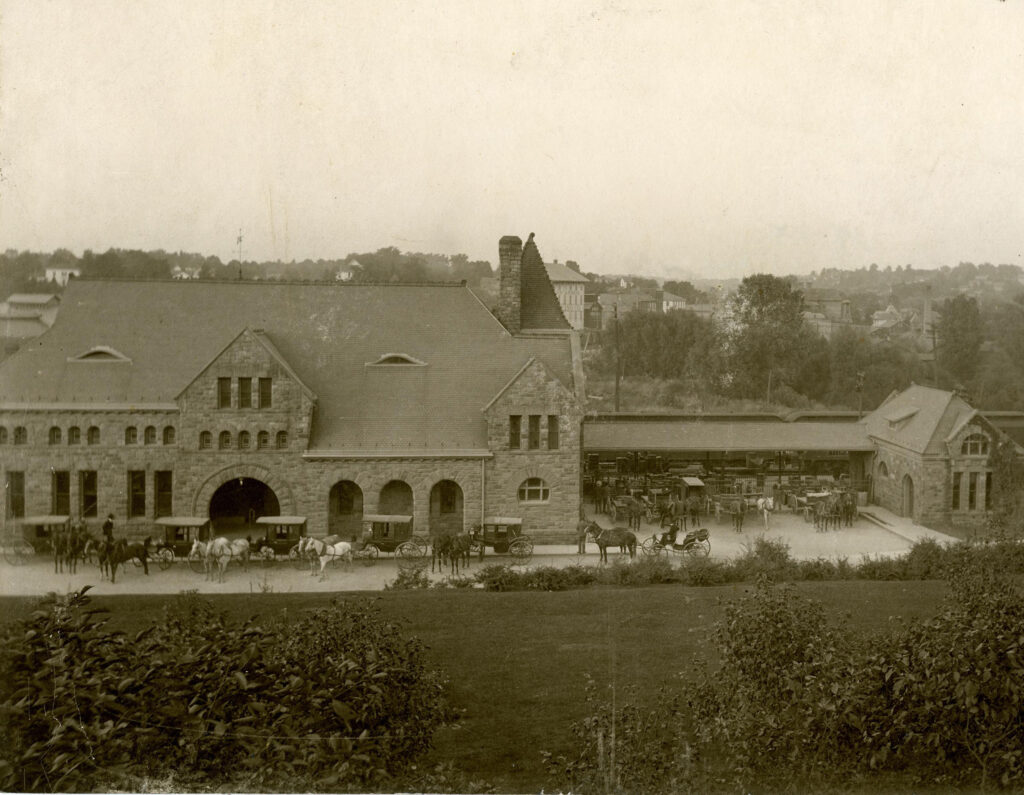
Long before it became the Gandy Dancer, a renowned restaurant in Ann Arbor, the structure at 401 Depot St. served as a vital gateway to both the city and the University of Michigan.
The Depot Street train station was constructed during a time when railways dominated transportation across the Midwest. The Ann Arbor rail line, dating back to 1839, eventually connected the city to Detroit and by 1852 extended to Chicago. By the late 19th century, a new depot was commissioned for Ann Arbor.

Constructed in 1886 as the Michigan Central Railroad Depot, the building featured Romanesque architecture by Frederick Spier from the Detroit firm Spier & Rohns. It utilized locally quarried stone from Four Mile Lake, between Chelsea and Dexter. The station included grand arches, stained-glass windows, and terra-cotta fireplaces, earning a reputation as one of the finest stops on the Michigan Central line between Buffalo and Chicago.
In the early 1900s, up to 13 daily runs from Detroit to Chicago passed through Ann Arbor, along with shorter local trips. U-M football teams frequently used the station, greeted by cheering fans, and students filled the station at semester’s end, heading home.

Prominent politicians like Theodore Roosevelt, Dwight D. Eisenhower, John F. Kennedy, and Richard Nixon made campaign stops at the Ann Arbor depot.
With the rise of the automobile, the depot’s original purpose diminished. By the 1960s, train service dwindled, and in 1969, the station was sold to restaurateur Chuck Muer, who transformed it into the Gandy Dancer restaurant. In 1975, the former train station site was listed on the National Register of Historic Places.

Amtrak’s current Ann Arbor station is located nearby on Depot Street, yet the older station remains a testament to the city’s history. Though its primary role has shifted, it continues to draw people to the tracks’ edge.
—
Read More Michigan News