The recent cyclosporiasis outbreak in Michigan has put the spotlight on food safety practices across the country. This gastrointestinal illness, caused by the parasite Cyclospora, saw Michigan registering the highest case numbers nationwide this summer. Experts suggest that the state’s advanced surveillance and testing systems might be a contributing factor to these high figures. Meanwhile, the outbreak underscores broader concerns about the vulnerabilities in our food systems.
Cyclospora poses a unique challenge as it withstands chlorinated water, a common method used to sanitize food in large-scale operations. This makes tracking parasite contamination difficult, especially in the context of a globalized food market and amid federal budget cuts in the U.S.
The origins of this outbreak remain partly a mystery, though investigations have narrowed down contaminated produce to imported lettuce from Taylor Farms, a major international supplier. A recent update from Michigan’s Department of Health and Human Services reassured that “the majority of the contaminated produce is likely no longer available for consumption.”
A Surge in Local Lettuce Demand
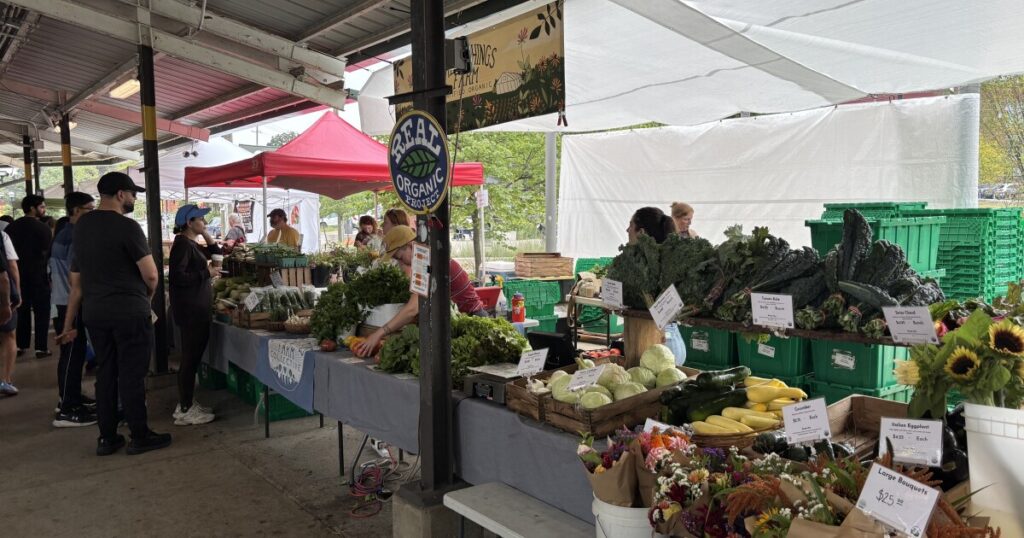
Local farms have experienced heightened demand for lettuce and greens amidst the outbreak. At the Ann Arbor Farmers Market, several vendors reported an uptick in sales.
Mohinder Singh, who runs Seva Farms in southeast Michigan, noted a dramatic shift in sales. “A week before this outbreak, I couldn’t sell all the lettuce I had. I had ended up calling Food Gatherers. They brought a semi truck out to the farm. We gave them 12 boxes of lettuce and even harvested some out in the field fresh for them because we just had too much. It was getting too big and it just wasn’t selling,” Singh commented. “And then all of a sudden, the opposite happened. And now I’m completely out. I’ve been selling it like crazy.”
Similarly, Violet Flores from Green Things Farm Collective recounted their surprise at the rapid change: “In the beginning, I don’t think we were really aware like how much this was going to change. So we were selling out [at] like 10am, of all our lettuce and then our greens after that, like bunched greens like kale.”
While local farms might not be immune to contamination risks, the shorter supply chains they often use can make it easier to trace sources of contamination. Emma Hardy, an expert with a PhD in the philosophy of food and food systems from the University of Michigan, explained, “There’s some sense going around of people being like, well, local’s somehow magically always going to be better. And you can get outbreaks of things on small farms and things like that, but it would be much more contained and much more traceable….So the shorter the distribution chain, just the shorter, fewer hands have touched it.”
Local farms also offer greater transparency, as Flores noted: “We’re harvesting the food as well. We’re working in the washing rooms where we wash and sanitize our vegetables. You can come ask us questions about what’s happening to the food you’re buying and you can do that to a lot of different people selling here, and at different markets as well.”
Sustainability and Future Challenges
Amanda Edmonds, who leads the University of Michigan’s Sustainable Food Systems Initiative, emphasized the potential resilience of local food systems in crises. “So as we’re thinking about resiliency, thinking about how do I get my stuff from closer to home as supply chains are more and more likely to be disrupted for all sorts of reasons,” she stated, suggesting that smaller systems can adapt more readily to disruptions.
As climate change continues to affect weather patterns, the frequency and duration of outbreaks like this could increase. The tropical and subtropical nature of Cyclospora means warmer climates could facilitate more frequent outbreaks in the U.S., affecting food security and farming predictability.
Edmonds concluded with a call to action for systemic change, “The big industrial food system has infrastructure, right? That takes investment. And so, great that in this time of crisis, we’re thinking about this. And how do we make sure that these systems, [this] infrastructure is viable in an ongoing way?” She asserted that the responsibility should not solely rest on consumers but on broader systemic changes.
—
Read More Michigan News