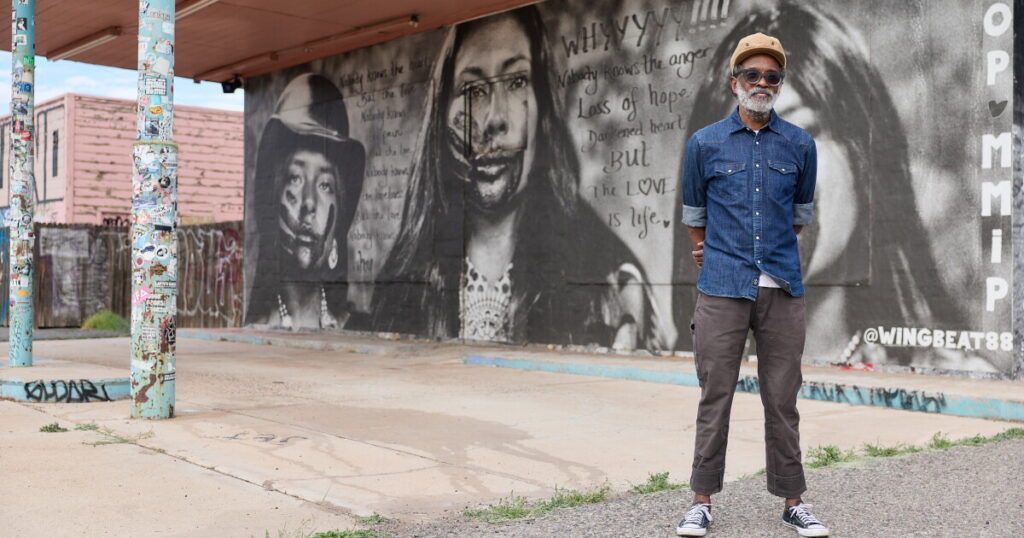
Street art often conjures images of vibrant urban landscapes, yet Chip Thomas has redefined this art form by bringing it to the vast, rural expanses of the Navajo Nation. Over the last 20 years, Thomas has been transforming the region’s abandoned structures into platforms for his socially impactful artwork, recently earning him a “genius” award from the MacArthur Foundation.
Thomas’s work primarily consists of large black and white portraits that capture the essence of daily life within the reservation. His art materials are straightforward: paper, black and white ink, and adhesive, yet his canvas is unconventional, ranging from deserted gas stations to old trailers and water tanks, all visible from the highway.
“Structures that are close enough to the road, that are big enough, where I can put an interesting, hopefully engaging piece,” Thomas said, “that will draw some attention, but not too much, because I don’t want to cause any accidents.”
Ephemeral Artwork For Navajo People
During a trip northward from Flagstaff, Thomas showed some of his work integrated into the desolate desert landscape. Amidst the sagebrush and yellow grasses, derelict buildings adorned with artwork emerged, each telling stories of the people and their struggles. One such piece, fading but still powerful, highlighted the health effects of uranium mining on Navajo workers.

“My image is of Kee John,” Thomas explained, “Who died at a young age from cancer related to his work in a uranium mine.” The installation, although deteriorating, still speaks volumes about the history and the harsh environment where it resides.

Along a highway, Thomas’s work caught the eye of Torrey Charley, a Navajo vendor, who appreciated the community connection his art fosters. “I was like, ‘oh wow, you know, there’s somebody that’s interested in the community,'” she said.
From Outlaw Artist To Community Engagement
Originally from North Carolina, Thomas arrived in the Navajo Nation in 1987 as a family physician. His plan for a short stay turned into a lifelong commitment, deepened by his engagement with the community’s daily life and culture.
Thomas’s transformation into an artist began in 2009 after discovering the works of French street artist JR, sparking a passion for creating large-scale public art. Initially working under the pseudonym Jetsonorama, Thomas embraced the thrill of street art’s anonymity.

His transition from an outlaw artist to a community-engaged one was marked by a pivotal moment when local recognition turned his anonymous art installation into a community project. The realization that dialogue with the community could amplify his work’s meaning shifted his approach.
A Landscape of Disorienting Scale
Thomas’s art weaves through the Navajo Nation’s expansive landscapes, a territory stretching across Arizona, New Mexico, and Utah. His installations emphasize the overlooked community life that thrives in these vast spaces, often unnoticed by passing tourists.
“People tend to look at a landscape like that as just kind of bleak and empty and worthless,” said art historian Keven Moore, who curated a retrospective of Thomas’ work at FotoFocus in Cincinnati.

“To drive across the desert and see a photograph, black and white photograph, pasted to a building of a smiling girl or an old couple. It’s striking, it’s surreal, it’s actually haunting,” Moore said, emphasizing the non-commercial nature of Thomas’s work.
Thomas’s art continues to be a reflection of the resilience and beauty of the Navajo people. He’s expanded his work beyond the reservation with projects in Cincinnati, North Carolina, Oakland, and Philadelphia. Yet, his primary audience remains the Navajo community, whose stories he passionately narrates through his ephemeral installations.
—
Read More Arizona News