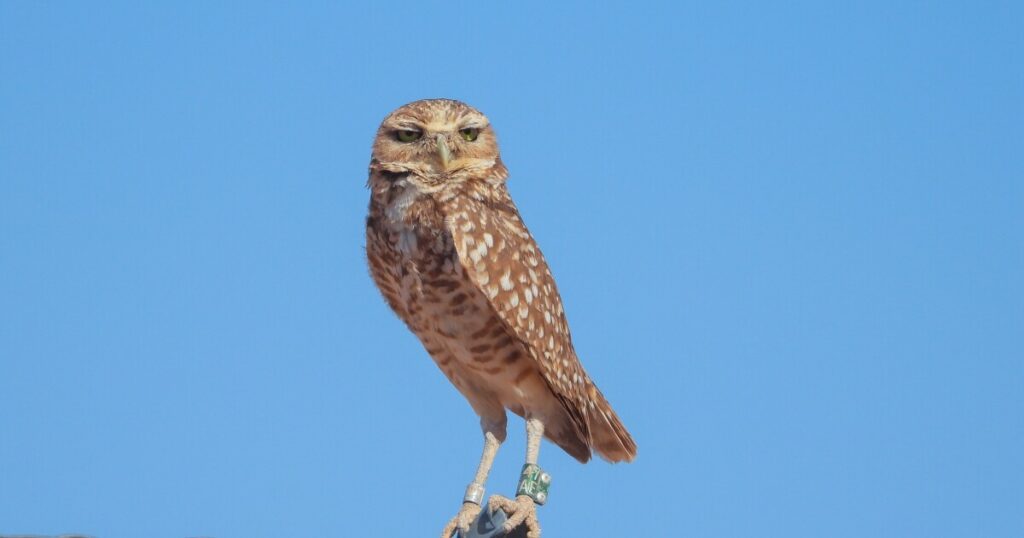
In the heart of the Arizona desert, a unique symbiosis is unfolding between renewable energy and wildlife. A burrowing owl perches atop a weather sensor, surveying the solar farm that sprawls across the horizon, its burrow hidden just beneath the sandy surface. This scene is part of a larger effort to integrate nature with technology at the Sun Streams solar farm, located west of Buckeye.
The solar farm is primarily designed to convert Arizona’s abundant sunlight into electricity. However, it has also become a sanctuary for the burrowing owl, a species emblematic of the region. Longroad Energy has collaborated with the nonprofit Wild at Heart to create this habitat for owls that have been displaced by urban development.
Samad Khan
/
Cronkite News
“We’re still figuring it out,” remarked Deron Lawrence, vice president of environment at Longroad. “Part of the research we’re undertaking is figuring out what that effect is and how the owls are affected.”
In March 2025, Wild at Heart moved nine pairs of owls and a single male from a construction site 50 miles away to the solar farm. The owls now reside in 30 artificial burrow sites, monitored continuously by motion-activated cameras, while biologists assess the nesting success and survival of these birds.
Greg Clark, habitat coordinator for Wild at Heart, has been involved in burrowing owl conservation for nearly three decades. “When we started investigating burrowing owls in 1999 and 2000, it was clear they were in trouble,” Clark explained. “We decided in 2000 that we were going to do something about it.”

Samad Khan
/
Cronkite News
Clark observes that the solar farm’s open environment could benefit the owls, allowing them to detect predators from a greater distance. “Solar panels don’t block the owl’s visibility,” Clark said. “The panels may even attract insects the owls can feed on. Though we’re still learning.”
The owls’ behaviors, reminiscent of human actions, continue to fascinate Clark. “They chase each other around. They’ll stand up to dogs and coyotes,” he noted. “The juveniles pick fights with each other. The males interact with female owls. The owls almost act like tiny little people.”

Samad Khan
/
Cronkite News
Not far from the solar farm, Clark manages the Mesquite Wildlife Oasis, where irrigation sustains native grasses and flowering plants to attract the insects that are vital to the owls’ diet. This oasis also serves as an educational platform for horticulture students learning about ecosystem restoration.
Clark regularly inspects the irrigation system and artificial burrows, ensuring that the habitat supports the 40 burrowing owls now residing at the solar facility. He stresses that while habitat restoration is a slow process, with seeds taking time to grow and environments to mature, the effort is essential.

Samad Khan
/
Cronkite News
“Development and wildlife conservation can coexist,” Clark said. “If you build conservation into a project from the beginning, you can create places where wildlife still has a chance.”
A burrowing owl stands directly in front of a monitoring camera near an artificial burrow in Tonopah on Sunday, July 5, 2026. (Video by Greg Clark/Wild at Heart)
This article first appeared on Cronkite News and is republished here under a Creative Commons Attribution-NoDerivatives 4.0 International License.
—
Read More Arizona News