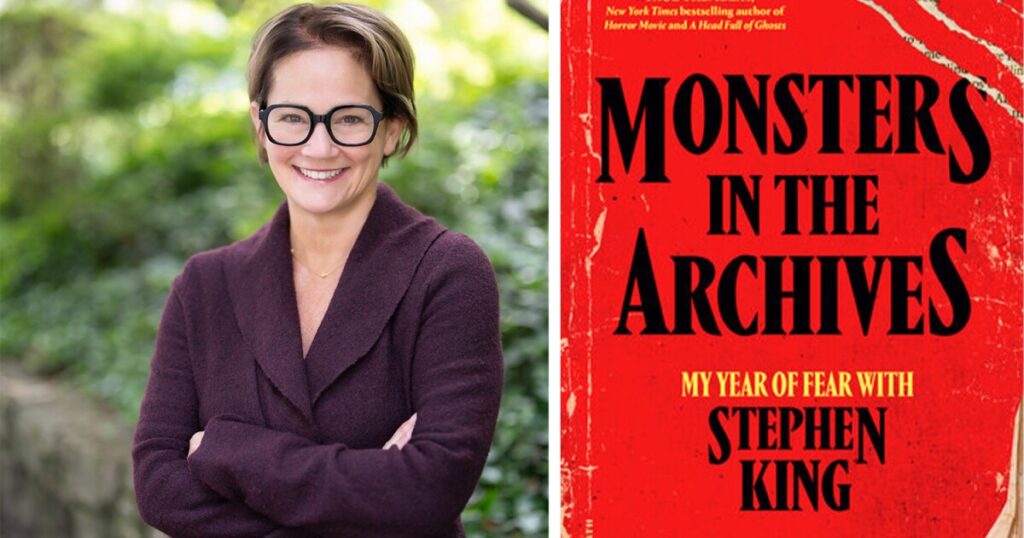
Caroline Bicks, a scholar with a background in Shakespearean studies from Harvard, has taken a deep dive into the world of another literary giant, Stephen King. Her latest work, “Monsters in the Archive: My Year of Fear with Stephen King,” explores the intricate elements of King’s storytelling through the lens of what she terms “bibliomagic.”
In a recent discussion, Bicks shared her insights after gaining exclusive access to King’s extensive archive. Her exploration focused on understanding how King crafts his stories, with a particular interest in his famous works from the 1970s.
Insights from the King Archive
During her conversation with Sam Dingman, Bicks explained the concept of bibliomagic, drawing inspiration from King’s own description of books as a kind of portable magic. “It’s where reader and writer meet in an imaginative space,” Bicks noted, referencing King’s book “On Writing: A Memoir of the Craft.”
Gaining access to the archive was a unique opportunity for Bicks, stemming from her role as the Stephen E. King Chair in Literature at the University of Maine. This position allowed her to connect with King directly, leading to a productive collaboration that included reviewing King’s manuscripts housed in a specially constructed climate-controlled space at his Bangor, Maine residence.
Bicks focused her research on five of King’s iconic novels: “The Shining,” “Carrie,” “Salem’s Lot,” “Night Shift,” and “Pet Sematary.” She examined how these stories, which left a lasting impression on her as a teenager, were crafted to evoke fear and fascination.
Exploring the Craft
The archive provided Bicks with a glimpse into King’s meticulous writing process. She discovered typewritten drafts annotated with King’s handwritten comments, showcasing his careful consideration of word choice and narrative structure. This tangible evidence of King’s exchanges with editors is a rarity in the digital age.
One notable discovery involved the use of the word “clitter” in a draft of “Pet Sematary.” Bicks recounted how a copy editor questioned this choice, only for King to affirm its correctness, describing “clitter” as a “very ghostly, soft clatter.”
This experience emphasized King’s attention to the auditory impact of his words, an aspect Bicks found crucial to understanding his storytelling technique.
A Writer’s Journey
Bicks also touched on King’s early career struggles, painting a picture of a time when King and his family faced financial hardships. Despite these challenges, King remained committed to his passion for writing, a dedication that ultimately paid off with the success of “Carrie.”
Reflecting on her time immersed in King’s works, Bicks concluded that the enduring appeal of his stories lies not just in their horror elements but in their exploration of deep human emotions like grief and loss.
This profound connection, she believes, is what ensures King’s place in the literary canon.
KJZZ’s The Show transcripts are created on deadline. This text is edited for length and clarity, and may not be in its final form. The authoritative record of KJZZ’s programming is the audio record.
—
Read More Arizona News