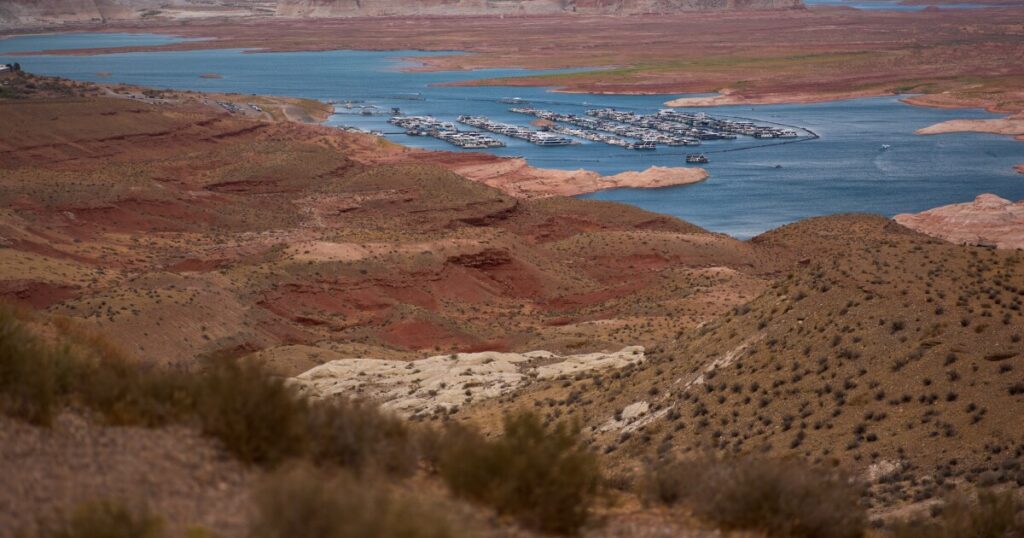
As the sun sets over the Utah-Arizona border, Lake Powell stands as a stark emblem of the ongoing water crisis in the western United States. Once a thriving reservoir, this body of water now struggles under the weight of drought, climate change, and overuse, leaving both recreational enthusiasts and local economies in a precarious position.
Impact of Shrinking Lake Levels
Matt Barrett, a frequent visitor to Lake Powell since 2013, has watched the reservoir’s levels dwindle year after year. “We need another one of those fast,” Barrett remarked, referencing the few snowy winters that temporarily boosted the lake’s levels. This decline has made accessing the lake a challenge, with dried-up boat ramps complicating activities like boating and camping.
Lake Powell, the second largest reservoir in the United States, currently stands at about 23% capacity. It’s perilously close to levels where hydropower generation would be impossible, potentially breaking historical lows observed in past decades. “The Colorado River is in full-blown crisis mode,” stated John Berggren, a regional policy manager with Western Resource Advocates.
Adapting to New Challenges
Despite the challenges, marina managers insist that recreational activities can still continue on the lake. However, the logistics have grown more complicated as boat ramps close or are relocated to deeper parts of the lake. Marinas like Antelope Point have been temporarily moved, and new ramps are under construction to maintain access despite the low water levels.
Efforts to manage the crisis include the federal government considering short-term plans for states sharing the river’s resources. Meanwhile, up to 1 million acre-feet of water from the Flaming Gorge Reservoir is being directed to Lake Powell to maintain critical elevations.
Broader Implications for the West
Lake Powell is not alone in this struggle; it is one of eight western reservoirs identified by the Bureau of Reclamation as being at or near record lows. New Mexico’s Elephant Butte Reservoir, part of the Rio Grande system, is down to about 2% capacity, leading to economic repercussions for local communities reliant on tourism.
Richard Holcomb, mayor of Elephant Butte, observed a downturn in visitors and weekend homeowners, affecting local revenue streams. “Many of our weekend homeowners have decided to look elsewhere for water opportunities,” he noted.
Infrastructure and Future Plans
With water levels at Lake Powell dropping, infrastructure improvements are underway. Antelope Point Marina plans to invest approximately $81 million to extend a ramp, enabling access even at lower water levels. Other marinas are also adapting, with new ramps and relocated sites ensuring continued access.
While recreational activities are still possible, the real challenge lies in accessibility. Kenneth Runnels, chief administrator with Antelope Point Holdings, emphasized, “The problem isn’t the recreation. The problem is the access, which is going to get fixed by the improvements in the ramp.”
For images and more details, visit the original AP News article.
—
Read More Arizona News