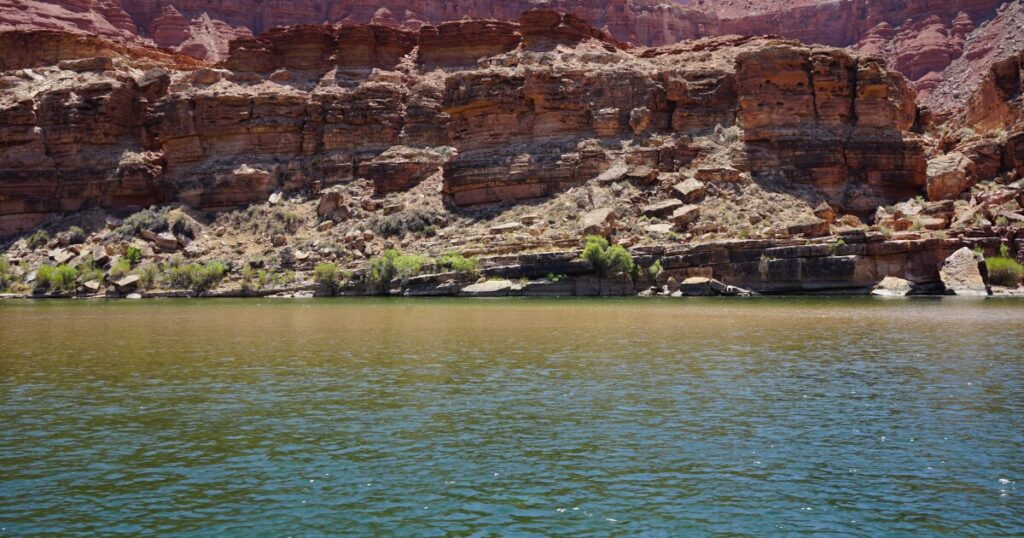
Amidst ongoing climate change challenges, a new federal directive offers a fresh approach to managing the Colorado River, a crucial water source shared by multiple states. While this framework establishes guidelines for states like Arizona, California, and Nevada, the implications for tribal nations with longstanding water rights remain ambiguous.
Following unsuccessful negotiations between Upper and Lower Basin states, the U.S. Bureau of Reclamation unveiled its Final Environmental Impact Statement, which outlines potential water allocation reductions of up to 40% for the states relying on the Colorado River. A detailed plan, specifically addressing Arizona’s water cuts for 2027 and 2028, is anticipated soon.
However, the situation for tribal nations is complex. Many tribes, despite holding senior water rights, do not have the necessary infrastructure to access their rightful shares. This includes the Navajo Nation, whose water rights remain unresolved. Brenda Jesus, a Navajo Nation Council delegate, expressed disappointment, stating, “These post-2026 guidelines regarding the next 10 years of water … in a sense, it does disappoint me as one delegate of the Navajo Nation Council.”
The 1922 Colorado River Compact, which historically governs river management, only briefly mentions tribes in Article VII, acknowledging the United States’ obligations to Indian tribes without detailing specific allocations. This lack of clarity continues to affect tribes like the Navajo, whose water rights are still not formalized.
A proposed federal settlement to secure water for the Navajo, Hopi, and San Juan Southern Paiute tribes is currently stalled in Congress due to opposition from Colorado, Utah, Wyoming, and New Mexico. Jesus criticized the disparity, noting the states have a framework while her tribe’s rights remain unsettled.
Similarly, the White Mountain Apache Tribe faces challenges in accessing its water from the Central Arizona Project (CAP), despite having quantified rights. A pending settlement grants it 52,000 acre-feet annually, with 25,000 acre-feet sourced from CAP. Tribe chairman Orlando Carroll highlighted concerns over potential water cuts, saying, “We would like more information on this.”
The bureau’s environmental impact statement lists the White Mountain Apache among tribes with CAP water rights but does not specify potential reductions. Heather Tanana, a University of Denver law professor and Navajo Nation citizen, explained that when tribes utilize their water rights, it affects the state’s overall water allocation. This dynamic could result in some Arizona tribes experiencing reductions due to Lower Basin cuts.
Tanana emphasized, “The federal government still has their treaty and trust responsibilities to tribes,” suggesting the possibility of legal challenges to ensure tribal rights are protected amidst broader cuts. Additionally, concerns extend beyond Arizona, with tribes like the Ute Mountain Ute in Colorado worried about securing domestic water supplies if reductions occur.
The disparity in the new federal framework’s treatment of states and the unresolved tribal settlements is evident. As Tanana points out, “We have to look at the reality today. These states have all benefited from these tribes not utilizing their water, it’s not equitable to keep them in these conditions.”
—
Read More Arizona News