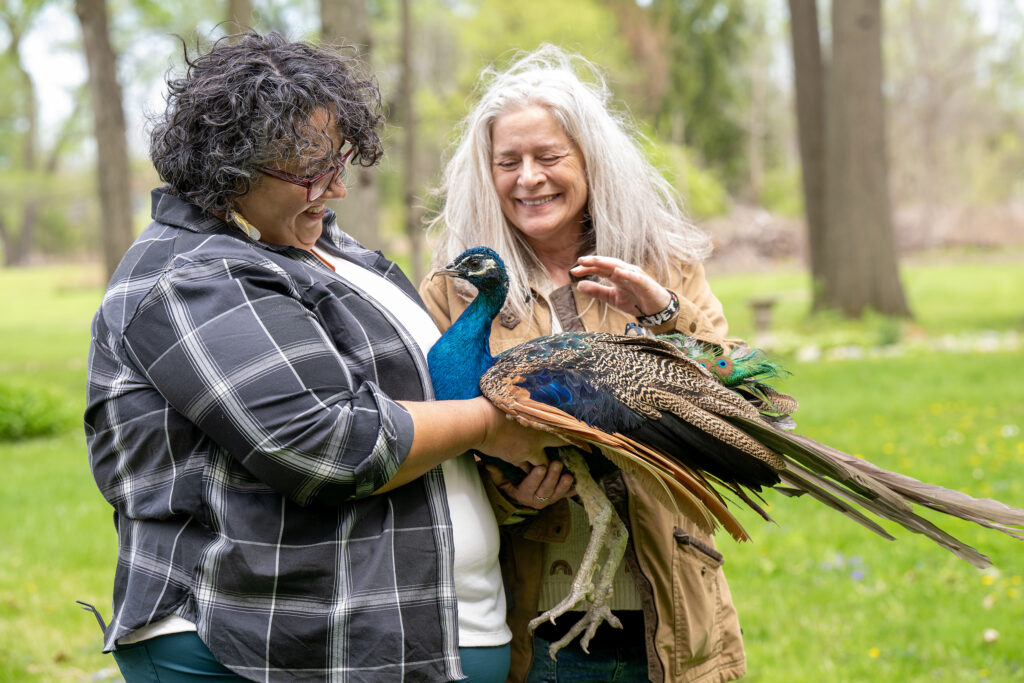
Geila Rajaee, a lecturer in Health Management and Policy at the School of Public Health, is known for her love of birds. Growing up in Canton with a flock of peacocks, this tradition is deeply tied to her Iranian heritage and her father’s passion for birds. Now living in her parents’ home, Rajaee continues to nurture an ever-growing flock. Her fondness for birds is shared by K Rivet Amico, a professor of health behavior, sparking a friendship between them.
Amico noticed Rajaee’s interest when she saw a mobile of guinea hens in her office. Their shared love for birds often intertwined with academic discussions, strengthening their bond. Birds became a recurring topic in their conversations, which evolved into a lasting friendship.

Peacocks, Pigeons, and Parrots
Hero, an 18-year-old peacock, enjoys his own space away from the full flock due to bullying. Rajaee cares for him, providing mealworms daily. During the pandemic, she began incubating peacock eggs, resulting in several new birds. Her current flock includes 11 chickens, 8 pigeons, and numerous peacocks, along with two parrots, Meiko and Taco.
Taco, a citron-crested cockatoo, is particularly clever, having learned to open bird cage doors. Rajaee’s fascination with birds extends to her teaching methods, incorporating bird-themed passwords in her online quizzes.

An Accidental Avian Expansion
In Brighton, Amico manages her own flock on a 25-acre farm. While the chickens were planned, the ducks were a surprise addition. A neighbor offered a Pekin drake, leading to the adoption of two Pekins, a Khaki Campbell, and two Muscovy hens.
Amico notes that having land often results in others offering animals to care for, expanding her flock unexpectedly.
The Benefits of Caring for Birds
For both women, tending to birds offers a grounding experience. Amico finds satisfaction in the immediate results of farm chores, contrasting with the often slow pace of academia. Rajaee appreciates the break from the seriousness of the classroom, finding joy and humor in observing her birds’ quirky behaviors.

Learning to respond compassionately to animals without verbal communication is a valuable skill. Rajaee uses creative methods, like a cat carrier with mealworms, to move her baby peacocks. Amico applies this empathy in both her bird care and her research on HIV prevention and treatment, focusing on marginalized communities.

What You Can Learn from a Duck
Rajaee’s journey into public health began after a decade as a healthcare chaplain. Her research explores the connection between spiritual distress and chronic disease risk. A memorable moment watching a duck at Princeton Theological Seminary sparked a lasting appreciation for nature’s beauty.
She describes these experiences as an “inoculation against spiritual distress,” emphasizing the importance of slowing down to enjoy simple pleasures like watching ducks or peacocks.
—
Read More Michigan News