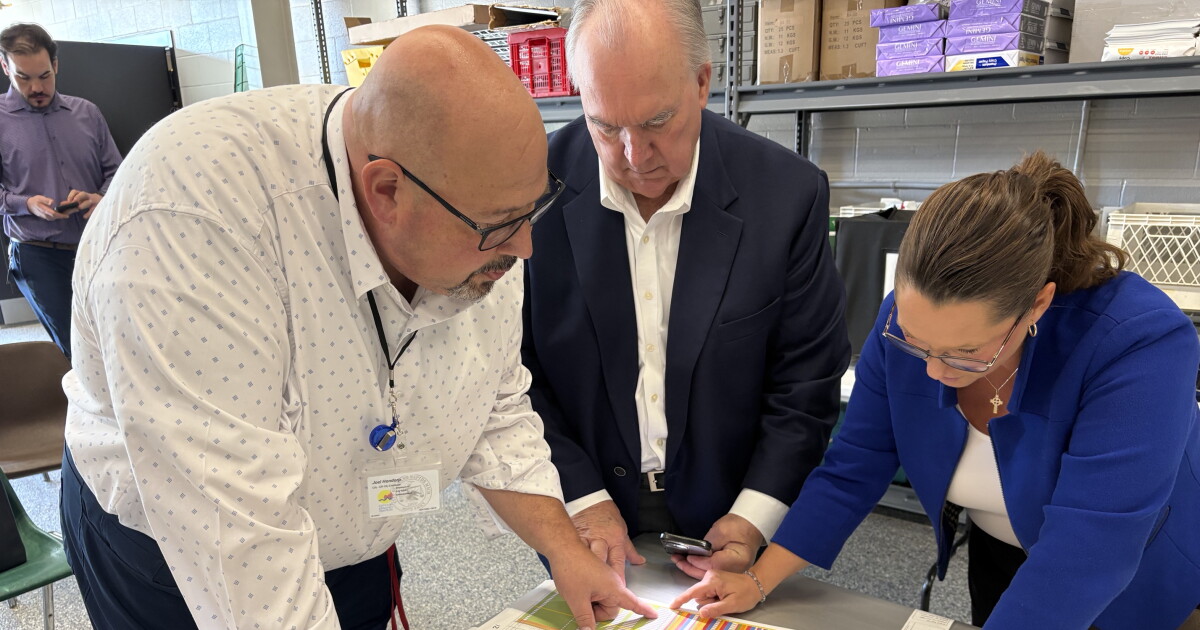
In James Bell’s math class at Chapman High School, sophomores are determining the intersection of two lines.
The students have previously identified this point using graphs but are now learning to use a matrix—a grid of rows and columns representing a system of equations. Matrices are crucial in fields like engineering and video game design for calculating moving objects’ positions.
Traditionally, such linear algebra concepts are introduced in the third year of high school math, often during Algebra II. However, a decade ago, the Chapman Unified School District in Kansas opted for “integrated math” over the traditional sequence of Algebra I, geometry, and Algebra II.
Integrated math blends algebra, geometry, and some trigonometry across multiple years, allowing students to switch between subjects within the same year. James Bell, who co-wrote the curriculum, believes this continuous exposure to algebra and geometry helps retain the concepts.
“You’re going to have the opportunity to change course and change direction and see different things,” Bell said. “Students even do a little trig—which is a scary word for kids, but when it’s integrated into every year of math, it doesn’t sound as scary. It doesn’t make it as overwhelming.” He added: “This is better for students. This is the best of both worlds.”
Chapman is among a growing number of districts embracing integrated math as part of a movement to rethink secondary math education, offering more course choices beyond calculus, such as data science and statistics.
Proponents argue that combining algebra and geometry can enhance students’ chances of excelling in advanced math, citing successful models in Europe and Asia. However, some educators prefer focusing on a single subject at a time, and concerns arise that integrated courses might omit essential topics needed for college calculus.
In Chapman, integrated math improved state test scores from 11% proficient to 67% over ten years. Principal Kate Thornton noted that the shift was influenced by the Kansas high school math test, which included concepts from both Algebra I and II.
Despite its benefits, integrated math remains a minority choice, with only 16% of districts offering it in some form. The West, particularly California, showed the most growth in adopting this model, according to a 2023 report by the Center for Education Market Dynamics.
A push for math education reform, driven by initiatives like the Launch Years Initiative, aims to align high school math with postsecondary education and workforce demands. Integrating algebra and geometry allows students to explore courses like data science and statistics in later years.
Maryland is set to mandate a two-year integrated algebra and geometry course statewide by 2027, aiming to improve proficiency—currently at 30%—in state exams. The state plans to offer diverse math pathways in 11th grade, aligning with the Blueprint for Maryland’s Future law.
However, the shift to integrated math lacks extensive research, and some educators worry it might not prepare students adequately for STEM fields. Critiques remain, with concerns about missing foundational knowledge in subjects like trigonometry.
Research by Elizabeth Huffaker from the University of Florida indicates a “small and positive” effect on test scores from integrated math, although results should be interpreted cautiously due to concurrent Common Core implementation.
Some states, like Utah, consider revisiting their integrated math approach, acknowledging teacher feedback that favors the traditional sequence. North Carolina is also exploring a two-year integrated math option to allow for statistics and data science courses.
This story about integrated math was produced by The Hechinger Report, a nonprofit, independent news organization focused on inequality and innovation in education. Sign up for the Hechinger newsletter.
—
Read More Kitchen Table News