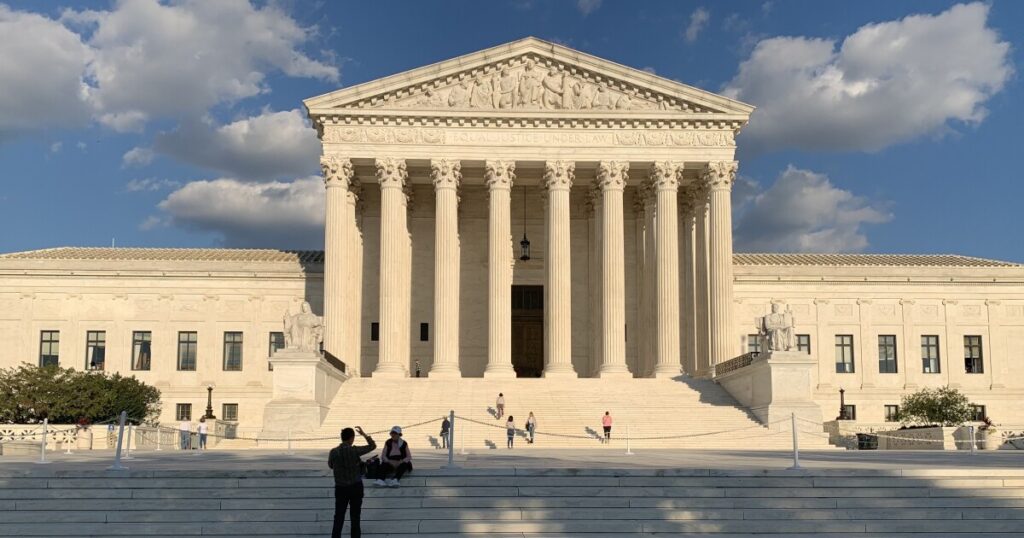
The U.S. Supreme Court’s recent session turned the spotlight on a pivotal case that questions the implications of birthright citizenship, a principle enshrined in the 14th Amendment. The Trump administration invoked a 19th-century ruling to defend an executive order signed at the onset of President Donald Trump’s second term.
In a historic move, President Trump attended the court proceedings, marking the first time a sitting president has observed oral arguments in the nation’s highest court’s chambers.
During the hearing, a brief but significant exchange occurred between Supreme Court Justice Neil Gorsuch and Solicitor General John Sauer. Justice Gorsuch inquired about the status of Native Americans as birthright citizens. After a moment of contemplation, Sauer responded, “I think so, on our test. Yes, if they’re lawfully domiciled here. I have to think that through, but that’s my reaction.” Gorsuch promptly replied, “I’ll take the yes, that’s alright.”
Gorsuch and Sauer going back-and-forth
U.S. Supreme Court Justice Neil Gorsuch asks Solicitor General John Sauer whether Native Americans are birthright citizens during Trump v. Barbara on April 1, 2026.
The case revisits an 1884 Supreme Court decision where John Elk, born into the Winnebago tribe, was denied U.S. citizenship despite the 14th Amendment. The court’s reasoning was based on tribes being considered distinct political entities. In contrast, the Indian Citizenship Act of 1924 later granted citizenship to Native Americans.
Bob Miller, an Eastern Shawnee professor at Arizona State University’s Indian Legal Clinic, remarked on the historical complexities, “My mother was probably not a United States citizen when she was born in 1923 in Oklahoma,” highlighting the unique legal status of tribes. He emphasized, “Our founding fathers knew from the beginning that tribes were, yes, outside the U.S. legal system and governance.”
Miller, who has extensively studied the Elk v. Wilkins precedent, stated, “We remain governments today, and so yes, it’s no surprise that Indian citizenship was treated differently. I disagree completely with the argument that that’s analogous to undocumented immigrants and them having children here.”
The Supreme Court’s decision on this matter is anticipated by summer.
—
Read More Arizona News