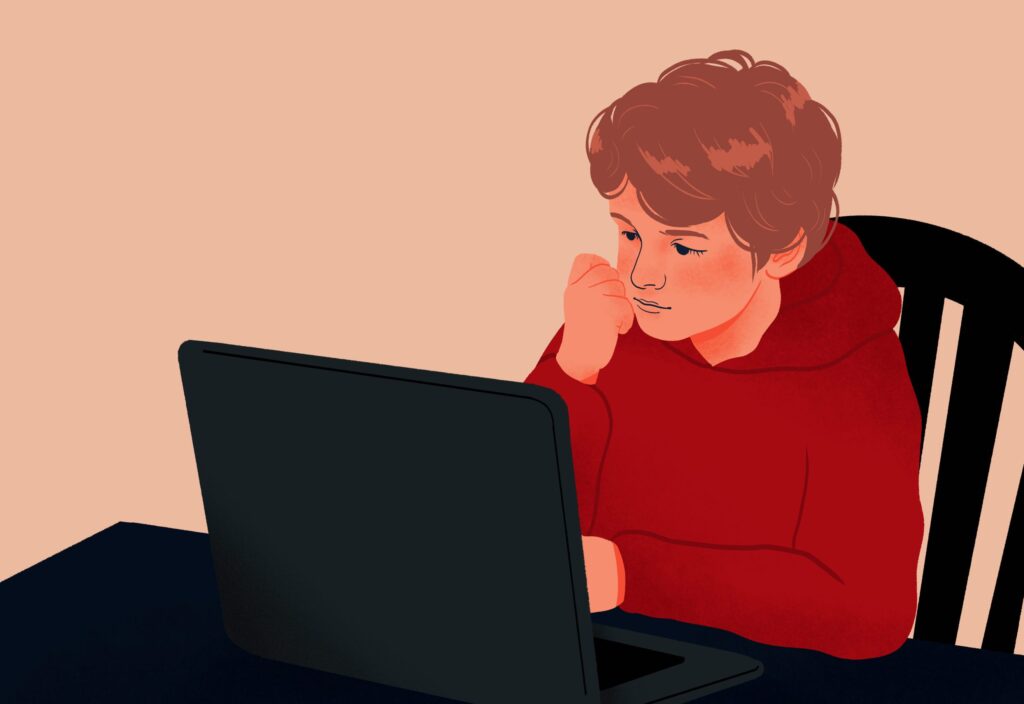
Jodi Carreon anticipated a reduction in laptop use at her son’s school post-pandemic. However, during his second-grade year, she discovered he was still using a Chromebook extensively.
A teacher’s note revealed her son was distracted by Minecraft and YouTube in class. Carreon, surprised by this behavior, founded the advocacy group San Marcos Unified School District Parents for Intentional Tech.
“Adults struggle with device focus. Expecting children to do so is unrealistic,” Carreon said.
While many school districts introduced one-to-one devices to enhance learning, parents and teachers report that students bypass restrictions to access games and videos on school-issued devices.
Interviews and surveys with over 45 parents, educators, and experts nationwide reveal elementary students using devices for non-academic activities like watching YouTube or playing games featuring inappropriate content.
Despite filters and safeguards, students still find ways to bypass restrictions. In Pennsylvania, second grader Bryn Prusky noted how easily friends get distracted by games pre-installed on their computers.
Teachers and parents question if classroom tech’s benefits outweigh the distractions. Neuroscientist Jared Cooney Horvath argues that educational technology detracts from actual learning.
In Brooklyn, teacher Martina Meijer notices students quickly diverting to video sites despite limited Chromebook use. Monitoring their activities becomes challenging, especially when students use headphones.
Devices intensify distractions, especially for young children whose ability to self-regulate is still developing. John Bellis, a parent, shared how his son altered a classmate’s online profile, showcasing the ease with which children can misuse technology.
Surveys indicate that 56% of teachers see off-task behavior on computers as a major distraction. A North Carolina audit revealed 31 instructional days lost annually to screen distractions.
Monitoring devices is often teachers’ responsibility. Molly Esquivel, a sixth-grade teacher, expressed frustration over the added burden.
Districts differ in their tech restrictions, with some blocking sites like YouTube while others allow them. Parents and teachers note that even when monitoring tools exist, they aren’t always utilized.
Some school districts have started reducing device use, especially in early grades. Los Angeles Unified, along with districts in Michigan and Oklahoma, have moved to cut back on technology in classrooms.
Sixteen states, including Alabama and Missouri, are evaluating educational technology and setting screen time limits. Recently, the U.S. surgeon general warned about excessive screen time, urging schools to limit it.
Despite efforts, not all districts embrace these changes. Lower Merion Township, for instance, rescinded a policy allowing parents to opt out of the one-to-one device program, citing curriculum requirements.
Some teachers find benefits in devices, such as keeping students engaged and simplifying assessments. However, experts like Tracy Weeks suggest a balanced approach to tech use in education, emphasizing the importance of safe and supportive learning environments.
Parents like Amy Swers are increasingly concerned about their children’s screen time in school, seeking more control and awareness over tech use in classrooms.
—
Read More Kitchen Table News